
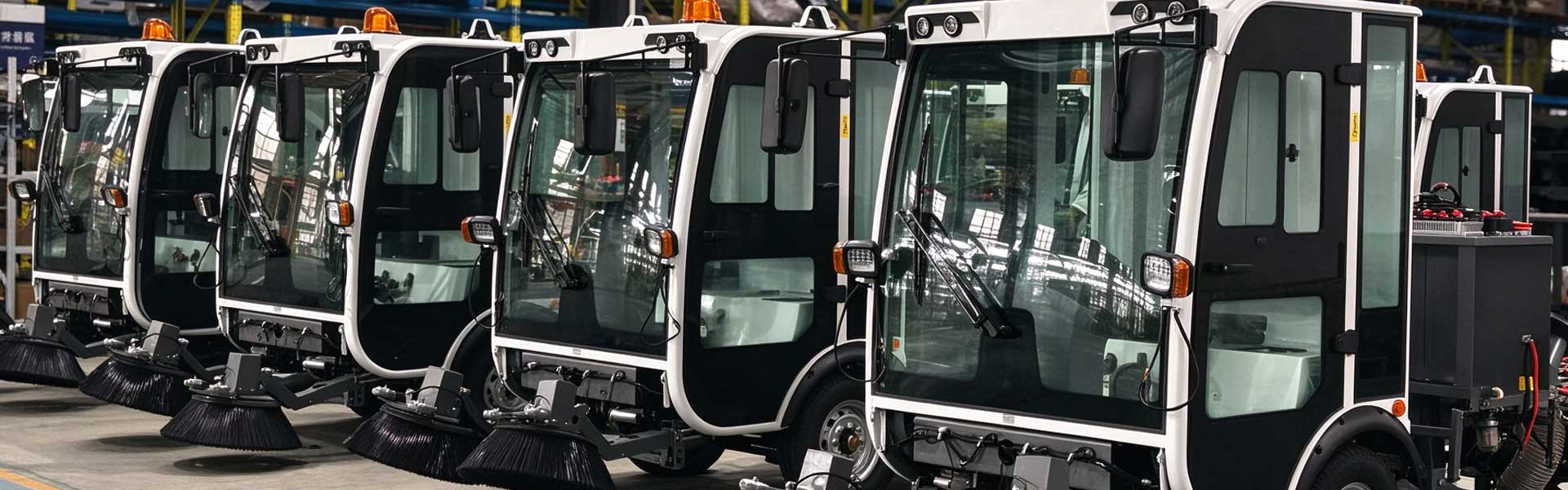
Logistics facilities operate under demanding schedules. Distribution centers, fulfillment warehouses, freight terminals, and storage facilities need clean floors without unnecessarily interrupting receiving, picking, packing, and dispatch operations.
Choosing the right floor scrubber helps facility managers organize routine cleaning around operating shifts and maintain suitable floor conditions for daily activities.
For logistics companies, warehouse equipment dealers, and industrial cleaning distributors, purchasing decisions should consider floor area, traffic patterns, cleaning frequency, and the time available for each cleaning session.
Why Logistics Facilities Need the Right Floor Scrubber
Large warehouses often have extensive concrete floors, forklift travel routes, loading areas, and pedestrian walkways. Dust, tire marks, packaging debris, and other contaminants can accumulate as daily operations continue.
Manual cleaning may be sufficient for small areas, but larger facilities often benefit from mechanized floor cleaning equipment.
A suitable floor scrubber for logistics facilities can combine floor brushing, cleaning solution application, and water recovery in one operation. This helps businesses manage routine maintenance across larger areas than may be practical with manual methods.
However, the right machine depends on the actual environment. Narrow aisles, congested picking areas, and busy loading zones may require a different configuration from large, open warehouse floors.
Match Cleaning Equipment to Shift Schedules
Cleaning time is one of the most important factors when selecting a machine for a logistics operation.
A warehouse operating one shift may have a longer cleaning window than a distribution center running several shifts each day. Facilities with continuous dispatch activity may need to clean selected areas during planned breaks or quieter periods.
When choosing equipment, consider the following:
Cleaning window: Estimate how much time is available before the next shift or operational period begins.
Daily floor area: Calculate the approximate area that must be cleaned during each session, including the frequency of repeat cleaning.
Operating interruptions: Account for aisle congestion, loading activity, and the need to move around pallets or parked equipment.
Battery runtime: Check whether the machine's expected operating time can cover the planned cleaning session. Charging time and battery arrangements may also affect scheduling.
Tank capacity: Suitable solution and recovery tank sizes can reduce the need for frequent refilling and emptying during larger cleaning jobs.
These factors help determine whether a walk-behind or ride-on machine is a better fit.
Walk-Behind or Ride-On Floor Scrubber?
A walk-behind machine may suit smaller warehouses, narrow aisles, and areas where operators need greater maneuverability. It can also be practical for facilities that clean selected zones rather than the entire building in one session.
A ride-on floor scrubber may be more suitable for larger distribution centers and open warehouse areas where operators need to cover substantial floor space efficiently.
For example, a 500 mm working-width scrubber may suit certain medium-sized cleaning tasks, while 700 mm or wider models can be considered for larger open areas. The appropriate selection depends on aisle width, machine dimensions, cleaning performance, and the available operating time.
A professional industrial floor scrubber supplier can help compare suitable models based on the facility's layout and schedule.
Select Equipment for Different Warehouse Areas
Not every part of a logistics facility has the same cleaning requirements.
-
Storage aisles: Prioritize maneuverability and compatibility with aisle dimensions.
-
Loading and unloading zones: Consider traffic levels, floor contamination, and the available cleaning window.
-
Packing areas: Look for equipment suited to the floor surface and the need to maintain clean working conditions.
-
Large open floors: Evaluate wider cleaning paths and appropriate tank capacity.
-
High-traffic walkways: Consider how frequently the area needs cleaning and how the machine can operate around pedestrians.
For mixed-use facilities, it may be worthwhile to combine different cleaning methods or machine sizes instead of expecting one machine to handle every area equally well.
Buying Floor Scrubbers for Multiple Warehouses
Logistics companies operating several facilities may benefit from standardizing selected equipment models. Common models can simplify operator training, spare parts purchasing, maintenance planning, and future procurement.
For businesses purchasing a commercial floor scrubber for warehouses, prepare a list of site requirements before requesting a quotation. Include the floor area, cleaning frequency, shift pattern, aisle dimensions, power or charging arrangements, and delivery location.
If you are a distributor supplying logistics customers, ask about available models, wholesale quantities, spare parts, warranty arrangements, and export documentation.
Compare the total purchasing value rather than focusing only on the initial machine price.
Request a Floor Scrubber Quotation
A suitable floor scrubber should match your facility's cleaning requirements without disrupting essential logistics activities.
Share your approximate floor area, daily cleaning schedule, floor conditions, preferred machine type, and destination country. This information helps identify appropriate models and provides a better starting point for price comparison.
Contact VORIL to discuss walk-behind and ride-on floor scrubbers for warehouses, distribution centers, and logistics facilities.