
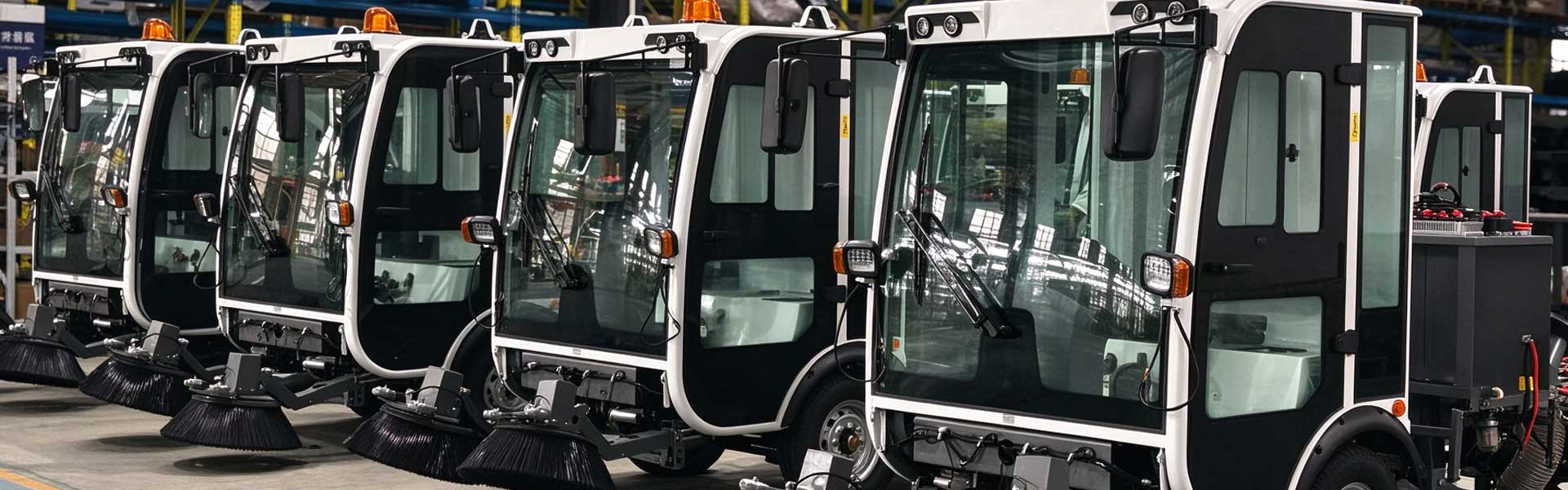
Cleaning a large commercial floor with traditional mops and manual equipment can consume a surprising amount of labor.
For a warehouse, shopping mall, distribution center or manufacturing facility covering thousands of square meters, the real question is not simply whether the floor can be cleaned.
The question is:
How quickly can your team clean the entire facility while maintaining consistent results?
This is where a commercial floor scrubber can make a significant difference.
Modern commercial scrubbers are designed for large-area floor cleaning, with ride-on models available for demanding environments. For example, current commercial equipment on the market can provide theoretical cleaning capacities ranging from several thousand to more than 5,000 m² per hour depending on machine configuration.
Large Floors Need More Than Manual Cleaning
Imagine a distribution warehouse with a floor area of 8,000 m².
If employees rely mainly on manual cleaning equipment, cleaning the entire facility can require multiple workers and several hours.
A commercial floor scrubber changes the workflow.
Instead of:
Worker → Mop → Bucket → Refill → Return → Repeat
the process becomes:
Machine → Scrub → Recover Dirty Water → Continue
The operator can cover a much larger area during the same working period.
For large facilities, this difference can directly affect labor costs.
Calculate the Cleaning Time Before You Buy
One of the easiest ways to compare machines is to calculate theoretical cleaning time.
For example, suppose a machine has a practical cleaning productivity of approximately 4,000 m²/hour.
For an 8,000 m² warehouse:
8,000 ÷ 4,000 = 2 hours
This does not mean the entire warehouse will always be completed in exactly two hours. Obstacles, turns, loading areas, equipment, operator breaks and tank refilling can reduce actual productivity.
But the calculation gives the purchasing team a useful starting point.
Instead of asking:
“Which scrubber is cheaper?”
ask:
“How many square meters can this machine realistically clean during our available cleaning window?”
That is a much better purchasing question.
Ride-On Floor Scrubbers Can Increase Large-Area Productivity
For large facilities, ride-on machines can be particularly attractive because the operator does not have to push the equipment throughout the entire cleaning shift.
For example, one current commercial ride-on scrubber lists a cleaning path of 750–900 mm, solution tank capacity of 125 L, and estimated productivity of up to approximately 4,300–5,300 m²/hour, depending on configuration.
Other industrial ride-on models offer considerably larger cleaning widths and higher theoretical coverage.
This means buyers can select different machine sizes according to facility area and daily workload.
Example: Cleaning a 12,000 m² Warehouse
Consider a warehouse with:
- Floor area: 12,000 m²
- Cleaning frequency: 1 time/day
- Available cleaning window: 4 hours
- Main floor: concrete
- Dirt level: medium
- Cleaning requirement: scrub + vacuum recovery
The minimum average productivity required is:
12,000 ÷ 4 = 3,000 m²/hour
A machine with a practical productivity comfortably above this level could provide enough capacity to complete the daily cleaning schedule while allowing time for obstacles and operating interruptions.
This is why the correct machine should be selected according to the floor area + available cleaning time + dirt level, rather than floor area alone.
Reduce Labor Hours With One Machine
Labor is often one of the biggest costs associated with commercial floor maintenance.
A commercial floor scrubber can allow one operator to handle work that previously required multiple workers using manual methods.
For example:
Suppose three workers each spend 3 hours cleaning an 8,000 m² facility.
That represents:
3 × 3 = 9 labor-hours
If a suitable machine allows one operator to complete the same routine in approximately 3 hours:
1 × 3 = 3 labor-hours
Potential difference:
9 − 3 = 6 labor-hours per cleaning cycle
At 250 working days per year, that could represent:
6 × 250 = 1,500 labor-hours
The actual result depends on the facility, floor condition, cleaning method and machine productivity, but this calculation shows why buyers should consider total operating cost rather than machine price alone.
Large Tanks Mean Fewer Interruptions
Machine productivity is not only about brush width.
Tank capacity also matters.
Imagine a machine that needs frequent water refilling.
Even if its theoretical cleaning speed is high, repeated stops can reduce practical productivity.
For large facilities, buyers should therefore compare:
- Cleaning width
- Clean-water tank
- Recovery tank
- Battery runtime
- Working speed
- Brush pressure
- Turning radius
- Squeegee width
- Charging time
A current commercial ride-on example offers 125 L solution capacity and 135 L recovery capacity, illustrating how larger tanks can support longer cleaning cycles.
Choose the Right Scrubber for Your Floor
Different facilities have different cleaning requirements.
Warehouses
Usually require:
- Large cleaning width
- Long operating time
- Strong dirt removal
- Good maneuverability around racks
Shopping Malls
Usually require:
- Quiet operation
- Consistent floor appearance
- Compact turning capability
- Flexible cleaning schedules
Manufacturing Facilities
Usually require:
- Heavy-duty construction
- Strong cleaning performance
- Resistance to industrial dirt
- Easy maintenance
Distribution Centers
Usually require:
- High productivity
- Large tanks
- Long battery runtime
- Ability to work around pallets and equipment
Professional floor scrubber manufacturers similarly position ride-on and industrial machines for warehouses, distribution centers, production areas and other large facilities.
Don't Buy Based Only on Theoretical Capacity
This is an important point when comparing a commercial floor scrubber for sale.
A supplier may quote:
5,000 m²/hour
But actual daily output can be lower because of:
- Obstacles
- Turns
- Cleaning corners
- Water refilling
- Dirty-water drainage
- Battery charging
- Operator breaks
- Floor conditions
Therefore, ask the supplier for both:
Theoretical productivity
and
Recommended practical application area
This gives you a more realistic basis for purchasing.
Example: Choosing Between Two Machines
Suppose your facility is 10,000 m².
Machine A:
- Theoretical productivity: 3,500 m²/h
- Cleaning width: 700 mm
- Smaller tanks
Machine B:
- Theoretical productivity: 5,000 m²/h
- Cleaning width: 900 mm
- Larger tanks
- Longer operating time
If the facility needs to be cleaned every day within a short time window, Machine B may provide better value even if its purchase price is higher.
The correct comparison is not:
Machine A = cheaper
It is:
Cost per cleaning cycle + labor + water + detergent + downtime + expected service life
What Should You Tell a Floor Scrubber Supplier?
When contacting a commercial floor scrubber supplier, provide:
- Total floor area
- Floor material
- Dirt type
- Cleaning frequency
- Required cleaning time
- Available aisle width
- Indoor or outdoor use
- Working hours per day
- Preferred walk-behind or ride-on design
- Required production quantity
For example:
Floor area: 10,000 m²
Floor: Concrete
Cleaning frequency: Daily
Available time: 3–4 hours
Dirt: Dust + oil residue
Environment: Warehouse
Quantity: 2 units
This allows the supplier to recommend a machine based on the actual application.
Invest in Cleaning Productivity, Not Just a Machine
For a large warehouse or commercial facility, floor cleaning is a recurring operating cost.
If the facility needs cleaning 250 days per year, even a small reduction in cleaning time can accumulate into hundreds or thousands of labor hours.
That is why choosing the right large floor scrubber machine can be an operational investment rather than simply a cleaning equipment purchase.
The best machine is the one that can:
Cover your floor area → Fit your cleaning schedule → Reduce labor → Maintain consistent results → Keep operating costs under control.
If your facility has more than 5,000, 10,000 or 20,000 m² of floor space, calculate your required cleaning productivity before requesting quotations.
The right commercial floor scrubber can turn a long manual cleaning job into a much more predictable daily operation.