
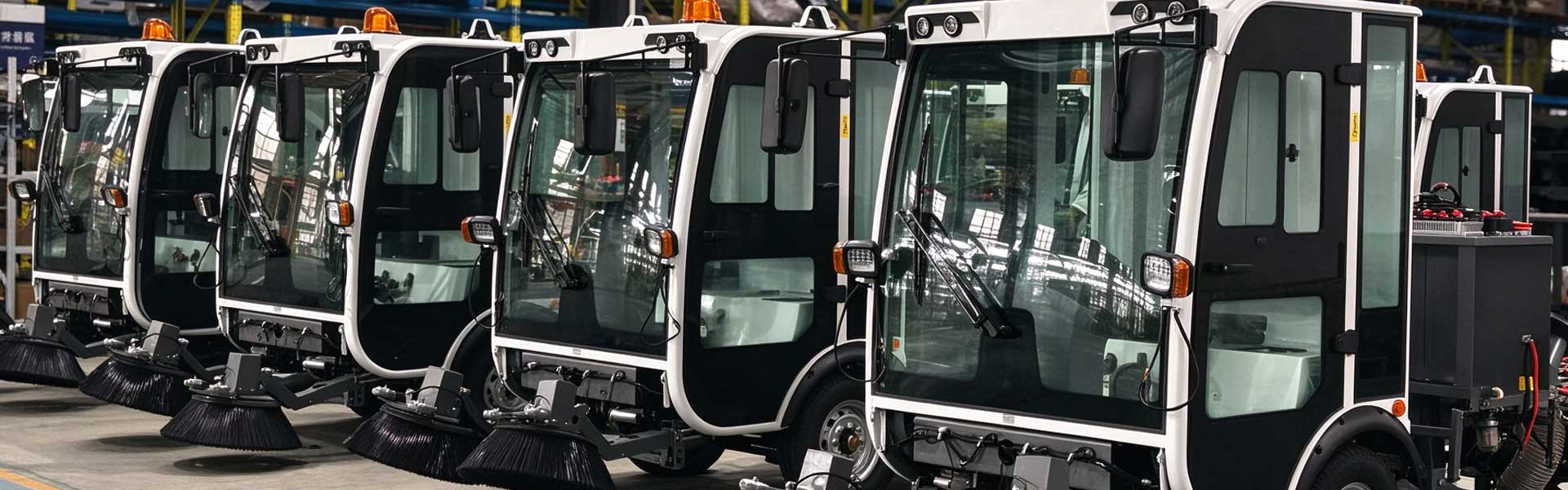
Food processing facilities have a very different cleaning requirement from ordinary warehouses.
A production floor may accumulate:
- Flour
- Grain particles
- Sugar
- Dry food residues
- Packaging materials
- Paper
- Plastic fragments
- Dust
- Product debris
When the production area is primarily dry, using large amounts of water is not always the most practical cleaning method.
In these situations, an industrial floor sweeper can provide a faster way to collect dry debris before it becomes a larger housekeeping problem.
Commercial and industrial sweepers are widely used in food and beverage facilities, warehouses, factories and other large areas where dry dirt and debris need to be removed efficiently.
Why Dry Food Processing Areas Need Efficient Sweeping
Consider a food processing facility with a 6,000 m² dry production and storage area.
During a normal production shift, small amounts of powder, packaging debris and product residue can accumulate around:
- Production lines
- Conveyor areas
- Pallet storage
- Loading zones
- Walkways
- Equipment edges
If employees clean these areas manually several times a day, the facility may lose a significant amount of labor time.
A sweeper allows the cleaning team to collect dry debris more efficiently.
Sweeping Is Different From Scrubbing
This distinction is important when choosing equipment.
A floor sweeper is primarily designed to collect:
Dust + dry debris + loose particles + waste
A floor scrubber is designed for:
Water + cleaning solution + mechanical scrubbing + dirty-water recovery
For a dry food-processing environment where the main problem is loose dry material, a sweeper may be the more appropriate first-stage cleaning machine.
Commercial sweepers are specifically used for dry dirt, dust and waste across warehouses, factories and food-and-drink facilities.
Example: Cleaning 6,000 m² of Production Floor
Suppose a food processing company needs to clean:
6,000 m²
every afternoon after production.
Assume the practical sweeping productivity is approximately:
4,000 m²/hour
The theoretical cleaning time is:
6,000 ÷ 4,000 = 1.5 hours
If manual cleaning requires four employees for 2 hours:
4 × 2 = 8 labor-hours
With one operator using a suitable sweeper for 1.5 hours:
1 × 1.5 = 1.5 labor-hours
Potential difference:
8 − 1.5 = 6.5 labor-hours per cleaning cycle
Again, actual results will vary based on floor layout, debris quantity, machine model and operator performance.
But when the facility performs this cleaning 250 times per year, the potential labor difference becomes significant.
Choose the Sweeper Based on the Type of Dry Waste
Not all food-processing debris is the same.
For example:
Flour and Fine Powder
The machine should provide appropriate dust-control performance and filtration for the environment.
Packaging Waste
The machine should be able to collect lightweight paper, plastic fragments and similar debris.
Grain and Larger Particles
The machine should have sufficient sweeping and collection capacity.
Mixed Dry Waste
A stronger industrial configuration may be more suitable.
The right food processing floor sweeper should therefore be selected according to the actual debris—not simply the size of the building.
Machine Productivity Matters in Large Food Facilities
Industrial sweepers can cover large areas much faster than manual brooms.
For example, current industrial sweeper ranges on the market include theoretical capacities from roughly 72,700 to 238,800 ft²/hour, depending on the model and configuration.
That corresponds to approximately 6,750–22,185 m²/hour.
These figures are theoretical and should not be treated as guaranteed daily output.
Actual productivity depends on:
- Floor layout
- Sweeping speed
- Debris level
- Turning
- Obstacles
- Operator skill
- Dust-control requirements
- Emptying frequency
For purchasing purposes, it is better to ask the supplier for a realistic application estimate.
Reduce Manual Cleaning Around Production Lines
Production-line areas can be particularly difficult to clean manually.
Employees may need to repeatedly sweep around:
- Conveyor legs
- Machine bases
- Pallets
- Storage racks
- Workstations
This creates repetitive labor.
A compact ride-on or walk-behind industrial sweeper can help the cleaning team cover open floor areas quickly while using manual tools only for corners and difficult access points.
This is often a better workflow than asking workers to manually sweep the entire facility.
Example: A Food Distributor With 10,000 m² of Floor
Imagine a food distributor with:
10,000 m²
of indoor dry storage and handling space.
The facility operates two shifts and needs cleaning at the end of each shift.
That means:
10,000 × 2 = 20,000 m²
of sweeping per day.
At a practical productivity of 5,000 m²/hour:
20,000 ÷ 5,000 = 4 hours/day
If manual cleaning requires a four-person team for the same total cleaning workload:
4 workers × 4 hours = 16 labor-hours/day
A machine operated by one worker for four hours could potentially reduce this to approximately:
4 labor-hours/day
Potential labor difference:
12 labor-hours/day
At 250 operating days:
12 × 250 = 3,000 labor-hours/year
The actual saving will depend on the facility, but this type of calculation can help management evaluate whether purchasing an industrial sweeper makes financial sense.
Dust Control Should Be Part of the Purchasing Discussion
Food processing facilities often need to pay particular attention to dust.
A suitable sweeper should be evaluated for:
- Filtration
- Dust containment
- Filter cleaning
- Waste hopper capacity
- Brush adjustment
- Operator visibility
- Maintenance access
Fine powder can behave differently from larger debris.
Therefore, tell your industrial floor sweeper supplier exactly what type of material the machine needs to collect.
For example:
Fine flour + packaging debris + dry product residue
is much more useful information than simply saying:
“We need a machine for a food factory.”
When a Sweeper and Scrubber Are Both Needed
Some food facilities have both dry and wet cleaning requirements.
For example:
Dry production area → Sweeper
Wet processing area → Floor scrubber
Heavy residue area → Scrubber + appropriate cleaning process
This allows the facility to use the right machine for each zone instead of forcing one machine to handle every cleaning task.
Professional cleaning equipment suppliers also offer separate sweeper and scrubber categories for different types of floor dirt and applications.
What Should You Ask Before Buying?
When requesting an industrial floor sweeper for sale, provide:
- Facility floor area
- Dry or wet environment
- Type of debris
- Average debris quantity
- Cleaning frequency
- Indoor or outdoor use
- Floor surface
- Narrowest aisle
- Required cleaning time
- Number of machines required
For example:
Area: 8,000 m²
Environment: Dry food warehouse
Waste: Flour + packaging debris
Cleaning frequency: 2 times/day
Floor: Concrete
Operation: Indoor
Required cleaning time: 2 hours
A supplier can then recommend a suitable machine size and sweeping configuration.
Choose a Sweeper That Matches Your Production Schedule
The purpose of purchasing an industrial sweeper is not simply to make the floor look cleaner.
For a food processing business, the bigger objective is to make routine cleaning:
Faster → More consistent → Less labor-intensive → Easier to schedule
If employees currently spend several hours every day sweeping dry production areas, calculate the annual labor hours first.
For example:
4 workers × 2 hours/day × 250 days = 2,000 labor-hours/year
If a suitable machine can significantly reduce that workload, the business can redirect labor to production, packaging, inspection or other higher-value activities.
For facilities with large dry floors, the right industrial floor sweeper supplier should help you calculate the machine capacity, working time and configuration before you purchase.
The best machine is not necessarily the one with the highest advertised cleaning speed.
It is the one that can reliably keep your actual production floor clean within your available cleaning schedule.