
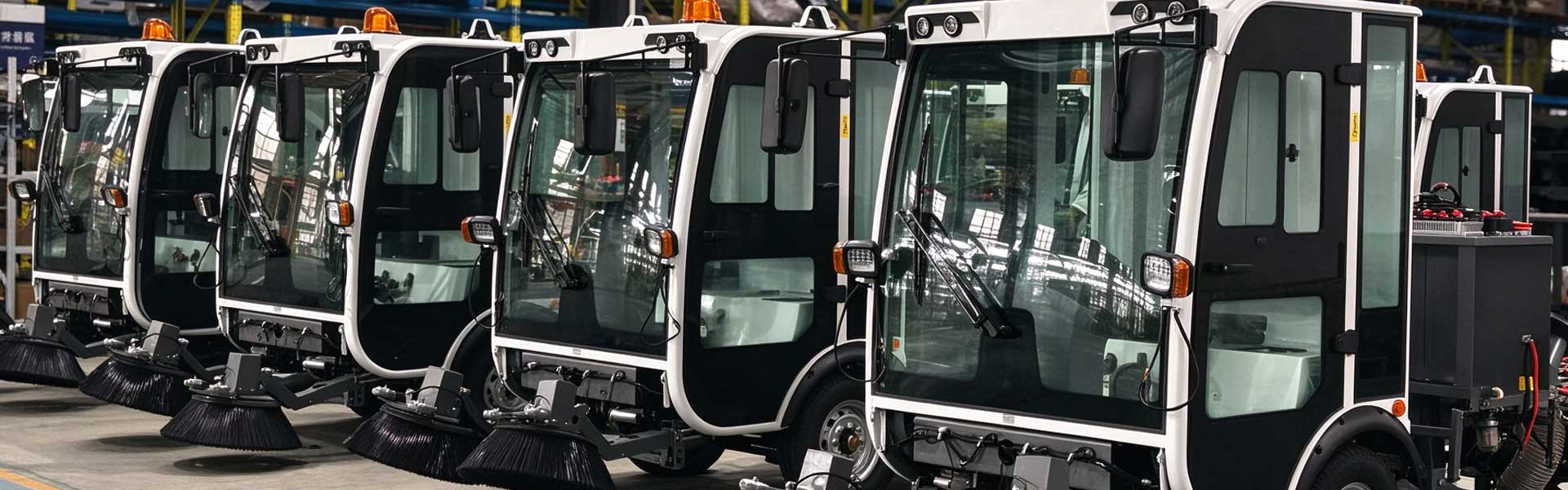
Distribution centers create a difficult cleaning environment.
Forklifts move continuously through aisles, pallets are loaded and unloaded, cardboard particles accumulate around packing areas, shrink-wrap pieces reach the floor and dust is carried throughout the facility.
For a small warehouse, manual sweeping may be manageable.
For a 20,000 m², 50,000 m² or 100,000 m² distribution center, however, sweeping with brooms and manual tools can consume a significant amount of labor.
This is where an industrial floor sweeper can become a practical investment.
Published cleaning benchmarks show that manual push-broom productivity can be around 3,896–5,556 sq ft/hour, while rider sweepers can exceed 60,000 sq ft/hour depending on equipment and operating conditions.
The exact productivity depends on the facility, but the commercial logic is clear: large floor areas create a strong economic case for mechanized sweeping.
1. Distribution Centers Need Continuous Floor Cleaning
A distribution center is not a static warehouse.
Every day there may be:
- Forklift traffic
- Pallet movement
- Truck loading
- Carton handling
- Shrink-wrap waste
- Cardboard debris
- Dust
- Packaging fragments
- Tire particles
If cleaning is postponed until the end of the week, debris can accumulate in high-traffic areas.
A better approach is often to divide the facility into zones.
For example:
| Zone | Cleaning frequency |
|---|---|
| Loading docks | Daily |
| Main forklift aisles | Daily |
| Packing area | Daily |
| Storage aisles | 3–5 times/week |
| Low-traffic areas | 1–3 times/week |
This can allow a distribution center to concentrate machine time where it produces the greatest operational value.
2. Manual Sweeping Becomes Expensive as Area Increases
Consider a distribution center with:
Floor area: 30,000 m²
Suppose effective manual sweeping productivity is approximately 400 m²/hour.
Required labor:
30,000 ÷ 400 = 75 labor-hours
With three workers:
75 ÷ 3 = 25 hours
That is more than three eight-hour shifts for one cleaning cycle.
Now consider a sweeper achieving a practical rate of 4,000 m²/hour:
30,000 ÷ 4,000 = 7.5 hours
One operator could potentially complete the basic sweeping work in a single shift, subject to facility layout and debris conditions.
Real-world sweeping productivity varies with aisle turns, obstacles, speed and floor conditions, so buyers should use conservative numbers rather than brochure maximums. Industry guidance commonly applies an efficiency factor to theoretical sweeper productivity.
3. A Ride-On Sweeper Can Change the Labor Requirement
For large distribution centers, a ride-on machine can make more sense than a manual or small walk-behind unit.
Consider a 50,000 m² facility.
Suppose:
Manual: 400 m²/hour
Ride-on sweeper: 6,000 m²/hour practical
Manual labor requirement:
50,000 ÷ 400 = 125 labor-hours
Machine cleaning time:
50,000 ÷ 6,000 ≈ 8.3 hours
If the facility needs daily cleaning, the difference can be substantial.
At $15/hour labor:
Manual labor cost:
125 × $15 = $1,875
Machine operator labor:
8.3 × $15 ≈ $124.50
Even after adding machine operating costs, the potential labor difference is large.
This is why large logistics facilities increasingly evaluate sweeping equipment based on labor hours saved per week, not just the purchase price.
4. Cleaning Width Is One of the First Numbers to Compare
A wider sweeping path can reduce the number of passes required.
Suppose:
Sweeper A: 800 mm cleaning width
Sweeper B: 1,300 mm cleaning width
For a large open warehouse, the 1,300 mm machine can potentially cover substantially more floor per pass.
But there is an important condition:
The machine must fit the facility's aisles.
If the distribution center has narrow storage aisles, an oversized sweeper may spend too much time turning and repositioning.
A current warehouse equipment guide recommends matching sweeper path width to aisle clearance and racking layout.
Therefore, before ordering an industrial floor sweeper for sale, measure the narrowest working area.
5. Productivity Should Be Calculated Using Real Working Conditions
Suppose a machine's theoretical capacity is:
13,000 m²/hour
It sounds impressive.
But assume the facility has:
- 30% time lost to turns
- Forklift traffic
- Loading zones
- Narrow aisles
- Debris collection stops
Using a conservative 70% efficiency factor:
13,000 × 70% = 9,100 m²/hour
For a 50,000 m² facility:
50,000 ÷ 9,100 ≈ 5.49 hours
That is a much more realistic number for shift planning.
Industry purchasing guidance similarly distinguishes theoretical productivity from real-world productivity and notes that obstacles and aisle geometry can significantly affect actual coverage.
6. Hopper Capacity Can Reduce Unproductive Stops
Imagine two sweepers:
| Specification | Sweeper A | Sweeper B |
|---|---|---|
| Cleaning width | 800 mm | 1,300 mm |
| Hopper | 60 L | 100 L |
| Practical productivity | 5,000 m²/h | 8,000 m²/h |
Suppose the facility contains a large amount of cardboard and packaging debris.
Sweeper A may need frequent hopper emptying.
Sweeper B can collect more material before stopping.
For a distribution center, hopper capacity can therefore be as important as cleaning width.
A buyer should ask:
How much debris can the hopper realistically hold during our normal cleaning cycle?
not simply:
How many liters is the hopper?
7. Battery Runtime Matters for Distribution Centers
A distribution center may require cleaning during:
- Early morning
- Shift changes
- Night shifts
- Loading downtime
- Weekend maintenance
Suppose the cleaning window is:
5 hours
If the machine provides only:
3 hours effective sweeping time
the operator will need a charging or battery replacement strategy.
But if the machine can support:
5–6 hours
the same cleaning schedule may be completed without interruption.
For fleet managers, battery information should therefore include:
- Battery capacity
- Battery type
- Effective runtime
- Charging time
- Charger type
- Replacement battery cost
- Battery service support
The right battery configuration can be more important than a small difference in purchase price.
8. Sweeping Can Free Warehouse Employees for Higher-Value Tasks
Consider a distribution center with four employees who each spend 1.5 hours/day manually sweeping.
Daily labor:
4 × 1.5 = 6 hours/day
At $15/hour:
6 × $15 = $90/day
At 26 working days:
$90 × 26 = $2,340/month
If a floor sweeper reduces manual cleaning to one operator for 1.5 hours:
1 × 1.5 × $15 = $22.50/day
Monthly:
$22.50 × 26 = $585
Potential labor difference:
$2,340 − $585 = $1,755/month
The four employees could instead spend the recovered time on:
- Picking
- Packing
- Loading
- Inventory
- Pallet handling
- Order preparation
This labor reallocation is often one of the strongest commercial arguments for buying a sweeper.
Industry cleaning guidance also identifies labor reallocation as a key advantage of mechanized floor-cleaning equipment.
9. Dust Control Matters in Logistics Facilities
Distribution centers can contain large quantities of fine dust and packaging debris.
A sweeper should therefore be evaluated for its dust-control capability rather than only brush width.
Ask the commercial floor sweeper supplier about:
- Dust filtration
- Filter cleaning
- Dust containment
- Side brush performance
- Main brush configuration
- Debris collection
The objective is not simply to move dust from one part of the warehouse to another.
The machine should collect debris effectively while limiting the amount of dust returned to the working environment.
10. Example: 20,000 m² Distribution Center
Consider a logistics center with:
Floor area: 20,000 m²
Cleaning frequency: 6 days/week
Manual cleaning team: 3 workers
Manual cleaning time: 4 hours/day
Labor:
3 × 4 = 12 hours/day
At $15/hour:
12 × $15 = $180/day
Monthly:
$180 × 26 = $4,680
Suppose a suitable sweeper reduces cleaning to:
1 operator × 2 hours/day
Labor:
2 × $15 = $30/day
Monthly:
$30 × 26 = $780
Potential labor difference:
$4,680 − $780 = $3,900/month
If the machine costs $18,000 and the facility can achieve the assumed labor savings, the simple equipment-only payback calculation would be:
$18,000 ÷ $3,900 ≈ 4.6 months
This is not a guaranteed payback because battery, maintenance, consumables, financing and other operating costs must also be included.
However, it demonstrates why a facility with high manual-cleaning costs should evaluate mechanized sweeping.
11. Don't Buy a Machine That Is Too Large
A common purchasing mistake is assuming that bigger is always better.
Suppose a distribution center has:
Floor area: 25,000 m²
but most storage aisles are only:
1.5 m wide
A very large ride-on machine may struggle with:
- Turning
- Racking
- Pallets
- Forklift traffic
- Loading areas
A medium-size machine may actually produce better overall results because it can spend more time sweeping and less time repositioning.
The correct purchasing question is:
How much usable floor can the machine clean per hour in our facility?
That is more useful than simply comparing the largest number on a product brochure.
12. Choose a Sweeper Based on Debris Type
Distribution centers do not all have the same floor debris.
A packaging warehouse may have:
- Cardboard pieces
- Plastic film
- Paper
- Dust
An automotive distribution center may have:
- Rubber particles
- Metal particles
- Oil-contaminated dust
A building-material warehouse may have:
- Sand
- Stone dust
- Fine powder
Tell the industrial floor sweeper manufacturer exactly what the machine needs to collect.
This helps determine the appropriate brush and dust-control configuration.
13. What to Include in a Sweeper RFQ
Instead of sending:
“Please quote one floor sweeper.”
Send:
Facility type: Distribution center
Floor area: 30,000 m²
Cleaning frequency: Daily
Debris: Cardboard, dust, plastic film
Narrowest aisle: 1.8 m
Cleaning window: 3 hours
Indoor/outdoor: Indoor
Required machine quantity: 2
Destination: ___
Then ask the supplier to recommend the machine size.
This gives the supplier enough information to recommend a commercially appropriate machine.
14. Compare the Complete Cost of Ownership
When comparing an industrial floor sweeper for sale, consider:
- Purchase price
- Shipping
- Battery
- Charger
- Brushes
- Filters
- Spare parts
- Warranty
- Maintenance
- Operator labor
- Expected service life
For example:
Machine A: $12,000
Machine B: $15,000
At first glance, Machine A is cheaper by:
$3,000
But suppose Machine B saves 1.5 labor-hours per cleaning cycle.
At $15/hour and 26 cleaning days:
1.5 × $15 × 26 = $585/month
Annual labor difference:
$585 × 12 = $7,020
In this example, the additional $3,000 purchase price could potentially be justified in less than one year based on labor savings alone.
Again, actual savings depend on real operating conditions.
15. Supplier Support Is Important for Distribution Centers
A distribution center cannot afford extended cleaning-equipment downtime.
Before selecting an industrial floor sweeper manufacturer, ask about:
- Spare brushes
- Filters
- Batteries
- Chargers
- Side brushes
- Main brushes
- Control components
- Warranty
- Technical support
- Export packing
For an overseas distributor, also confirm:
- MOQ
- Lead time
- Container loading
- Electrical configuration
- Spare-parts pricing
- User manuals
- After-sales support
A slightly cheaper machine is not necessarily the better purchase if spare parts are difficult to obtain.
Conclusion
For distribution centers, the value of a floor sweeper comes down to one major business question:
How many manual cleaning hours can the machine remove from the operation?
A properly selected sweeper can cover large areas faster, reduce repetitive manual work and allow warehouse employees to focus on picking, packing, loading and inventory.
For a small facility, manual sweeping may still be economical.
For a 20,000–100,000 m² distribution center with daily cleaning requirements, however, the economics can change quickly.
Before purchasing an industrial floor sweeper for sale, calculate your floor area, current labor hours, cleaning frequency, aisle width and debris type.
Then compare a commercial floor sweeper supplier based on the complete equipment package rather than price alone.
A capable industrial floor sweeper manufacturer should be able to provide the appropriate machine configuration, spare parts, export support and after-sales service for long-term warehouse operation.