
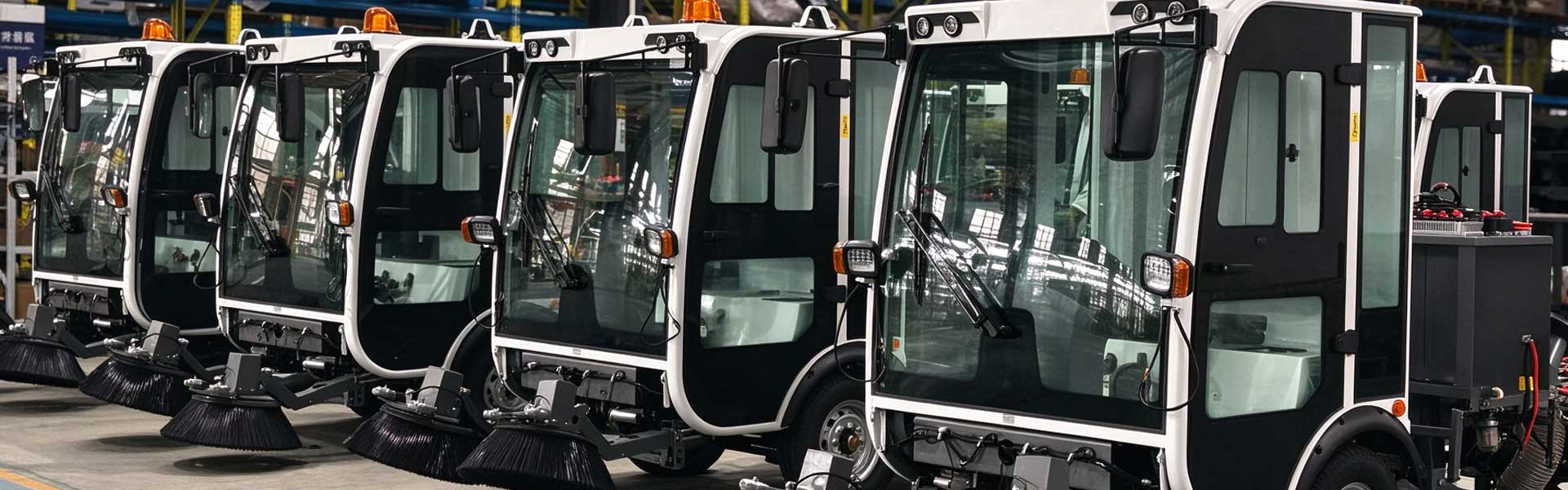
Industrial workshop floors are exposed to a completely different level of dirt than ordinary commercial buildings.
Metal dust, tire marks, oil residue, production debris, packaging material and accumulated grime can build up around machines, workstations and material-handling routes. For a small workshop, manual cleaning may still be manageable. For a 5,000 m², 10,000 m² or larger production facility, however, labor quickly becomes the major cost.
This is where a heavy-duty floor scrubber becomes a practical purchasing decision rather than simply another cleaning machine.
A properly sized scrubber can combine solution application, mechanical scrubbing and dirty-water recovery in one pass. Published industry examples show manual cleaning at roughly 2,000–3,000 sq ft/hour, while properly sized floor scrubbers can reach 10,000–40,000+ sq ft/hour depending on machine and floor conditions.
The actual result depends on the floor layout, obstacles, soil level and machine configuration, but the difference is large enough to make equipment purchasing worth evaluating.
1. Industrial Workshops Have a Labor Problem, Not Just a Cleaning Problem
Consider a workshop with:
Floor area: 8,000 m²
If a manual cleaning team effectively covers 250 m²/hour, the theoretical labor requirement is:
8,000 ÷ 250 = 32 labor-hours
With four workers:
32 ÷ 4 = 8 hours
That means a full working shift could be consumed just cleaning the floor.
Now consider a properly sized machine achieving a practical cleaning rate of 2,000 m²/hour:
8,000 ÷ 2,000 = 4 hours
One operator could potentially complete the same basic floor-cleaning area in approximately half the elapsed time.
The actual rate will vary because workshop floors contain machines, pallets, corners and production traffic. Nevertheless, the labor difference demonstrates why industrial facilities often move from manual cleaning to mechanized equipment.
Published warehouse and industrial cleaning benchmarks also show substantially higher productivity for ride-on equipment compared with manual methods.
2. Heavy-Duty Cleaning Makes Sense When the Floor Has Built-Up Dirt
Not every workshop needs the same machine.
A light-duty machine may be adequate for:
- Clean assembly areas
- Small warehouses
- Retail backrooms
- Offices
- Light manufacturing
A heavy-duty machine becomes more attractive when the floor regularly has:
- Oil and grease residue
- Rubber marks
- Heavy dust
- Metal particles
- Industrial dirt
- Forklift tire marks
- Production debris
- Repeated spills
For heavily contaminated floors, buyers should evaluate not just cleaning width but also brush pressure, water recovery and machine durability.
Some current industrial cleaning guidance recommends higher scrub pressure for compacted distribution-center soil compared with ordinary commercial cleaning.
The purchasing goal is simple:
The machine should remove the actual dirt found on your workshop floor without requiring repeated manual passes.
3. Calculate the Labor Saving Before Buying
Suppose a workshop currently uses:
3 cleaners × 6 hours/day = 18 labor-hours/day
Assume the fully loaded labor cost is $15/hour.
Daily cleaning labor:
18 × $15 = $270/day
At 26 working days/month:
$270 × 26 = $7,020/month
Now suppose a floor scrubber allows the same basic cleaning program to be handled by one operator for four hours:
1 × 4 × $15 = $60/day
Monthly labor:
$60 × 26 = $1,560
Potential labor difference:
$7,020 − $1,560 = $5,460/month
Even after considering electricity, brushes, squeegees, detergent and maintenance, the difference can be commercially significant.
This is the kind of calculation an industrial buyer should make before requesting a quotation.
4. Cleaning Width Affects Daily Productivity
Suppose two machines are being compared:
| Specification | Machine A | Machine B |
|---|---|---|
| Cleaning width | 500 mm | 700 mm |
| Nominal productivity | 2,500 m²/h | 4,500 m²/h |
| Application | Medium workshop | Larger workshop |
If the facility only has 2,000 m² of accessible floor, Machine B may provide little additional value.
But if the facility has 10,000 m² of open production floor, the wider machine can substantially reduce cleaning time.
For example:
10,000 ÷ 2,500 = 4 hours
versus:
10,000 ÷ 4,500 ≈ 2.22 hours
Potential time difference:
4 − 2.22 = 1.78 hours per cleaning cycle
At 26 cleaning days/month:
1.78 × 26 ≈ 46.3 hours/month
That is more than a full working week of labor time.
This is why buyers should compare machine capacity against actual floor area rather than purchasing based on machine price alone.
5. Don't Use the Brochure Number as Your Actual Cleaning Time
A machine advertised at 4,500 m²/hour does not necessarily clean 4,500 m² of real workshop floor every hour.
Actual productivity can be reduced by:
- Turning
- Narrow aisles
- Production equipment
- Pallets
- Workers
- Material movement
- Dirty areas requiring slower passes
- Tank filling
- Dirty-water discharge
Current industry buying guidance specifically warns that theoretical productivity can differ substantially from real-world productivity because of obstacles, turning and other operating conditions.
For purchasing purposes, a safer approach is to apply an efficiency factor.
For example:
Rated productivity: 4,500 m²/h
Assume practical efficiency of 70%:
4,500 × 70% = 3,150 m²/h
For a 10,000 m² workshop:
10,000 ÷ 3,150 ≈ 3.17 hours
This is a much more useful number for production planning.
6. Tank Capacity Can Determine How Much Work Gets Done
Imagine a workshop needs to clean 10,000 m².
A machine has a relatively small solution tank, requiring frequent refilling.
Suppose each refill supports 2,000 m².
The operator needs approximately:
10,000 ÷ 2,000 = 5 tank cycles
If another machine can cover 5,000 m² per filling:
10,000 ÷ 5,000 = 2 tank cycles
The second machine could save several interruptions.
For a large industrial site, tank capacity is therefore not simply a specification on a brochure. It directly affects daily productivity.
7. Battery Runtime Should Match the Cleaning Window
Many industrial workshops prefer battery-powered floor scrubbers because they can operate without exhaust emissions and are suitable for indoor environments.
But the battery must match the working schedule.
For example:
Required cleaning time: 4 hours
Machine effective runtime: 3 hours
The operator will need an additional charging or battery-management solution.
If the facility operates two shifts, this becomes even more important.
A buyer should ask the industrial floor scrubber supplier:
- What is the rated runtime?
- Under what operating conditions?
- What battery configuration is included?
- How long does charging take?
- Is an additional battery available?
- What is the expected battery service life?
The objective is to make sure the machine can support the facility's cleaning schedule rather than simply having a large battery specification.
8. Floor Scrubbing Can Free Workers for Production Tasks
Cleaning labor has an opportunity cost.
Suppose two production workers spend one hour per day cleaning workshop floors.
That's:
2 × 1 = 2 labor-hours/day
At 26 days:
52 labor-hours/month
If those workers are instead assigned to:
- Material handling
- Packaging
- Inspection
- Order preparation
- Machine operation
the business may gain additional productive capacity.
This is one reason industrial scrubbers are often evaluated as productivity equipment, not just cleaning equipment.
Industry guidance similarly highlights labor reallocation as a major benefit of mechanized floor cleaning.
9. Choose the Machine Around Your Workshop Layout
Before contacting an industrial floor scrubber manufacturer, measure:
- Total floor area
- Narrowest aisle
- Door width
- Elevator dimensions
- Turning areas
- Floor type
- Heaviest dirt
- Cleaning frequency
For example:
A 700 mm cleaning width may look attractive, but if a large portion of the workshop has 800 mm aisles, the machine may not be practical.
A 500 mm machine could potentially provide better overall productivity because it can access more of the facility.
The best machine is therefore the one that provides the highest usable productivity, not simply the highest advertised productivity.
10. Example: 10,000 m² Manufacturing Workshop
Consider a factory with:
Floor area: 10,000 m²
Cleaning frequency: 6 days/week
Current manual crew: 3 workers
Cleaning time: 5 hours/day
Current labor:
3 × 5 = 15 labor-hours/day
At $15/hour:
15 × $15 = $225/day
Monthly labor at 26 days:
$225 × 26 = $5,850
Suppose a suitable scrubber reduces cleaning to 2.5 hours with one operator:
1 × 2.5 × $15 = $37.50/day
Monthly:
$37.50 × 26 = $975
Potential labor difference:
$5,850 − $975 = $4,875/month
Even if the machine requires $800/month for maintenance, consumables, electricity and depreciation allocation, the potential operating difference remains significant.
This is the kind of real-world example that can help justify an equipment purchase to management.
11. What to Ask When Buying a Heavy-Duty Floor Scrubber
When comparing a heavy duty floor scrubber for sale, request:
- Cleaning width
- Practical productivity
- Solution tank capacity
- Recovery tank capacity
- Battery type
- Expected runtime
- Brush pressure
- Machine dimensions
- Turning radius
- Machine weight
- Noise level
- Warranty
- Spare parts availability
Also provide your supplier with your actual application.
For example:
“We have 10,000 m² of concrete workshop floor, six cleaning days per week, forklift traffic and oil/dust contamination. We need to finish daily cleaning within 3 hours.”
This is far more useful than simply asking:
“Please send your floor scrubber price.”
12. The Right Supplier Can Reduce Purchasing Risk
An experienced industrial floor scrubber supplier should be able to help compare machine size against:
- Floor area
- Dirt level
- Cleaning frequency
- Labor availability
- Indoor/outdoor environment
- Battery requirements
- Budget
For an overseas buyer, also ask for:
- Export packing
- Spare parts list
- User manual
- Electrical configuration
- Warranty terms
- Loading information
- Shipping dimensions
The machine price is only one part of the purchase.
Conclusion
For industrial workshops, a heavy-duty floor scrubber can turn floor cleaning from a labor-intensive task into a predictable daily production process.
The strongest purchasing case usually comes from the numbers:
floor area + cleaning frequency + labor hours + practical machine productivity + operating cost.
If a workshop spends dozens of labor-hours every week on floor cleaning, it is worth comparing a heavy duty floor scrubber for sale with the current manual process.
A reliable industrial floor scrubber supplier can help match the machine to the facility, while an experienced industrial floor scrubber manufacturer can provide the equipment, spare parts and support needed for long-term industrial use.