
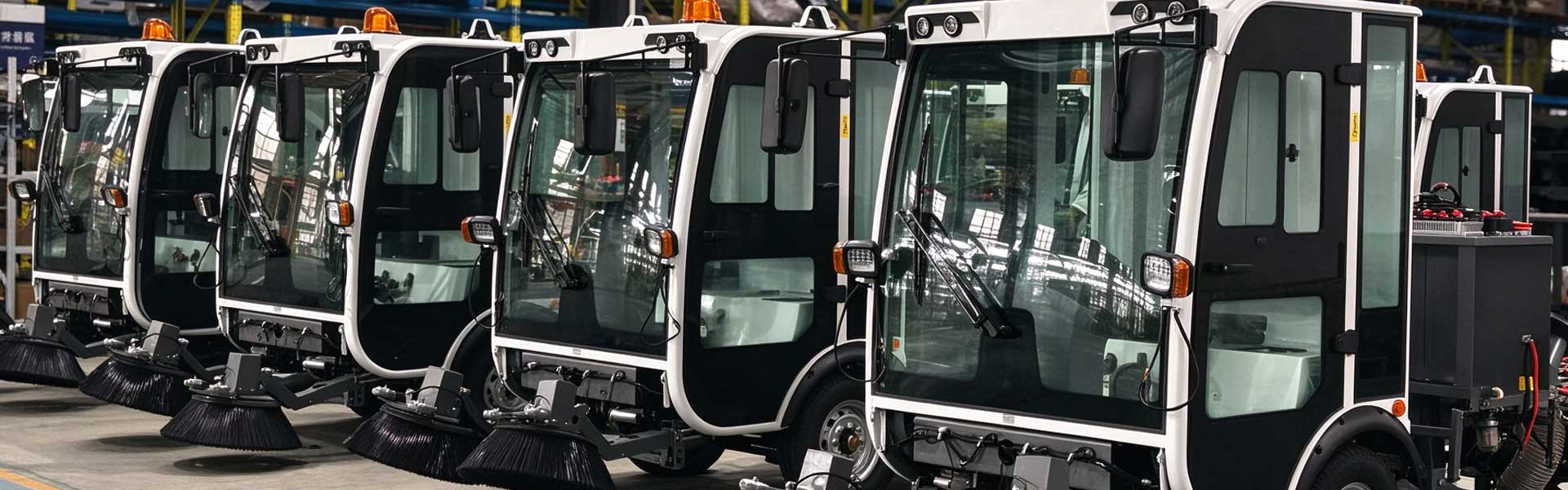
Metalworking shops rarely have clean floors for long.
After machining, cutting, grinding, drilling or fabrication, the floor can quickly accumulate:
- Metal chips
- Small scrap pieces
- Dust
- Cutting debris
- Packaging material
- Dirt brought in by forklifts
- Fine particles around machines
A traditional broom may remove some of this material, but manual sweeping becomes increasingly inefficient as the workshop grows.
For manufacturers, a better question is:
How much production time and labor are being spent cleaning the workshop every day?
This is where an industrial floor sweeper for sale can become a practical investment.
Industrial sweepers are designed to collect dry debris over larger floor areas, making them particularly useful in workshops, warehouses, factories and logistics facilities.
1. Why Metalworking Workshops Need Mechanical Sweeping
Consider a metalworking factory with:
Workshop area: 8,000 m²
Production shifts: 2/day
Cleaning frequency: After each shift
If workers spend 45 minutes manually sweeping the floor after each shift:
45 minutes × 2 = 90 minutes/day
Over 26 working days:
90 × 26 = 2,340 minutes
That equals:
39 hours/month
Even if only one worker performs the cleaning, the factory is spending almost a full working week every month on manual sweeping.
If several workers are involved, the labor requirement becomes much higher.
A mechanical sweeper can turn this into a more structured cleaning operation.
2. What Can a Floor Sweeper Remove?
A commercial electric sweeper is particularly useful for dry debris such as:
- Dust
- Dirt
- Small particles
- Paper
- Packaging debris
- Leaves
- Light industrial waste
- Dry production residue
For metalworking environments, however, buyers should distinguish between general debris collection and specialized collection of sharp or ferrous metal chips.
Magnetic sweepers, for example, are specifically designed to collect ferrous chips, screws and other magnetic metal debris. They are not a replacement for a powered sweeper in every workshop situation.
Therefore, the right equipment depends on exactly what is on the floor.
3. Floor Sweeper or Floor Scrubber?
This is one of the most important purchasing decisions.
Choose a floor sweeper when you mainly need to remove:
- Metal chips
- Dust
- Dry dirt
- Small debris
- Packaging waste
Choose a floor scrubber when you mainly need to remove:
- Oil residue
- Sticky dirt
- Mud
- Food residue
- Liquid contamination
- Embedded grime
Use both when the workshop has both dry and wet contamination.
For example:
Morning: electric floor sweeper removes dust and chips.
End of shift: floor scrubber cleans oil and embedded dirt.
This two-stage approach can be more practical than trying to make one machine perform every cleaning task.
4. Example: A CNC Workshop
Imagine a CNC machining workshop with approximately:
6,000 m² floor area
The workshop contains:
- 20 CNC machines
- Material storage
- Finished-product area
- Forklift lanes
- Operator walkways
During production, metal chips accumulate around machining areas while dust and small debris spread into the aisles.
The factory manager purchases a ride-on sweeper for the main floor and keeps manual cleaning tools for areas immediately around individual machines.
The operator can sweep:
- Main production aisles
- Forklift routes
- Material storage areas
- Open spaces
- Finished-product areas
The machine handles the large floor area while workers concentrate on detailed cleaning around equipment.
This is often more efficient than asking production workers to manually sweep the entire workshop.
5. Choose the Sweeper According to Workshop Size
The machine's cleaning width and productivity should match the floor area.
For example:
Small workshop
A compact walk-behind sweeper can be useful for:
- Narrow aisles
- Small production rooms
- Maintenance areas
- Workshops with many obstacles
Medium workshop
A larger walk-behind or compact ride-on sweeper can increase daily productivity.
Large industrial facility
A ride-on sweeper is often more appropriate for:
- Large factories
- Warehouses
- Logistics centers
- Parking areas
- Distribution facilities
The important point is to calculate the required cleaning capacity rather than buying based purely on machine appearance.
6. A Simple Productivity Calculation
Suppose a workshop has:
10,000 m² cleaning area
The buyer expects the sweeper to achieve a practical productivity of:
5,000 m²/hour
The theoretical cleaning time is:
10,000 ÷ 5,000 = 2 hours
If the workshop has a cleaning window of only 2–3 hours between shifts, this machine may be appropriate.
But if the actual cleaning window is only 60 minutes, the buyer should consider a higher-capacity machine.
This simple calculation can prevent both under-buying and over-buying.
7. Don't Confuse Maximum Capacity With Real Working Capacity
A machine may be advertised with a high theoretical sweeping capacity.
That does not mean an operator will achieve the same result in a real workshop.
Actual performance depends on:
- Floor layout
- Debris quantity
- Turning
- Obstacles
- Operator experience
- Cleaning speed
- Waste-bin emptying
- Battery condition
For example, a machine rated at 10,000 m²/hour may not realistically clean 10,000 m² of a crowded CNC workshop every hour.
There may be dozens of machines, columns, pallets and narrow passages.
For procurement purposes, it is better to ask the supplier:
What practical area can one operator clean per hour in a workshop with machines and obstacles?
That answer is more useful than maximum theoretical capacity.
8. Metal Chips Require Special Attention
Metal chips are not ordinary household dust.
Sharp chips can create problems for:
- Workers
- Tires
- Shoes
- Forklifts
- Finished products
A specialized magnetic sweeper can be useful for ferrous chips because it can collect magnetic debris without requiring workers to touch each piece manually.
However, magnetic equipment will not collect non-ferrous materials such as aluminum or certain stainless-steel debris.
Therefore, if your workshop processes:
steel + iron
a magnetic collection solution may be useful.
If it processes:
aluminum + plastic + dust + paper
a conventional mechanical floor sweeper may be more appropriate.
For mixed debris, the supplier should understand the material before recommending the machine.
9. Example: Metal Fabrication Workshop
Consider a metal fabrication company producing steel components.
Its workshop has:
Floor area: 12,000 m²
Working schedule: 2 shifts/day
Main debris: steel chips, dust and small scrap
Cleaning requirement: once after each shift
The company initially uses four workers to sweep the workshop manually.
The factory manager calculates:
4 workers × 1 hour × 26 days = 104 labor-hours/month
Instead of continuing with manual sweeping, the company purchases an industrial ride-on sweeper.
The machine handles the main open areas, while workers remain responsible for detailed cleaning around welding stations and machinery.
The objective is not to eliminate manual cleaning completely.
The objective is to move repetitive large-area sweeping from manual labor to mechanical cleaning.
10. Battery Working Time Matters in Industrial Workshops
For an electric sweeper, battery working time should match the actual cleaning schedule.
Suppose a workshop requires:
2 hours of sweeping per shift
A machine with insufficient runtime may require an additional battery or interruption for charging.
Before purchasing, ask the supplier about:
- Battery type
- Battery capacity
- Typical working time
- Charging time
- Battery replacement cost
- Charger specification
- Spare battery availability
This is especially important for factories operating two or three shifts.
The cheapest machine is not necessarily the cheapest solution if its battery capacity does not match the production schedule.
11. Dust Control Can Also Affect Machine Selection
Fine workshop dust can become airborne during sweeping.
For dusty environments, buyers should pay attention to the sweeper's dust-control system and filtration configuration.
A suitable machine should help collect debris rather than simply pushing dust around the workshop.
This is particularly important for:
- Grinding areas
- Cutting areas
- Cement-related workshops
- Warehouses
- Large manufacturing floors
The buyer should tell the supplier whether the main problem is:
large debris, fine dust, metal chips, or a combination of all three.
12. What Should You Ask Before Buying an Industrial Sweeper?
When comparing an industrial floor sweeper for sale, ask for more than the machine price.
Provide:
Floor area: 10,000 m²
Floor: concrete
Debris: steel chips + dust
Cleaning frequency: twice/day
Available cleaning time: 1.5 hours
Main obstacles: CNC machines and pallets
Preferred operation: ride-on
Destination: Your country
Then ask the supplier to recommend:
- Sweeping width
- Practical cleaning capacity
- Battery configuration
- Dust filtration
- Waste hopper capacity
- Turning radius
- Machine dimensions
- Spare parts
- Export packing
- Warranty
- Delivery terms
This creates a much more useful quotation.
13. Voril Electric Floor Sweepers for Industrial Cleaning
Voril supplies electric floor sweepers for commercial and industrial applications where customers need to replace repetitive manual sweeping with mechanical cleaning.
Depending on the project, buyers can consider different machine sizes for:
- Workshops
- Warehouses
- Manufacturing plants
- Logistics centers
- Parking areas
- Distribution facilities
The right floor sweeper for metal workshop applications depends on the type of debris, floor area and available cleaning time.
If your workshop has metal chips, dust or dry production debris, send Voril the following information:
Floor area + debris type + cleaning frequency + available cleaning time + floor type.
For example:
We have a 10,000 m² steel fabrication workshop. The main debris is steel chips and dust. We need to clean the workshop twice per day and prefer an electric ride-on sweeper.
Voril can then recommend a suitable configuration and provide a quotation.
Instead of assigning workers to spend hours pushing a broom across the factory floor, put an electric floor sweeper to work on the large-area cleaning job.