
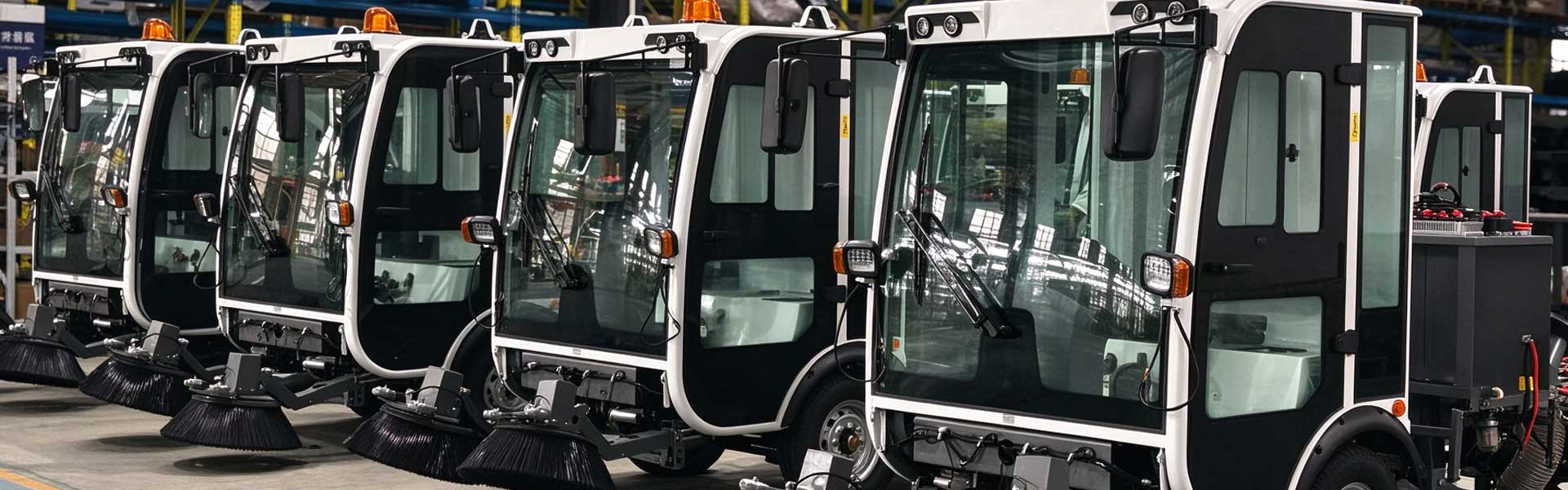
Shopping malls face a cleaning challenge that ordinary mops and manual cleaning teams struggle to handle efficiently.
Large entrances, polished corridors, food courts, escalator areas and retail aisles may receive thousands of visitors every day. Dust, footprints, spilled drinks, food residue and tracked-in dirt can quickly make a floor look dirty again after it has just been cleaned.
For facility managers, the question is not simply whether the floor can be cleaned.
The real question is:
How can a large shopping mall maintain clean floors every day without using excessive labor or keeping customers away from the cleaning area for too long?
This is where an electric floor scrubber for shopping mall applications can become a practical investment.
Commercial scrubbers are already available in compact walk-behind configurations as well as larger ride-on models. For example, commercial machines on the market range from compact units designed for narrow retail areas to machines capable of cleaning around 28,000 sq. ft. per hour.
1. Shopping Mall Floors Need More Than Simple Sweeping
A shopping mall normally has several different types of floor contamination.
Main entrance
The entrance area receives dirt and dust brought in from outside.
During rainy weather, water and mud can also be tracked inside.
Shopping corridors
Continuous pedestrian traffic creates:
- Dust
- Footprints
- Fine dirt
- Rubber marks
- General surface contamination
Food courts
Food courts create a different cleaning problem.
Grease, drink spills, food particles and sticky residues require more than dry sweeping.
Retail stores
Stores may have tile, vinyl, concrete, terrazzo or other hard flooring.
The cleaning equipment therefore needs to be flexible enough for different floor conditions.
For this reason, a sweeper and a scrubber often serve different jobs.
Sweeper = remove dry debris and dust
Scrubber = wash, scrub and recover dirty water
Commercial floor scrubbers are commonly used in retail stores, warehouses, schools, hospitals and other hard-floor environments.
2. Why a Shopping Mall Should Consider an Electric Floor Scrubber
Manual mopping may work for a small retail store.
It becomes much less attractive when the cleaning area reaches tens of thousands of square meters.
Consider a hypothetical shopping mall with:
Floor area: 30,000 m²
Main cleaning area: 20,000 m²
Cleaning frequency: 1–2 times per day
Operating schedule: 7 days/week
If a cleaning team spends several hours manually cleaning the main corridors every day, labor costs accumulate quickly.
A commercial scrubber can significantly increase the amount of floor one operator can cover.
For example, a commercial walk-behind scrubber currently marketed in the U.S. has a rated productivity of approximately 17,500 sq. ft./hour, while other commercial machines are advertised at around 19,000 sq. ft./hour or higher.
Actual output will depend on the floor layout, obstacles, operator speed and cleaning conditions, but the difference illustrates why commercial equipment becomes attractive for larger facilities.
3. Choose the Machine According to Mall Size
A common purchasing mistake is choosing a machine simply because it has a high cleaning capacity.
A better approach is to match the machine to the mall's actual layout.
Small shopping center
For smaller facilities with narrow corridors and many retail stores, a compact walk-behind machine can be practical.
A machine with a cleaning width around 500 mm can provide good maneuverability while still covering a substantial area.
Medium-size shopping mall
For larger corridors and open areas, a higher-capacity walk-behind or ride-on scrubber can reduce cleaning time.
Large shopping mall
For very large atriums, corridors and open spaces, a ride-on scrubber can reduce operator fatigue and increase daily productivity.
Some commercial ride-on scrubbers are specifically positioned for supermarkets, airports and other high-traffic facilities.
The correct purchasing decision depends on floor area + layout + traffic + cleaning frequency, not simply the largest machine available.
4. Example: A 20,000 m² Shopping Mall
Consider a shopping mall with approximately:
20,000 m² of hard flooring
The facility manager wants to clean the main public areas every day.
Instead of assigning several workers to manual mopping, the facility purchases a commercial ride-on floor scrubber.
Suppose the machine's practical cleaning productivity is approximately:
3,000 m²/hour
The theoretical cleaning time for 20,000 m² would be:
20,000 ÷ 3,000 ≈ 6.7 hours
Actual working time will be higher because the operator must navigate stores, columns, elevators, seating areas and other obstacles.
However, the machine can still consolidate a large amount of floor cleaning into a structured daily operation.
If the facility previously required multiple workers for the same task, the equipment can potentially reduce labor demand while producing a more consistent cleaning result.
5. Dry Floors Quickly After Scrubbing
Shopping malls cannot afford to leave large wet areas in busy pedestrian zones.
This is particularly important near:
- Main entrances
- Food courts
- Escalators
- Elevator entrances
- Supermarket entrances
A modern scrubber combines the scrubbing process with dirty-water recovery.
For example, commercial scrubbers commonly use a rear squeegee and vacuum system to recover dirty water immediately after scrubbing. One commercial model currently lists a 22-inch squeegee and 500 W vacuum motor for this purpose.
This allows the cleaning team to return the floor to normal use more quickly than traditional wet mopping.
6. Tank Capacity Also Matters
Imagine an operator cleaning a large shopping mall with a small water tank.
If the operator repeatedly stops to refill clean water and empty recovered water, machine productivity falls.
Therefore, buyers should compare:
- Cleaning width
- Solution tank capacity
- Recovery tank capacity
- Battery working time
- Travel speed
- Operator visibility
- Turning radius
For example, a commercial 18-inch walk-behind machine currently listed on the market uses a 12-gallon solution tank and 13-gallon recovery tank, while another compact machine uses 7-gallon and 8-gallon tanks.
The right tank size depends on the cleaning area and machine configuration.
7. What About Polished Marble and Other Premium Floors?
Shopping malls often contain expensive flooring materials.
These can include:
- Marble
- Terrazzo
- Ceramic tile
- Epoxy
- Sealed concrete
- Vinyl
The machine should therefore be selected together with the correct brush or pad.
A mall manager should tell the supplier exactly what floor surfaces are being cleaned.
For example:
Our mall has approximately 18,000 m² of tile and 5,000 m² of polished stone. We need daily cleaning and want a ride-on electric scrubber.
This gives the supplier much better information for recommending the machine configuration.
Commercial shopping-mall cleaning solutions commonly distinguish between polished stone, tile, food-court areas and narrow service corridors rather than using one identical cleaning setup everywhere.
8. Buying a Commercial Floor Scrubber: What Should You Compare?
When comparing a commercial floor scrubber for sale, do not look only at the machine price.
Compare:
| Item | Why It Matters |
|---|---|
| Cleaning width | Determines coverage per pass |
| Practical productivity | Helps estimate daily working time |
| Solution tank | Reduces refill frequency |
| Recovery tank | Supports continuous cleaning |
| Battery capacity | Determines operating time |
| Machine size | Important for mall aisles and doors |
| Brush/pad options | Must match the floor |
| Squeegee width | Affects water recovery |
| Spare parts | Important for long-term operation |
| After-sales support | Reduces downtime |
A machine with a slightly higher purchase price may be a better investment if it significantly reduces daily labor and cleaning time.
9. A Practical Purchasing Example
Suppose two machines are available:
Option A
- 500 mm cleaning width
- Walk-behind
- Compact design
- Suitable for corridors and retail areas
Option B
- 700 mm cleaning width
- Ride-on
- Larger tanks
- Designed for larger open areas
For a 5,000 m² shopping center with many narrow aisles, Option A may be the better purchase.
For a 30,000 m² mall with large open corridors, Option B may provide better productivity.
This is why Voril does not recommend choosing a machine only from a product catalog.
The machine should match the actual cleaning project.
10. Choose the Right Shopping Mall Floor Cleaning Machine
A shopping mall needs consistent cleaning every day.
The right shopping mall floor cleaning machine can help facility managers reduce manual cleaning work, improve floor appearance and organize daily cleaning operations more efficiently.
Voril offers electric floor scrubbers for commercial and industrial applications, including walk-behind and ride-on configurations.
When requesting a quotation, provide:
Floor area + floor type + cleaning frequency + working hours + preferred machine type.
For example:
20,000 m² shopping mall, mainly tile and concrete, daily cleaning, 6–8 hours operation. We are looking for a ride-on electric floor scrubber.
With this information, Voril can recommend a suitable configuration and prepare a quotation for your project.
If your shopping mall needs faster and more consistent floor cleaning, contact Voril for an electric floor scrubber matched to your actual cleaning area.