
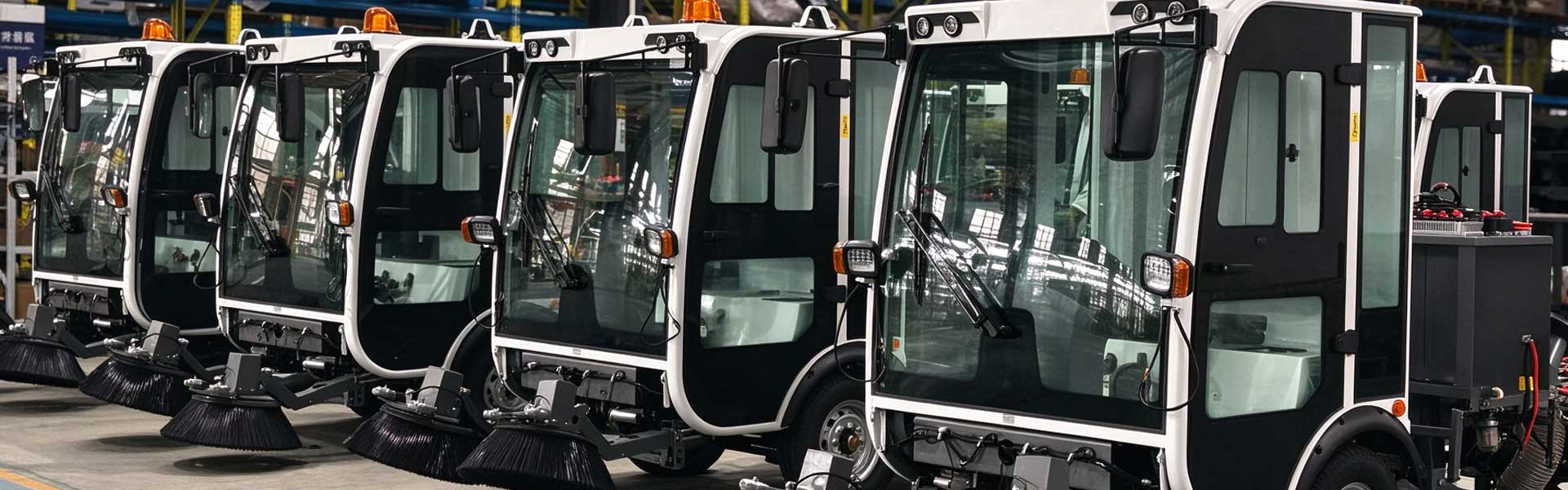
Large commercial buildings can accumulate an enormous amount of dust and loose debris every day.
Shopping centers, warehouses, distribution facilities, exhibition centers, factories, airports and large retail buildings may have tens of thousands or even hundreds of thousands of square feet of floor to maintain.
Using a conventional broom across these areas is slow and labor-intensive.
A properly sized floor sweeper for commercial buildings can turn large-area cleaning into a much faster and more repeatable process.
The key is matching the machine to the building's floor area, traffic pattern and debris level.
Why Large Buildings Need a Different Cleaning Strategy
Cleaning 10,000 sq. ft. and cleaning 200,000 sq. ft. are completely different operational tasks.
A small manual sweeper may be perfectly practical for a compact retail area. But when the cleaning area expands, operator walking distance becomes a major factor.
Consider a simple example.
A commercial building has:
100,000 sq. ft. of hard flooring
If the cleaning team needs to complete sweeping before the building opens, the available cleaning window may be only a few hours.
A machine that can cover approximately 30,000 sq. ft./hour has a very different operating profile from one capable of more than 70,000 sq. ft./hour.
Kärcher currently lists commercial and industrial sweeper categories ranging from approximately 30,000 sq. ft./hour for walk-behind machines to more than 70,000 sq. ft./hour for industrial machines, with some industrial configurations listed above 200,000 sq. ft./hour.
This is why large buildings should not select a sweeper based only on purchase price.
Where a Commercial Floor Sweeper Creates the Most Value
A commercial floor sweeper is particularly useful when the main problem is loose dry debris.
Typical applications include:
- Warehouses
- Shopping centers
- Distribution centers
- Manufacturing plants
- Parking facilities
- Loading areas
- Sports facilities
- Large retail buildings
- Exhibition centers
Commercial sweepers are designed to collect dust, dirt and debris while reducing the amount of manual sweeping required.
For large facilities, the main benefit is simple:
More floor area can be cleaned with fewer operator hours.
Example: A 100,000 Sq. Ft. Commercial Building
Imagine a distribution center with:
100,000 sq. ft. of concrete floor
The facility needs daily sweeping before the first shift begins.
Suppose a machine provides a practical cleaning productivity of approximately 40,000 sq. ft./hour.
A simple area calculation gives:
100,000 ÷ 40,000 = 2.5 hours
This is not a guarantee of a 2.5-hour cleaning job because actual productivity depends on aisles, turns, racks, loading zones and other obstacles.
However, it demonstrates how machine productivity can be matched to the available cleaning window.
Now consider a larger ride-on machine with substantially higher area coverage.
The same facility may be able to complete the main sweeping task much faster, leaving more time for entrances, corners and high-traffic zones.
Walk-Behind vs. Ride-On for Large Commercial Buildings
Choosing between walk-behind and ride-on equipment is one of the most important purchasing decisions.
Walk-Behind Floor Sweeper
A walk-behind machine can be a good fit when the building has:
- Medium-sized floor areas
- Narrow aisles
- Many obstacles
- Tight corners
- Multiple small cleaning zones
Kärcher lists walk-behind commercial sweepers with area performance up to approximately 39,600 sq. ft./hour.
They are easier to maneuver than many larger ride-on machines and can be useful for facilities where flexibility is more important than maximum productivity.
Ride-On Floor Sweeper
For very large buildings, ride-on machines can provide a significant productivity advantage.
The operator sits on the machine and controls the sweeping system while traveling through the facility.
Kärcher lists ride-on and industrial sweeper configurations with area performance reaching tens of thousands of square feet per hour, with some industrial models rated at more than 190,000 sq. ft./hour.
For a large warehouse or commercial building, this difference can directly affect how long the cleaning operation takes.
Large Area Cleaning Is About More Than Machine Speed
A common mistake is to look only at the advertised square feet per hour.
A sweeper may have an impressive theoretical capacity, but the building itself determines how much of that capacity can actually be used.
For example:
Open warehouse: high productivity
Warehouse with narrow aisles: lower productivity
Shopping mall with many people: lower operating speed
Large loading dock: high productivity
Building with many columns: more turning and repositioning
The machine must therefore match the actual environment.
Cleaning Width Matters
A wider sweeping path means the machine can collect debris over a larger area in each pass.
This can be especially valuable in:
- Large warehouses
- Distribution centers
- Exhibition halls
- Manufacturing plants
- Parking structures
- Large commercial corridors
But wider is not automatically better.
If a building has narrow aisles, a very wide machine may require additional repositioning.
For this reason, buyers should compare:
Sweeping width + machine width + turning radius + aisle width
rather than looking at sweeping width alone.
Hopper Capacity Can Save Cleaning Time
Hopper capacity becomes increasingly important as the cleaning area increases.
A machine with a small debris container may require frequent emptying.
Every additional stop means lost cleaning time.
For example, consider a large commercial facility where an operator must stop several times during one shift to empty a small hopper.
Even if the machine itself is fast, repeated dumping can reduce the actual productivity.
A larger hopper allows the operator to spend more time sweeping and less time handling collected debris.
For large-area applications, hopper capacity should therefore be considered alongside sweeping width and battery runtime.
Battery Sweeper for Indoor Commercial Buildings
For indoor commercial buildings, battery-powered sweepers can be particularly attractive.
They avoid fuel exhaust inside the building and can provide a quieter cleaning operation.
This makes them suitable for:
- Warehouses
- Shopping centers
- Retail buildings
- Production areas
- Distribution centers
- Indoor parking facilities
Battery runtime should be matched to the cleaning schedule.
For example, if the building requires three hours of continuous sweeping, ask the supplier whether the selected machine can complete the planned route on one charge.
Also check:
- Charging time
- Battery type
- Battery capacity
- Replacement battery cost
- Expected operating hours
- Charging infrastructure
Dust Control Is Important in Commercial Buildings
Large buildings often contain significant amounts of fine dust.
Simply pushing a dry broom through a warehouse can redistribute dust instead of effectively controlling it.
Modern commercial sweepers can incorporate filtration and dust-control systems.
For example, the Advance Proterra industrial sweeper is designed for applications including warehouses, factories and parking garages and uses a multi-stage dust-control system.
For indoor facilities, ask suppliers specifically about filtration and dust containment rather than focusing only on sweeping width.
Example: Choosing a Sweeper for Three Buildings
Consider a cleaning contractor responsible for three commercial facilities:
| Building | Area | Layout | Suitable Direction |
|---|---|---|---|
| Retail building | 25,000 sq. ft. | Many corners | Walk-behind |
| Distribution center | 100,000 sq. ft. | Wide aisles | Ride-on |
| Industrial facility | 200,000 sq. ft. | Large open floor | Heavy-duty ride-on |
The same machine does not necessarily make sense for all three buildings.
The 25,000 sq. ft. retail building may prioritize maneuverability.
The 100,000 sq. ft. distribution center may prioritize sweeping width, hopper capacity and battery runtime.
The 200,000 sq. ft. industrial facility may prioritize maximum area productivity and long operating time.
This is why commercial buyers should provide the supplier with actual site information before requesting a quotation.
Don't Forget Loading Docks and High-Traffic Areas
Large commercial buildings rarely have uniform cleaning requirements.
Some areas accumulate much more debris than others.
Loading docks may receive:
- Cardboard pieces
- Packaging debris
- Dust
- Pallet fragments
- Sand
- Outdoor dirt
Production areas may generate fine dust.
Entrances may receive dirt brought in by pedestrians.
Parking areas may contain tire debris and sand.
A suitable large area floor cleaning solution should therefore be capable of handling the dominant debris type rather than simply maximizing theoretical sweeping speed.
Sweeper or Scrubber?
This distinction is important when purchasing equipment.
A floor sweeper is primarily designed to collect dry, loose debris.
A floor scrubber is designed for wet cleaning, using water, detergent, brushes or pads and a recovery system.
For example:
Floor sweeper: dust, sand, leaves, packaging debris, loose dirt
Floor scrubber: stains, adhered dirt, tire marks, oily residue and wet-cleaning requirements
For some large facilities, using both machines provides a more complete floor-care program.
Nilfisk specifically recommends sweeping loose debris before using a scrubber for deeper cleaning.
How to Select a Floor Sweeper for a Large Building
Before purchasing a floor sweeper for commercial buildings, prepare the following information for the supplier:
1. Total cleaning area
Give the supplier the actual area that needs to be swept.
2. Area that must be cleaned per shift
A 200,000 sq. ft. building may not require all 200,000 sq. ft. to be swept every day.
3. Cleaning window
Tell the supplier whether the machine has:
- 1 hour
- 2 hours
- 4 hours
- An entire shift
to complete the work.
4. Floor surface
Specify whether the floor is:
- Concrete
- Epoxy
- Asphalt
- Tile
- Other hard flooring
5. Debris type
Explain whether the machine will collect:
- Fine dust
- Sand
- Leaves
- Packaging debris
- Metal fragments
- Wood particles
- General warehouse dirt
6. Building layout
Provide:
- Aisle width
- Door width
- Turning areas
- Ramps
- Columns
- Loading areas
These details allow the supplier to recommend a machine based on the actual facility rather than a generic catalogue.
The Real Value Is Cleaning Time Saved
For a commercial building manager, the biggest benefit of a sweeper is not the machine itself.
It is the time saved every day.
Suppose a facility currently requires two workers to manually sweep for three hours.
That represents:
6 labor-hours per cleaning cycle
If a ride-on sweeper allows one operator to complete the main sweeping task in approximately two hours, the operation becomes:
2 labor-hours per cleaning cycle
The exact savings depend on actual machine productivity, labor costs and site conditions, but this simple example shows why large facilities often evaluate sweepers based on operating cost rather than purchase price alone.
A Better Way to Compare Supplier Quotations
When comparing machines, ask every supplier for the same information:
| Specification | Supplier A | Supplier B | Supplier C |
|---|---|---|---|
| Sweeping width | — | — | — |
| Rated productivity | — | — | — |
| Recommended working productivity | — | — | — |
| Hopper capacity | — | — | — |
| Battery capacity | — | — | — |
| Runtime | — | — | — |
| Turning radius | — | — | — |
| Machine width | — | — | — |
| Machine weight | — | — | — |
| Dust filtration | — | — | — |
| Charging time | — | — | — |
| Spare parts | — | — | — |
This makes it easier to identify whether a low-priced machine actually provides the capacity required for your building.
Final Thoughts
Large commercial buildings need cleaning equipment that matches their scale.
A suitable commercial floor sweeper can help reduce manual sweeping, improve cleaning consistency and allow operators to cover large areas within a limited maintenance window.
For smaller commercial spaces, a maneuverable walk-behind sweeper may be sufficient. For warehouses, distribution centers and other large buildings, a ride-on machine can provide much higher area coverage.
The right choice depends on:
- Floor area
- Cleaning frequency
- Available cleaning time
- Sweeping width
- Hopper capacity
- Battery runtime
- Building layout
- Debris type
- Dust-control requirements
If you are looking for a floor sweeper for commercial buildings, give the supplier your floor area, daily cleaning target and building layout first. A machine configured around the actual cleaning job will usually be much more useful than simply choosing the machine with the highest advertised square-feet-per-hour number.