
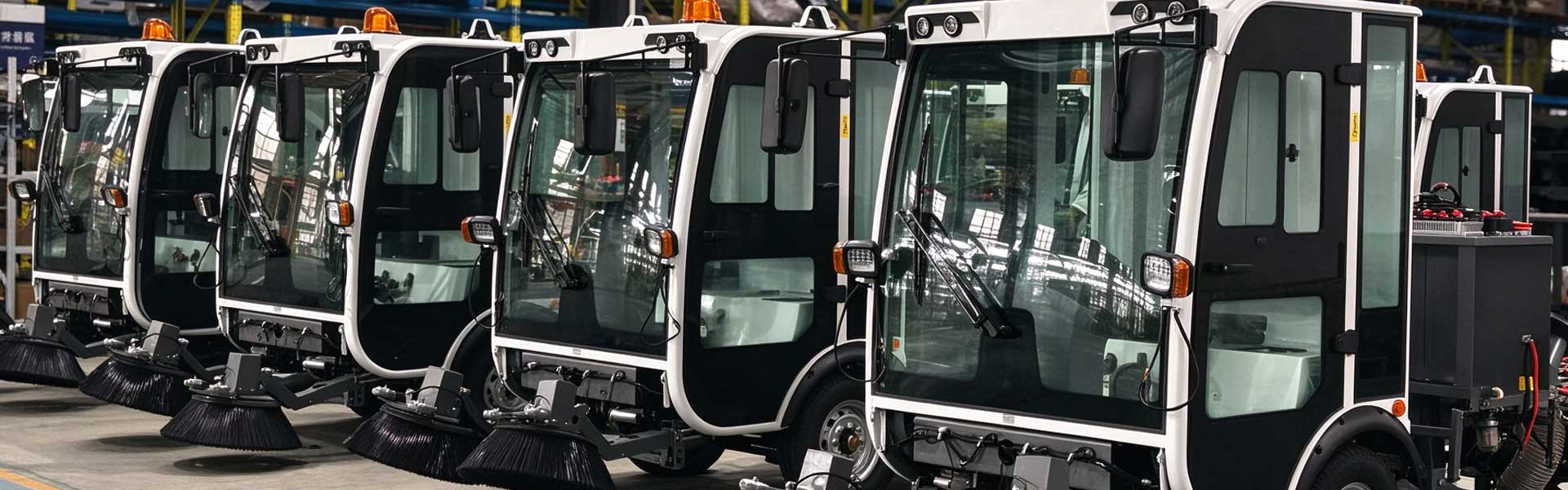
Large warehouses have a simple floor-cleaning problem: there is a lot of floor to clean, but very little time to do it.
A 5,000 m², 10,000 m² or even 30,000 m² logistics facility may have forklifts moving continuously, pallets occupying part of the floor and workers operating around the clock.
For this type of facility, manual mopping is difficult to scale.
A commercial industrial floor scrubber can combine water application, brush scrubbing and wastewater recovery in one pass, allowing one operator to cover a much larger area than manual cleaning.
For large logistics facilities, current market examples commonly put ride-on scrubber productivity in the range of approximately 3,000–6,000+ m²/h, with larger machines capable of higher rated figures under ideal conditions.
The key for buyers is not simply finding the machine with the biggest number.
It is finding a machine that can finish the actual cleanable floor area within the available cleaning window.
Why Large Warehouses Need a Different Cleaning Machine
A logistics warehouse may contain:
- Concrete floors
- Epoxy-coated floors
- Forklift traffic lanes
- Loading areas
- Storage aisles
- Picking areas
- Packing zones
- Distribution areas
Common floor contamination includes:
- Dust
- Tire marks
- Mud
- Oil spots
- Packaging debris
- Dried spills
- Dirt carried in from loading areas
Sweeping can remove dry debris, but it does not replace wet scrubbing when the floor has tire marks, stains or accumulated dirt.
For these areas, a floor scrubber provides a more complete warehouse floor cleaning process.
How Much Floor Can an Industrial Floor Scrubber Clean?
The answer depends on the model.
For example, a walk-behind scrubber may provide approximately 1,500–3,000 m²/h in published or market examples, while ride-on machines commonly reach approximately 3,000–6,500 m²/h depending on machine size and operating conditions.
Some larger commercial machines advertise considerably higher theoretical productivity.
But buyers should be careful with these figures.
A machine rated at:
5,000 m²/h
does not necessarily mean the operator will clean 5,000 m² every hour in a real warehouse.
Turning, forklifts, racks, doors, refilling, wastewater recovery and heavily soiled areas all reduce practical productivity.
Example: Cleaning a 10,000 m² Warehouse
Suppose a logistics company has:
10,000 m² of actual cleanable floor
and wants to complete cleaning within:
3 hours
The required practical cleaning rate is:
10,000 ÷ 3 = 3,333 m²/h
This means a machine with a nominal productivity of 3,500 m²/h may be too close to the limit once real warehouse interruptions are considered.
A machine rated around:
5,000–6,000 m²/h
could provide more operating margin, depending on the layout.
This is a much better way to select a machine than simply saying:
“We have a 10,000 m² warehouse. Which scrubber should we buy?”
Cleaning Width Makes a Difference
Cleaning width determines how much floor the machine covers in each pass.
For example:
| Machine type | Typical cleaning width | Typical productivity range |
|---|---|---|
| Compact walk-behind | 500 mm | 1,500–2,500 m²/h |
| Larger walk-behind | 600–700 mm | 2,000–3,000 m²/h |
| Compact ride-on | 600–850 mm | 3,000–4,500 m²/h |
| Medium ride-on | 850–1,000 mm | 4,000–6,000 m²/h |
| Large ride-on | 1,000 mm+ | 5,000–10,000+ m²/h |
These are useful purchasing ranges rather than guaranteed real-world output. Actual results depend on the facility and machine configuration.
For a large open warehouse, increasing the cleaning width can significantly reduce the number of passes required.
Example: 500 mm vs 1,000 mm Cleaning Width
Imagine a warehouse with long, open forklift aisles.
A 500 mm machine requires more passes to cover the same floor.
A 1,000 mm machine covers approximately twice the width per pass.
This does not mean it will clean exactly twice as fast because travel speed, turning and tank capacity also matter.
But for a warehouse with long open routes, a wider scrubber can substantially improve productivity.
This is why many large logistics facilities use ride-on machines rather than small walk-behind units.
Ride-On Operation Reduces Operator Fatigue
Large warehouse cleaning can involve several hours of continuous machine operation.
With a walk-behind scrubber, the operator has to walk behind the machine throughout the cleaning route.
With a ride-on model, the operator sits on the machine and controls the cleaning route from the driver's position.
This becomes particularly useful when the cleaning route covers several thousand square metres.
Current comparisons commonly show walk-behind machines in the roughly 1,500–3,000 m²/h range and ride-on machines around 3,000–6,500 m²/h, although exact performance varies by model.
For a warehouse manager, this can mean the difference between spending most of a shift cleaning and completing the main floor-cleaning route within a planned maintenance window.
Tank Capacity Is Important for Large Warehouses
Productivity is not only about brush width.
Consider two machines:
Machine A
- Cleaning width: 500 mm
- Solution tank: 50 L
- Recovery tank: 60 L
Machine B
- Cleaning width: 850 mm
- Solution tank: 100 L
- Recovery tank: 110 L
Machine B can potentially cover a larger area before requiring water-related service.
For large facilities, larger solution and recovery tanks can reduce interruptions.
For example, one current ride-on model lists an 860 mm cleaning width, 100 L solution tank and 105 L recovery tank, with rated productivity around 4,000 m²/h.
This type of configuration is much more relevant to a logistics warehouse than simply looking at the brush width.
Battery Runtime Should Match the Cleaning Window
Battery runtime is another important purchasing consideration.
Suppose the cleaning schedule is:
5:00 AM–9:00 AM
The machine needs enough operating time to complete the required route.
Some current ride-on models specify approximately 5–7 hours of runtime depending on battery configuration.
However, buyers should ask suppliers to distinguish between:
Battery runtime under test conditions
and
expected operating time during actual cleaning.
Heavy scrubbing, frequent acceleration and other operating conditions can affect runtime.
Example: Logistics Warehouse Cleaning Plan
Suppose a distribution center has:
- 12,000 m² cleanable floor
- 4-hour cleaning window
- 1 operator
- Concrete floor
- Moderate dirt
- Frequent forklift traffic
Required practical productivity:
12,000 ÷ 4 = 3,000 m²/h
A machine rated at approximately 4,500–5,000 m²/h may provide useful capacity margin.
The purchasing team should then check:
- Cleaning width
- Actual productivity
- Tank capacity
- Battery runtime
- Turning radius
- Machine width
- Squeegee width
- Operator visibility
The machine must also physically fit through the warehouse's narrowest aisle and doorway.
What About Narrow Warehouse Aisles?
A large machine is not automatically better.
Suppose a warehouse has:
1.2 m aisles
A large ride-on scrubber may not have enough room to turn comfortably.
In this situation, a walk-behind machine or compact ride-on may be more appropriate.
Recent buyer guidance emphasizes measuring the narrowest access point and turning route, rather than choosing a machine solely according to total building size.
A practical purchasing rule is:
Measure the route first. Choose the machine second.
Industrial Floor Scrubber for Different Warehouse Sizes
As a general purchasing reference:
| Cleanable floor area | Possible machine choice |
|---|---|
| 500–2,000 m² | Walk-behind scrubber |
| 2,000–5,000 m² | Large walk-behind or compact ride-on |
| 5,000–10,000 m² | Ride-on scrubber |
| 10,000 m²+ | Medium/large ride-on |
| Very large open warehouse | Large ride-on or multiple machines |
These are starting points rather than strict rules. A 3,000 m² warehouse with very narrow aisles may still need a walk-behind, while a 5,000 m² open distribution floor can benefit from a compact ride-on.
What Should Buyers Ask an Industrial Floor Scrubber Supplier?
When requesting a quotation, provide:
Warehouse information
- Total floor area
- Actual cleanable area
- Narrowest aisle
- Doorway width
- Floor material
- Floor condition
Cleaning requirements
- Cleaning area per shift
- Available cleaning time
- Cleaning frequency
- Type of dirt
- Required cleaning result
Machine requirements
- Cleaning width
- Productivity
- Solution tank
- Recovery tank
- Battery type
- Runtime
- Turning radius
- Machine width
This allows the supplier to recommend a suitable configuration instead of simply quoting the largest machine available.
Example: Choosing a Logistics Warehouse Floor Scrubber
A logistics company cleans:
8,000 m²/day
The available cleaning window is:
2.5 hours
Required practical productivity:
8,000 ÷ 2.5 = 3,200 m²/h
The company could compare:
Walk-behind: approximately 2,000–3,000 m²/h
Ride-on: approximately 4,000–5,000 m²/h
If the warehouse has wide open aisles, the ride-on configuration provides more capacity margin.
If the warehouse contains narrow picking aisles, however, a combination of a ride-on for open areas and a compact machine for restricted areas may be more practical.
FAQ: Industrial Floor Scrubber for Warehouse Cleaning
What type of floor scrubber is suitable for a large warehouse?
Ride-on floor scrubbers are commonly used for large open warehouses because they combine wider cleaning paths, larger tanks and seated operation.
How much area can an industrial floor scrubber clean per hour?
Depending on the model, published productivity can range from around 1,500 m²/h for smaller walk-behind machines to more than 6,000 m²/h for larger ride-on models. Actual productivity is lower when the route includes obstacles and interruptions.
What size scrubber do I need for a 10,000 m² warehouse?
Calculate the required practical productivity first. For example, cleaning 10,000 m² within 3 hours requires approximately 3,333 m²/h. Then select a machine with sufficient practical capacity and confirm that it can navigate the warehouse.
Is a ride-on scrubber better for logistics warehouses?
Ride-on machines can be particularly useful for large, open logistics floors where long cleaning routes make walking behind the machine inefficient. However, narrow aisles may favor a walk-behind or compact machine.
What information should I send for a quotation?
Send the cleanable floor area, cleaning time, aisle width, floor type, dirt conditions and desired cleaning frequency. The supplier can then recommend the appropriate industrial floor scrubber configuration.
Conclusion
Large-scale warehouse floor cleaning is primarily a productivity problem.
The right industrial floor scrubber should match the actual floor area, available cleaning time, aisle width, battery runtime and water capacity.
For example, a 10,000 m² warehouse that needs cleaning within three hours requires approximately 3,333 m²/h of practical productivity. That calculation gives the purchasing team a much better starting point than simply choosing a machine based on its advertised size.
For logistics companies looking for a logistics warehouse floor scrubber, provide your floor area, aisle width and cleaning schedule to the supplier. The machine can then be selected around the actual warehouse rather than a generic product specification.