
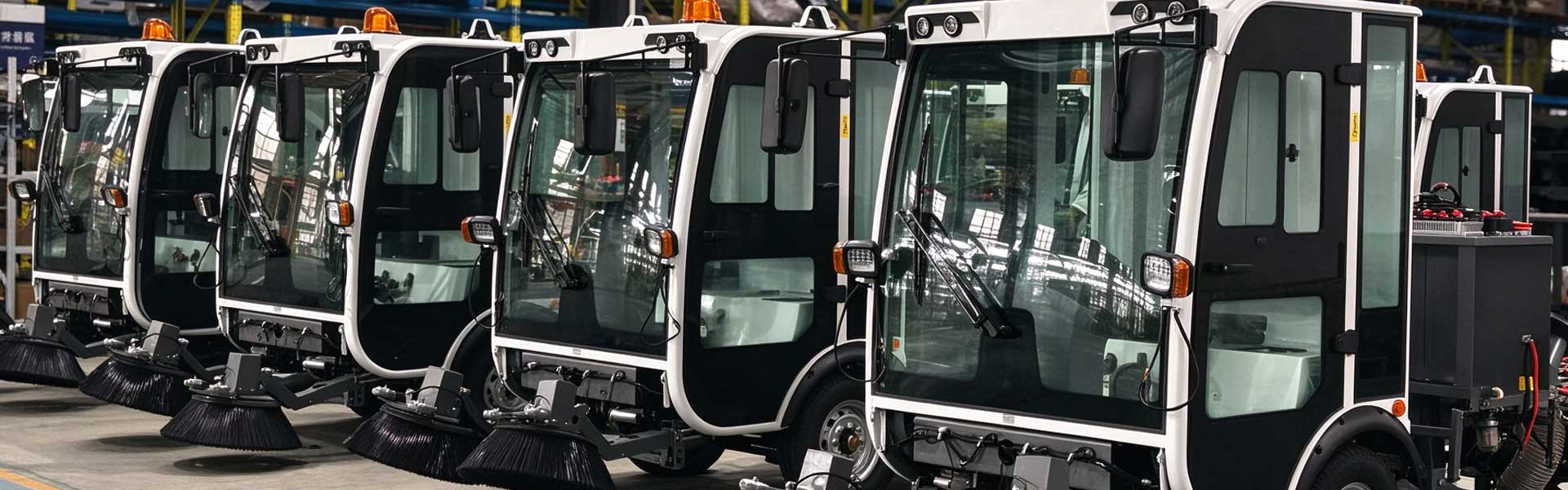
A busy logistics center can accumulate cardboard, plastic wrap, pallet debris, dust and dirt throughout the day. With forklifts, pallet trucks and delivery vehicles constantly moving through the facility, manual sweeping quickly becomes a time-consuming job.
For logistics operators, the goal is not simply to make the floor look clean. The real goal is to clean more square meters in less time without taking workers away from warehouse operations.
That is where a commercial floor sweeper becomes a practical investment.
Modern electric sweepers can cover large warehouse areas much faster than manual cleaning. Depending on machine size and working conditions, commercial sweepers can deliver productivity ranging from tens of thousands of square feet per hour to more than 100,000 square feet per hour on larger ride-on machines.
Why Logistics Centers Need Faster Floor Cleaning
Logistics centers are different from small commercial buildings.
A typical facility may include:
- Storage aisles
- Pallet staging areas
- Loading and unloading zones
- Forklift routes
- Packing areas
- Dispatch areas
- Large open concrete floors
These areas generate different types of dry debris every day.
For example, cardboard fragments and plastic packaging can accumulate around packing stations, while dust, pallet wood particles and dirt are commonly found around forklift routes.
Cleaning manually may work for a small warehouse, but the labor requirement increases rapidly as the floor area grows.
A commercial floor sweeper allows one operator to continuously collect loose debris into the machine's hopper while moving through the facility.
Example: Cleaning a 10,000 m² Logistics Center
Consider a logistics center with approximately 10,000 m² of floor space.
If workers manually sweep the facility, cleaning time can become a significant part of the daily maintenance schedule.
A commercial electric sweeper with a practical productivity of approximately 4,000–6,000 m²/h could theoretically cover the same floor area in roughly:
10,000 ÷ 5,000 = 2 hours
Actual cleaning time will vary because of racks, pallets, corners, traffic and turning.
This is why machine productivity should not be judged only by the maximum specification in a product catalog. The actual route and layout of the logistics center also matter. Industry guidance similarly recommends sizing a sweeper according to the cleaning route and operating conditions rather than floor area alone.
Choosing a Logistics Floor Sweeper by Facility Size
The right logistics floor sweeper depends heavily on the size and layout of the facility.
Small and Medium Logistics Areas
For facilities with relatively narrow aisles, frequent turns and limited open space, a walk-behind electric floor sweeper can be a practical choice.
It provides:
- Compact dimensions
- Easy maneuverability
- Lower storage requirements
- Good access around racks
- Simple operation
A walk-behind machine is particularly useful when the operator needs to move between pallets, racks and loading areas.
Large Logistics Centers
For larger warehouses and distribution centers, a ride-on commercial floor sweeper can significantly increase cleaning productivity.
The operator sits on the machine instead of walking behind it, while the wider sweeping path allows more floor area to be covered with each pass.
Industry comparisons commonly place ride-on sweepers at approximately 40,000–100,000+ ft²/h, compared with roughly 15,000–35,000 ft²/h for many walk-behind industrial sweepers.
For a large logistics center with long aisles and wide open staging areas, this difference can become important.
Example: A 20,000 m² Distribution Warehouse
Imagine a distribution center with 20,000 m² of concrete flooring.
The facility needs daily sweeping because forklifts and pallet handling generate dust and packaging debris.
If a suitable ride-on sweeper achieves a practical productivity of approximately 6,000 m²/h, the basic cleaning calculation is:
20,000 ÷ 6,000 ≈ 3.3 hours
A machine with higher productivity could reduce the required cleaning window further.
For logistics companies operating multiple shifts, saving even 30–60 minutes per cleaning cycle can make a meaningful difference because cleaning can be scheduled during a shorter low-traffic period.
Commercial Floor Sweeper for Forklift Routes and Loading Areas
Forklift traffic creates another challenge.
Dust and small debris tend to accumulate along frequently used routes, especially near:
- Loading docks
- Pallet storage
- Warehouse entrances
- Packaging stations
- Truck loading areas
A logistics floor sweeper can collect these loose materials before they are distributed throughout the warehouse.
For example, a distribution center may schedule sweeping:
Before the first shift → Main warehouse routes
Between shifts → Loading and staging areas
After the final shift → Full-floor cleaning
This creates a repeatable cleaning routine instead of waiting until debris becomes excessive.
Sweeper or Scrubber? Choose According to the Cleaning Job
A floor sweeper is designed primarily for dry debris collection.
It is ideal for:
- Dust
- Cardboard pieces
- Plastic packaging
- Small wood particles
- Sand
- Loose dirt
If the logistics center also has oil marks, tire marks, grease or other adhered contamination, a floor scrubber may be required for wet cleaning.
Many large logistics facilities use both types of machines: a sweeper for loose debris and a scrubber for deeper wet cleaning.
For example:
Daily: Electric floor sweeping
Weekly: Deeper floor scrubbing
This combination helps keep the warehouse consistently clean without using a scrubber for every daily cleaning task.
Why Electric Floor Sweepers Are Practical for Indoor Logistics Centers
For indoor logistics applications, electric sweepers provide several practical advantages.
They avoid the need for fuel storage and are suitable for enclosed warehouse environments where exhaust emissions are undesirable.
Battery-powered sweepers are also easier to integrate into routine warehouse cleaning schedules.
A typical operation can be:
- Charge the machine
- Clean the main aisles
- Sweep loading zones
- Empty the debris hopper
- Recharge after the cleaning cycle
The exact runtime depends on the battery configuration, machine size, floor condition and operating pattern.
How to Select the Right Commercial Floor Sweeper
Before ordering a machine, logistics operators should provide four basic pieces of information:
1. Total Cleaning Area
Tell the supplier whether the facility is:
- 2,000 m²
- 5,000 m²
- 10,000 m²
- 20,000 m²
- 50,000+ m²
2. Aisle Width
A large machine may have excellent productivity but still be unsuitable if it cannot comfortably operate between warehouse racks.
3. Daily Cleaning Time
If you only have one hour available for cleaning, machine productivity becomes much more important.
4. Type of Debris
Tell the supplier whether the machine needs to collect:
- Dust
- Cardboard
- Plastic
- Wood particles
- Sand
- General warehouse debris
These details help determine the appropriate machine size and configuration.
A Commercial Floor Sweeper Can Turn Cleaning Into a Scheduled Process
The biggest advantage of mechanized cleaning is not simply higher sweeping speed.
It is repeatability.
Instead of assigning workers to manually sweep whenever the floor becomes dirty, a logistics center can establish a fixed cleaning schedule using an electric commercial floor sweeper.
For example:
| Facility | Suggested Equipment | Typical Cleaning Focus |
|---|---|---|
| Small warehouse | Walk-behind sweeper | Aisles and work areas |
| Medium warehouse | Electric walk-behind | Aisles + loading zones |
| Large distribution center | Ride-on sweeper | Full warehouse |
| Large logistics hub | High-productivity ride-on | Warehouse + staging areas |
The actual machine should always be selected according to the facility layout and required cleaning window.
Get the Right Logistics Floor Sweeper for Your Facility
For logistics centers, the best machine is not necessarily the largest machine.
A compact walk-behind floor sweeper can be more practical for narrow aisles, while a ride-on sweeper can provide much higher productivity in large open warehouses.
If you are purchasing a commercial floor sweeper for a logistics center, provide your cleaning area, aisle width, cleaning frequency and debris type. These details allow the supplier to recommend a machine that matches your actual operation rather than simply selling you the largest model.
Looking for an electric logistics floor sweeper for your warehouse or distribution center? Contact us with your floor area and cleaning requirements to discuss the suitable model.