
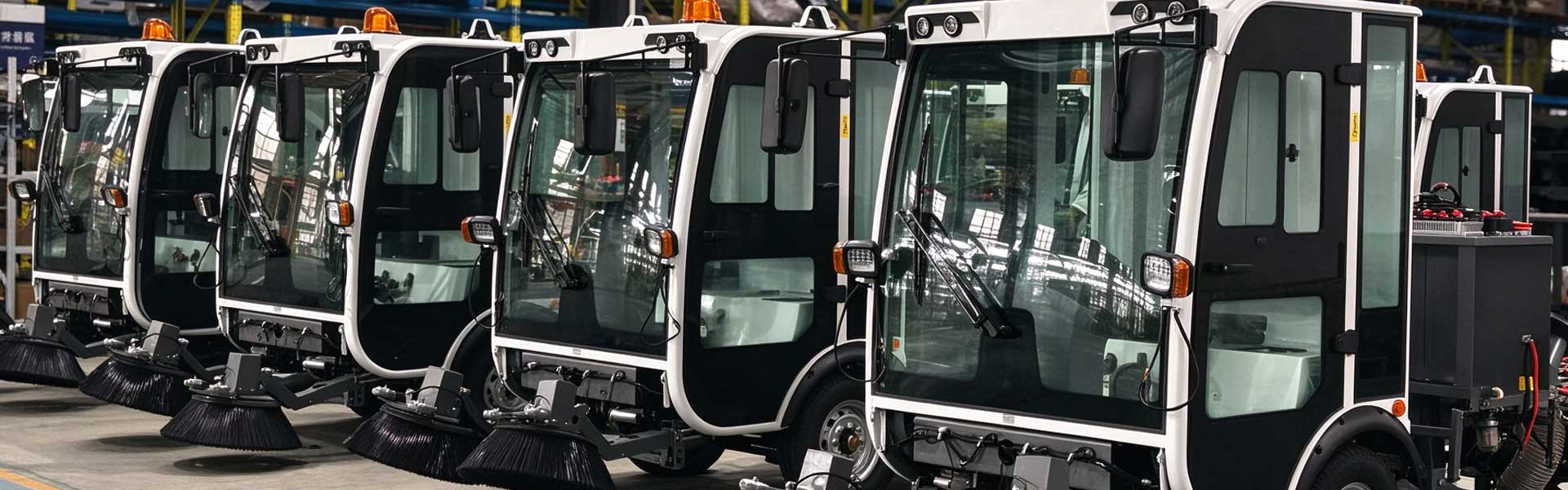
Factory floors deal with much more than ordinary dust.
Forklift traffic, tire marks, metal dust, production residue, oil stains, packaging debris, and daily foot traffic can quickly make a production floor difficult to maintain.
For a small workshop, manual cleaning may still be manageable. But when a factory has 5,000 m², 10,000 m² or more of hard floor, using mops and manual cleaning equipment can consume a significant amount of labor time.
This is where an industrial floor scrubber can become a practical part of the daily cleaning operation.
Instead of simply washing the floor, an electric floor scrubber combines scrubbing, water application and dirty-water recovery in one machine, making it suitable for regular cleaning of compatible concrete, epoxy, tile and other hard industrial floors.
A Factory Floor Needs More Than a Quick Sweep
Sweeping can remove loose dust and debris, but it does not solve every factory-floor problem.
Consider a manufacturing workshop with:
- Concrete or epoxy flooring
- Forklift traffic throughout the day
- 8–10 hours of daily production
- Oil and dust around equipment
- 8,000 m² of total floor area
After several days of production, the floor may develop visible tire marks, dust accumulation and other residues.
A broom or floor sweeper can remove loose material, but embedded dirt and surface residue may require scrubbing and water recovery.
An industrial floor scrubber is designed for this type of wet-cleaning operation.
How Much Floor Can an Industrial Floor Scrubber Clean?
Cleaning productivity varies significantly according to machine size, floor layout, operator behavior, obstacles and the actual cleaning process.
Commercial machines on the market range from compact walk-behind machines to large ride-on models. For example, one current 520 mm industrial walk-behind model lists a maximum productivity of about 2,600 m²/h, while a 660–710 mm ride-on model lists up to 4,300 m²/h. Larger ride-on machines can exceed 5,000 m²/h under specified conditions.
These are machine-rated figures rather than guaranteed real-world production rates. Actual output will be lower when the operator needs to stop, turn, refill, avoid equipment or clean around obstacles.
That distinction matters when selecting a factory floor scrubber.
Example: Cleaning an 8,000 m² Factory
Suppose a factory has approximately:
8,000 m² of cleanable floor
and uses a ride-on scrubber with a stated productivity of around:
4,300 m²/h
The theoretical coverage would be:
8,000 ÷ 4,300 ≈ 1.86 hours
In actual operation, additional time may be needed for turning, obstacles, water management and other interruptions.
So the factory should not assume that the entire 8,000 m² will always be completed in exactly 1.86 hours.
However, the calculation provides a useful starting point when comparing machine capacity with the cleaning requirement.
Walk-Behind or Ride-On Factory Floor Scrubber?
This is one of the most important decisions when purchasing a floor scrubber for factory applications.
Walk-Behind Floor Scrubber
A walk-behind model is useful when the factory has:
- Narrow aisles
- Multiple production rooms
- Smaller cleaning areas
- More obstacles
- Frequent changes between cleaning zones
For example, a 500–520 mm cleaning-width machine can be suitable for smaller production workshops and warehouse areas. One current model lists 520 mm cleaning width, 55 L clean-water capacity, 60 L recovery capacity and approximately 2–3 hours of working time.
This type of machine can provide a good balance between cleaning performance and maneuverability.
Ride-On Floor Scrubber
A ride-on model becomes more practical when the factory has:
- Large open floor areas
- Long forklift aisles
- Large production workshops
- Distribution areas
- Multiple hours of daily cleaning
For example, a current industrial ride-on model with an 810 mm cleaning path lists up to 5,300 m²/h productivity, a 115 L solution tank, a 125 L recovery tank, and approximately 4–5 hours maximum runtime.
For a large factory, the larger machine can reduce the amount of time required for routine floor cleaning.
Example: 10,000 m² Manufacturing Plant
Consider a factory with:
10,000 m² floor area
The floor consists mainly of concrete and epoxy surfaces.
The factory needs daily cleaning because forklifts and workers operate throughout the production area.
A compact walk-behind machine may require multiple cleaning cycles to cover the entire floor.
A larger ride-on factory floor scrubber can provide a wider cleaning path and larger water tanks.
For example, a commercial 26-inch ride-on scrubber currently listed for industrial facilities provides:
- 660 mm cleaning path
- 29-gallon solution tank
- 32-gallon recovery tank
- Up to 62,500 ft²/h stated productivity
- Approximately 6–8 hours runtime under the specified configuration
The larger tanks also reduce the number of interruptions caused by frequent filling and emptying.
For a factory manager, this is often more important than simply looking at the brush width.
Dirty Factory Floors Need Scrubbing, Not Just Sweeping
Consider a forklift route where tires repeatedly leave dark marks on an epoxy floor.
A sweeper can remove loose dust around the route, but the tire marks and surface residue may remain.
A floor scrubber uses a brush or pad together with water and cleaning solution to mechanically clean the floor, while the rear squeegee and vacuum system recover the dirty water.
This creates a different cleaning process:
Water + brush/pad → Scrubbing → Dirty-water recovery → Cleaner floor
For factories dealing with regular dust and surface residue, this can be more appropriate than relying only on dry sweeping.
Choosing the Right Machine for Oil and Industrial Dirt
Not every industrial floor has the same type of contamination.
Before purchasing a floor scrubber for factory applications, identify what is actually on the floor.
Light Dust and General Dirt
A standard disk-brush configuration may be sufficient for routine maintenance.
Forklift Tire Marks
A stronger scrubbing configuration and appropriate cleaning pad can be considered.
Heavy Industrial Residue
The customer may need greater brush pressure, an appropriate brush type, and a suitable cleaning chemical.
Oil and Grease
The cleaning process should be selected around the actual type and concentration of oil. A floor scrubber is not a substitute for choosing the correct detergent or degreasing process.
The machine configuration should therefore be discussed together with the floor material and contamination type.
Concrete and Epoxy Floors Are Common Factory Applications
Many industrial workshops use concrete or epoxy floors.
These surfaces are suitable applications for many commercial floor scrubbers when the correct brush or pad is selected.
For example, current industrial ride-on models are marketed for factory workshops, epoxy floors, concrete floors, logistics warehouses and distribution centers.
However, buyers should still tell the supplier what floor surface they have before ordering.
A machine designed for smooth epoxy flooring may require a different brush or pad configuration from one used on heavily textured concrete.
Water Tank Capacity Matters in Large Factories
Machine productivity isn't the only number that matters.
Imagine two machines with similar cleaning widths.
One has a relatively small solution tank, while another has a much larger tank.
If the smaller machine needs frequent refilling, the operator may spend more time away from actual cleaning.
For larger industrial areas, tank capacity becomes increasingly important.
For example, a current industrial ride-on scrubber lists 115 L clean water and 125 L recovery capacity, while a smaller walk-behind model may use around 50–60 L tanks.
For a factory cleaning thousands of square meters every day, these differences can affect the practical workflow.
Example: Selecting a Machine for a 5,000 m² Factory
Suppose a customer has:
- Floor area: 5,000 m²
- Floor type: epoxy
- Working environment: manufacturing workshop
- Cleaning frequency: daily
- Main contamination: dust + forklift tire marks
- Cleaning team: 1 operator
A compact or mid-size walk-behind machine may be considered if the factory has narrow aisles and many obstacles.
If the same 5,000 m² consists mainly of open floor space, a compact ride-on machine may also be considered.
The important point is that floor area alone does not determine the machine.
The layout matters just as much.
Don't Choose a Factory Floor Scrubber by Cleaning Width Alone
A wider brush is attractive because it can cover more floor in each pass.
But a machine that is too large for the factory can become difficult to maneuver.
Before buying, check:
- Factory floor area
- Narrowest aisle
- Door width
- Turning space
- Floor material
- Dirt type
- Cleaning frequency
- Required working hours
- Battery runtime
- Solution tank capacity
- Recovery tank capacity
For example, a 1,000 mm-class machine may be productive on an open production floor but inconvenient in a narrow workshop.
A 520–700 mm walk-behind floor scrubber may be more practical for areas with tighter access.
Electric Floor Scrubber for Daily Factory Cleaning
For indoor factories, electric battery-powered scrubbers can be particularly convenient because there are no engine exhaust gases during operation.
This makes battery-powered equipment suitable for many indoor production environments where regular wet cleaning is required.
Current commercial machines range from compact battery-powered walk-behind models to large battery-powered ride-on machines, with published working times ranging from roughly 2–3 hours for some compact machines to 4–8 hours for larger configurations, depending on battery system and model.
The correct runtime should always be evaluated against the factory's actual cleaning schedule.
A Practical Buying Checklist for Factory Managers
Before requesting a quotation for an industrial floor scrubber, prepare these details:
- Total cleaning area: e.g. 5,000 / 8,000 / 10,000 m²
- Floor material: concrete, epoxy, tile, etc.
- Main dirt: dust, tire marks, oil, production residue
- Narrowest aisle: important for machine width
- Door dimensions: important for access
- Daily cleaning time: e.g. 2–4 hours
- Cleaning frequency: daily, weekly, or multiple times per day
- Walk-behind or ride-on preference
- Required battery runtime
- Water tank requirements
For example:
Factory area: 8,000 m²
Floor: epoxy + concrete
Main dirt: dust and forklift tire marks
Narrowest aisle: 1.8 m
Cleaning: once per day
Required cleaning time: under 3 hours
Operator: 1 person
With this information, a supplier can recommend the appropriate machine size instead of simply quoting the largest available model.
Turn Factory Floor Cleaning Into a Faster Daily Process
A dirty production floor does not necessarily require more cleaning workers.
The right industrial floor scrubber can combine mechanical scrubbing, water application and dirty-water recovery into one powered cleaning operation.
For smaller workshops and tighter spaces, a walk-behind factory floor scrubber can provide the necessary maneuverability.
For large open production areas, a ride-on floor scrubber for factory applications can provide higher coverage, larger tanks and longer operating time.
The best machine configuration depends on the actual factory—not just the total floor area.
If you are looking for an industrial floor scrubber for your factory, send us your floor area, floor type, aisle width, dirt type and required cleaning time. We can help match the cleaning width, tank capacity and machine configuration to your production facility.