
Keeping a workshop floor clean is not simply about appearance. In a manufacturing environment, dust, metal chips, packaging waste, wood particles and other debris can accumulate quickly around production lines, storage areas and equipment.
For companies still relying on brooms or small manual cleaning equipment, cleaning can take significant labor time every day.
An electric floor sweeper provides a more practical way to handle routine manufacturing floor cleaning, especially when the facility has large concrete, epoxy or other hard-surface floors.
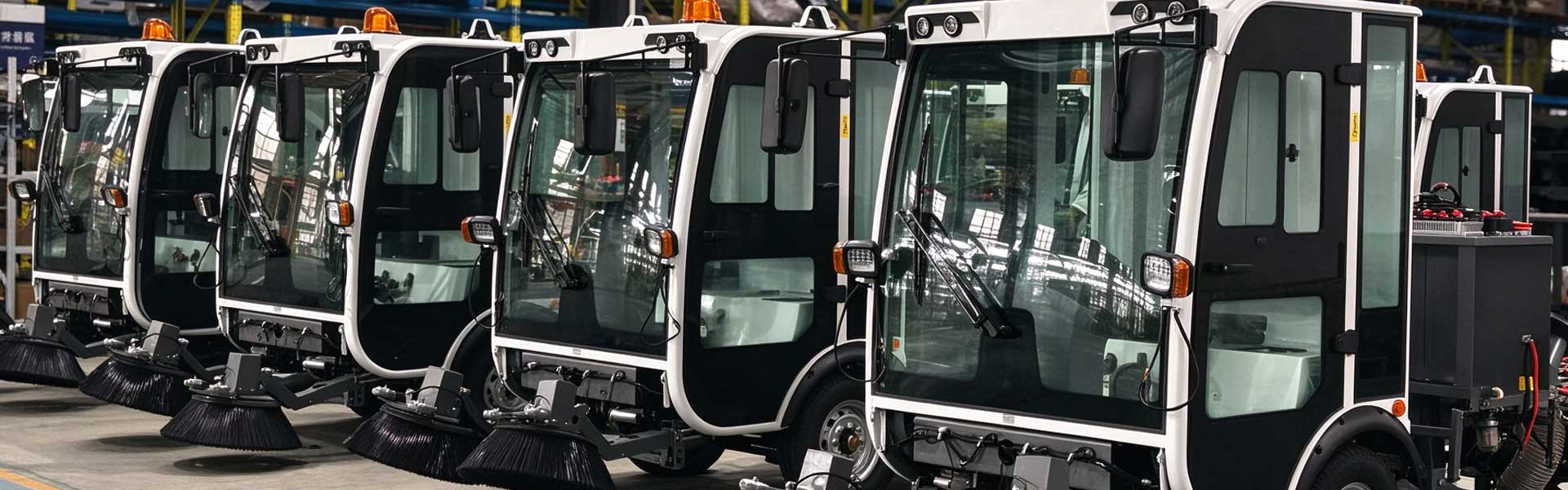
Instead of assigning several workers to push brooms across the workshop, a ride-on electric sweeper can combine powered driving, rotating brushes, dust collection and filtration in one machine.
For example, commercial ride-on sweepers currently available on the market can offer cleaning widths around 1,200–1,780 mm, theoretical cleaning capacities from approximately 6,000 to 12,000 m²/h, and working times of around 3–6 hours, depending on the model.
Why Workshops Are Moving From Manual Sweeping to Electric Cleaning
A manufacturing workshop may look relatively clean in the morning and become covered with debris after several hours of production.
Typical workshop debris includes:
- Metal chips
- Plastic particles
- Wood dust
- Packaging materials
- Paper scraps
- Sand and grit
- General production waste
- Fine dust
Manual sweeping can move this material from one location to another, while an electric sweeper is designed to collect debris into a hopper.
For larger facilities, productivity becomes especially important.
One current industrial ride-on sweeper example provides a 1,400 mm sweeping width, 9,000–15,000 m²/h working efficiency and 180 L dustbin capacity.
This type of configuration is designed for facilities where cleaning several thousand square meters manually would consume too much labor time.
A Workshop Cleaning Example
Consider a manufacturing workshop with:
Floor area: 12,000 m²
Cleaning requirement: Once every working day
Main surface: Concrete
Debris: Dust, packaging waste and production particles
Suppose the company wants to complete routine floor cleaning within approximately 2 hours.
The required average cleaning rate is:
12,000 m² ÷ 2 hours = 6,000 m²/h
A sweeper with a theoretical capacity of around 8,000 m²/h may therefore look suitable on paper.
For example, one ride-on electric sweeper lists:
- Sweeping width: 1,440 mm
- Cleaning capacity: 8,000 m²/h
- Working time: 4–6 hours
- Dust hopper: 160 L
The actual cleaning time will depend on production equipment, aisles, turning, obstacles and the amount of debris. But the calculation gives the buyer a practical starting point for equipment selection.
Don't Choose a Sweeper Only by Maximum Cleaning Capacity
When comparing an electric floor sweeper, buyers often focus on one number:
m²/h
This is important, but it is not the only specification that matters.
A workshop buyer should also compare:
Sweeping Width
A wider cleaning path allows the machine to cover more floor with each pass.
For example:
- 1,200 mm
- 1,400 mm
- 1,780 mm
- 2,000 mm
are different machine classes available on the market.
A 1,400 mm machine may be easier to maneuver in a manufacturing workshop with narrow aisles, while a 1,780 mm or 2,000 mm machine can make more sense for large open production floors.
A current electric ride-on model with a 1,780 mm sweeping width is specified at up to 12,000 m²/h, while a larger model with a sweeping width above 2,000 mm is listed at more than 15,000 m²/h.
The wider machine is not automatically better for every workshop. The floor layout needs to be considered together with cleaning capacity.
Hopper Capacity Reduces Cleaning Interruptions
The dust hopper is another important specification for manufacturing floor cleaning.
A small hopper may require frequent emptying when the workshop generates large amounts of debris.
For example, a machine with:
60 L hopper
may require more frequent dumping than one equipped with:
120–180 L hopper
when both machines are used in a high-debris environment.
Current commercial ride-on sweepers offer examples such as 120 L, 160 L and 180 L hopper capacities.
Example
A workshop produces a large amount of packaging waste every day.
If the cleaning operator has to stop repeatedly to empty a small hopper, the advertised cleaning capacity does not translate directly into practical productivity.
A larger hopper allows the operator to spend more time sweeping and less time stopping for waste disposal.
This is why buyers should compare:
Cleaning width + cleaning capacity + hopper volume
rather than looking at m²/h alone.
Electric Power Makes Sense for Indoor Workshops
For indoor manufacturing environments, an electric sweeper can provide a practical alternative to fuel-powered equipment.
The main advantages for indoor use include:
- No exhaust emissions from an internal combustion engine
- Lower noise compared with many fuel-powered machines
- Battery-powered operation
- Easy starting
- Suitable for concrete and epoxy floors
- Convenient operation in warehouses and workshops
Current electric ride-on sweeper models are marketed for warehouses, factories, workshops, distribution centers and other hard-surface commercial or industrial areas.
For example, one commercial electric ride-on model provides approximately 3–4 hours of working time, a 51-inch / approximately 1,295 mm working width, and a 24-gallon waste hopper.
Another model lists 4–6 hours of working time with a 1,440 mm sweeping width.
This makes battery runtime an important factor when planning a workshop cleaning schedule.
Battery Runtime: Can One Machine Clean the Whole Workshop?
Suppose a factory operates two cleaning periods:
Morning: 1.5 hours
Afternoon: 1.5 hours
Total daily cleaning time:
3 hours
A sweeper offering approximately 4–6 hours of working time could potentially cover the planned cleaning schedule without requiring an additional machine during the day, subject to actual operating conditions.
However, buyers should not assume that the published maximum runtime equals continuous full-load cleaning time.
Actual battery performance can vary with:
- Floor condition
- Driving speed
- Brush pressure
- Debris quantity
- Battery condition
- Operating habits
- Cleaning frequency
For a factory purchasing decision, it is better to compare the expected cleaning route with the machine's practical operating time.
Dust Control Is Important in Manufacturing
Sweeping a workshop is not simply about moving visible debris.
Fine dust can become airborne during aggressive sweeping, particularly on dry concrete floors.
For this reason, many electric sweepers combine sweeping with dust filtration and, on some models, water spraying for dust suppression.
For example, a current ride-on sweeper specification lists a 6 m² filter area together with a water spray system designed to reduce dust during operation.
Another industrial electric sweeper uses a filtration system and dust-control functions alongside its 1,400 mm sweeping width and large hopper.
When purchasing a workshop floor sweeper, ask the supplier about:
- Filter area
- Filter type
- Dust-shaking system
- Water spray
- Filter cleaning frequency
- Suitable dust types
This is particularly relevant for workshops generating fine dust rather than only large debris.
Where Can a Workshop Floor Sweeper Be Used?
An electric floor sweeper can be used in many manufacturing and industrial environments.
Machinery Workshops
Suitable for collecting:
- Metal chips
- Dust
- Packaging waste
- General debris
Furniture and Woodworking Workshops
Suitable for:
- Wood particles
- Sawdust
- Packaging materials
- Floor debris
The machine configuration should be matched to the specific dust and debris generated by the production process.
Automotive Workshops
Common cleaning requirements include:
- Dust
- Paper
- Small debris
- Workshop waste
The sweeper can help maintain open service areas and storage zones.
Metal Processing Plants
For metalworking environments, buyers should specify the type and size of metal debris generated.
A machine designed for general workshop dust may not be appropriate for unusually heavy, sharp or hot material. The supplier should confirm the intended application before purchase.
Warehouses Attached to Factories
Many manufacturing sites also have:
- Raw material storage
- Finished goods warehouses
- Loading areas
- Packaging areas
A ride-on sweeper can be used across these hard-surface areas when the floor layout permits.
Workshop Floor Sweeper vs. Manual Cleaning
Consider a factory with 10,000 m² of cleanable floor.
If manual cleaning requires several workers for several hours every day, the labor cost accumulates over the year.
A ride-on sweeper allows one trained operator to cover a much larger area.
Published commercial specifications illustrate the potential scale: one 1,250 mm ride-on model lists a theoretical capacity of 8,500 m²/h, while another 1,400 mm-class model lists 8,000 m²/h.
Actual productivity will always be lower than a theoretical maximum because real workshops contain:
- Machines
- Workers
- Pallets
- Columns
- Aisles
- Turning areas
- Loading zones
- Obstacles
For this reason, buyers should use published capacity to shortlist equipment and, where possible, conduct an actual cleaning test before making a large fleet purchase.
A Realistic Manufacturing Floor Cleaning Calculation
Imagine a factory with:
Cleanable floor: 20,000 m²
Required cleaning window: 3 hours
Required average productivity:
20,000 ÷ 3 = 6,667 m²/h
A sweeper with a published theoretical capacity of approximately 8,000 m²/h would provide a starting point for comparison.
A model with:
- 1,400+ mm sweeping width
- 8,000 m²/h theoretical capacity
- 160 L hopper
- 4–6 hours working time
could be evaluated for this application.
The final decision should then be confirmed through the actual workshop route, because theoretical capacity does not account for every turning, obstacle and stopping requirement.
Choose the Right Size for Your Workshop
For buyers comparing different electric sweepers, the following approach is practical:
| Workshop Requirement | Equipment Direction |
|---|---|
| Small workshop / narrow areas | Compact sweeper |
| 2,000–6,000 m² area | Compact or mid-size ride-on sweeper |
| 6,000–15,000 m² area | Mid-size electric ride-on sweeper |
| 15,000+ m² large open floor | Higher-capacity ride-on sweeper |
| Narrow aisles | Prioritize machine width and turning radius |
| Heavy daily debris | Larger hopper and suitable filtration |
| Long cleaning schedule | Longer battery runtime |
These are starting points rather than fixed rules. Current commercial models demonstrate substantial variation in sweeping width, hopper capacity and operating time.
Why an Electric Floor Sweeper Can Be a Better Workshop Investment
The value of a commercial sweeper is not simply that it moves faster.
It can help a factory:
- Reduce manual sweeping work
- Increase cleaning consistency
- Cover larger floor areas
- Reduce cleaning interruptions
- Collect dust and debris more systematically
- Improve the appearance of production areas
- Maintain warehouse and workshop floors with fewer operators
For a company operating a large workshop every day, these operational improvements can be more important than the machine's maximum advertised speed.
What Should You Tell a Sweeper Supplier?
If you are purchasing an electric floor sweeper for a factory, send the supplier these details:
1. Floor area
For example: 8,000 m² or 20,000 m².
2. Floor material
Concrete, epoxy, tile, asphalt, etc.
3. Main debris
Dust, metal chips, packaging waste, wood particles, sand, etc.
4. Cleaning frequency
Once per day, twice per day, weekly, etc.
5. Available cleaning time
For example: 2 hours per day.
6. Narrowest aisle or doorway
This determines whether the machine can operate comfortably.
7. Indoor or outdoor use
8. Required battery runtime
With this information, the supplier can match the machine's sweeping width, hopper capacity, battery configuration and filtration system to the actual workshop.
Upgrade Your Workshop Cleaning
For manufacturing companies, cleaning is part of daily facility management.
If your team is still spending hours pushing brooms through a large production area, an electric floor sweeper can turn routine manufacturing floor cleaning into a more efficient machine-based operation.
For smaller workshops, a compact machine may be sufficient. For larger factories, a ride-on workshop floor sweeper with a wider cleaning path, larger hopper and longer battery runtime can provide the productivity needed for daily cleaning.
The right machine should be selected according to:
Floor Area + Debris Type + Cleaning Time + Sweeping Width + Hopper Capacity + Battery Runtime
Looking for an Electric Floor Sweeper for Your Workshop?
Send us your workshop floor area, floor type, main debris, cleaning schedule and required working time.
We can help you select a suitable electric floor sweeper for your manufacturing facility and provide the machine specifications, configuration and quotation.