
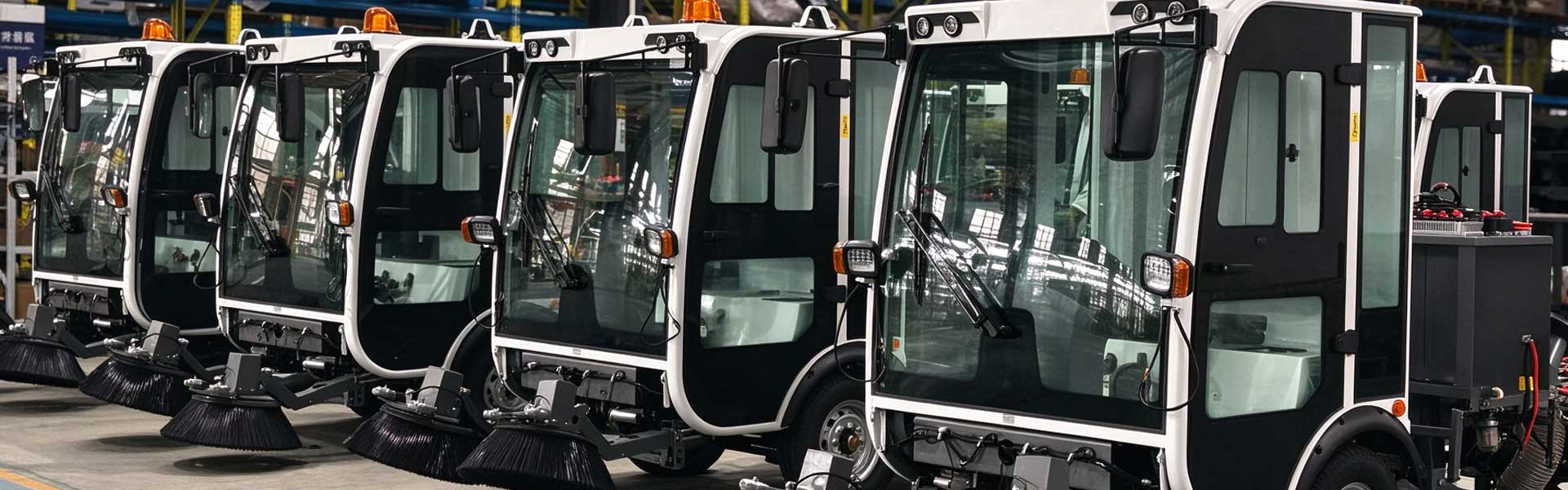
Factory floors can accumulate dust, metal chips, packaging materials, wood particles, sand, plastic pieces and other debris throughout the working day. In a busy production plant, manual sweeping may keep the floor temporarily clean, but it can also consume a significant amount of labor.
For factories with thousands or tens of thousands of square meters of floor space, a floor sweeper for factory cleaning can provide a faster and more consistent way to remove dry dust and debris.
The key is not simply choosing the biggest machine.
The right factory floor sweeper should match the factory's floor area, debris type, aisle width, cleaning frequency and required cleaning time.
Why Factories Need More Than a Traditional Broom
Consider a manufacturing plant with:
- 20,000 m² of floor area
- 2 production shifts per day
- Forklift traffic
- Metal and packaging debris
- Daily cleaning requirement
- A 2-hour cleaning window
If two workers use manual brooms for 2 hours every day:
2 workers × 2 hours = 4 labor-hours/day
At 26 working days per month:
4 × 26 = 104 labor-hours/month
A ride-on sweeper can change this workflow by allowing one operator to cover a much larger floor area while collecting debris directly into the machine's hopper.
Current industrial sweeper specifications illustrate the potential scale. For example, some ride-on industrial sweepers are rated for more than 50,000 sq. ft./h, while larger industrial models can have published productivity figures exceeding 190,000 sq. ft./h under specified conditions. These figures are manufacturer-rated or theoretical capacities, so actual factory productivity will depend on obstacles, turning, debris load and operator conditions.
1. Calculate the Factory Cleaning Requirement First
Before requesting a quotation, calculate the required cleaning productivity.
For example:
Factory floor: 30,000 m²
Available cleaning time: 3 hours
Required average productivity:
30,000 ÷ 3 = 10,000 m²/h
This gives the buyer a starting point for machine selection.
A machine rated at 12,000 m²/h may appear sufficient, but the published figure does not necessarily represent the actual production-floor result.
Factory cleaning includes:
- Turning around machines
- Avoiding workers
- Moving around pallets
- Entering and leaving aisles
- Cleaning corners
- Crossing production areas
- Emptying the hopper
- Dealing with heavier debris
For this reason, buyers should leave a reasonable productivity margin instead of selecting a machine whose maximum rating barely matches the calculated requirement.
2. A Factory Floor Sweeper Must Handle Different Types of Debris
Factory dust is rarely just ordinary household dust.
Depending on the production process, the floor may contain:
- Fine dust
- Metal chips
- Plastic scraps
- Wood particles
- Paper
- Packaging debris
- Sand
- Small stones
- Pallet fragments
- Production residue
Different debris requires different sweeping performance.
A suitable floor sweeper for factory applications should therefore be evaluated according to:
Main brush + side brush + suction/dust control + filter + hopper capacity
For example, a manufacturing plant producing metal components may have small metal chips and grinding residue, while a packaging factory may generate more cardboard, paper and plastic debris.
The machine configuration should reflect the actual debris rather than simply the size of the facility.
3. Dust Control Is Just as Important as Debris Collection
A machine can pick up visible debris while still allowing fine dust to return to the air.
This is why filtration becomes important in industrial floor cleaning.
A current manufacturing-facility sweeper guide specifically identifies filtration and dust control as major considerations where fine dust or visible airborne dust is present.
For a factory with significant fine dust, ask the supplier about:
- Filter type
- Filter area
- Automatic filter cleaning
- Vacuum airflow
- Dust suppression
- Optional high-efficiency filtration
- Filter replacement cost
For example, one industrial ride-on sweeper uses a multi-stage filtration system and offers optional HEPA filtration for certain applications.
The goal is not simply to make the floor look clean.
The goal is to collect dust instead of redistributing it around the production area.
4. Cleaning Width Directly Affects Productivity
Cleaning width is one of the most important specifications when buying a factory floor sweeper.
A wider sweeping path means fewer passes across a large open floor.
For example:
Machine A
Sweeping width: 800 mm
Machine B
Sweeping width: 1,400 mm
If both machines operate at similar speeds and conditions, the second machine can cover substantially more floor in each pass.
One current ride-on sweeper, for example, uses a 1,400 mm sweeping width and is rated at up to 8,400 m²/h, with a 150 L hopper.
However, wider is not automatically better.
If the factory has narrow aisles, dense machinery or restricted doorways, an oversized machine may spend more time maneuvering.
Therefore:
Open factory floor → prioritize sweeping width
Narrow production aisles → prioritize maneuverability
5. Example: 15,000 m² Manufacturing Plant
Consider a factory with:
- Floor area: 15,000 m²
- Cleaning frequency: once per day
- Required cleaning time: 2 hours
- Main debris: dust, packaging pieces and small production waste
Required average productivity:
15,000 ÷ 2 = 7,500 m²/h
A ride-on sweeper rated around 8,000–10,000 m²/h may appear suitable, but the buyer should still check whether that number is theoretical or based on actual operating conditions.
If the factory contains many obstacles, the practical rate will be lower.
If most of the floor consists of large open production areas, the machine can spend more time moving in straight lines and may achieve much better route efficiency.
This is why a machine demonstration on the actual floor can be valuable before a large equipment purchase.
6. Hopper Capacity Determines How Often Operators Stop
Another important specification is the debris hopper.
Imagine a factory generates a large amount of packaging waste every day.
If the hopper is too small, the operator may need to stop repeatedly to empty it.
For large industrial applications, hopper capacities can range from relatively compact bins to much larger systems. For example, the Reinmatic KRM 90 lists a 90 L waste hopper, while larger industrial sweepers can use substantially larger hoppers.
When comparing machines, ask:
- How many liters is the hopper?
- What type of debris can it handle?
- How easy is it to empty?
- Can the hopper be removed or lifted?
- Does the machine offer high dumping?
- How frequently will the hopper need to be emptied?
A larger hopper can be particularly useful when the factory generates substantial dry debris during production.
7. Battery Operation Makes Electric Sweepers Practical Indoors
For factories that require indoor cleaning, electric sweepers can provide several practical advantages.
There is no fuel exhaust during operation, and battery-powered machines can operate in enclosed production areas without the exhaust associated with combustion engines.
For example, current ride-on industrial sweeper ranges include battery-powered configurations designed for warehouses, logistics facilities and manufacturing environments.
When selecting an electric machine, however, battery capacity should be matched to the cleaning schedule.
Suppose:
- Required cleaning time: 3 hours
- Machine working time: 4–5 hours
This provides a reasonable operating margin for a normal cleaning cycle.
If the factory requires 6–8 hours of continuous sweeping, battery capacity and charging strategy become much more important.
8. Ride-On or Walk-Behind Floor Sweeper?
For smaller production areas, a walk-behind machine may be sufficient.
For larger factories, a ride-on machine can reduce operator walking and increase the amount of floor covered during each shift.
As a general market reference, current commercial guidance places walk-behind sweepers in the tens of thousands of square feet per hour, while ride-on machines can reach substantially higher published productivity levels.
A simple comparison:
| Requirement | Walk-Behind Sweeper | Ride-On Sweeper |
|---|---|---|
| Small factory | Suitable | May be oversized |
| Medium factory | Suitable | Suitable |
| Large factory | More labor-intensive | More suitable |
| Narrow aisles | Excellent | Depends on model |
| Large open floor | More passes | Higher productivity |
| Operator fatigue | Higher | Lower |
| Long cleaning routes | Less convenient | More convenient |
| Large debris hopper | Model dependent | Generally easier to specify |
The right choice depends on the actual factory rather than simply floor area.
9. Example: Reducing Manual Cleaning Labor
Consider a factory currently using:
3 workers × 2.5 hours/day
Total:
7.5 labor-hours/day
At 26 working days:
7.5 × 26 = 195 labor-hours/month
Now suppose a ride-on sweeper allows the same facility to use:
1 operator × 2 hours/day
Total:
2 × 26 = 52 labor-hours/month
The theoretical difference is:
195 − 52 = 143 labor-hours/month
This is not a guaranteed labor saving because actual productivity depends on the factory layout, debris conditions and cleaning procedure.
However, it demonstrates why an industrial sweeper should be evaluated as a labor-productivity investment, not only as a cleaning machine.
10. Industrial Floor Cleaning Should Follow the Production Schedule
A factory sweeper does not necessarily need to operate continuously.
Many plants can schedule sweeping:
- Before the production shift
- During scheduled breaks
- Between production runs
- After loading operations
- At the end of the shift
- Before floor scrubbing
This is especially useful when the factory uses both a sweeper and a floor scrubber.
The sweeper removes:
- Dust
- Loose debris
- Metal chips
- Packaging waste
- Dry particles
The scrubber can then handle:
- Oil or dirt residue
- Tire marks
- Stains
- General floor washing
Using each machine for the job it is designed for can create a more efficient industrial floor cleaning process.
11. Factory Example: Metal Processing Plant
Consider a metal-processing factory with:
Floor area: 25,000 m²
Cleaning window: 3 hours
Floor: Concrete
Debris: Metal chips + grinding dust + packaging material
Aisle width: 2.5 m
Cleaning frequency: Daily
Required average productivity:
25,000 ÷ 3 = 8,333 m²/h
The buyer could look for an electric ride-on sweeper with:
- Approximately 1.2–1.5 m sweeping width
- Strong main brush
- Side brush for edges
- Effective dust filtration
- Large hopper
- Battery suitable for the full cleaning cycle
- Turning radius suitable for production aisles
The important point is that the buyer does not necessarily need the machine with the highest advertised productivity.
The better specification is the machine that can maintain efficient sweeping inside the actual factory route.
12. What Should You Ask Before Buying a Floor Sweeper for Factory Use?
Before requesting a quotation, prepare these details:
Floor Information
- Total floor area
- Concrete, epoxy or other surface
- Indoor or outdoor
- Smooth or uneven floor
Debris Information
- Fine dust
- Metal chips
- Wood particles
- Plastic
- Packaging waste
- Sand or stones
Layout Information
- Narrowest aisle
- Doorway width
- Turning space
- Racking
- Production equipment
- Loading areas
Cleaning Requirement
- Daily or weekly cleaning
- Required cleaning time
- Number of operators
- Single or multiple shifts
Machine Requirement
- Walk-behind or ride-on
- Electric or other power system
- Sweeping width
- Hopper capacity
- Battery working time
- Dust filtration system
This information allows a supplier to recommend a machine based on the actual application rather than sending a generic factory sweeper quotation.
13. A Simple Purchasing Example
A factory manager sends the following RFQ:
Application: Metal manufacturing factory
Floor area: 30,000 m²
Floor: Concrete
Cleaning frequency: Daily
Cleaning time: 3 hours
Main debris: Metal dust, small chips and packaging debris
Aisle width: 2.8 m
Operation: Indoor
Power: Electric
Destination: South America
The supplier can then calculate:
30,000 ÷ 3 = 10,000 m²/h required average productivity
From there, the supplier can recommend a suitable sweeping width, battery capacity, hopper size and filtration configuration.
This is a much better way to purchase an industrial floor cleaning machine than comparing prices without providing application information.
Conclusion: Match the Factory Sweeper to the Actual Job
Removing factory dust and debris efficiently is mainly a question of coverage, dust control, debris capacity and route efficiency.
For a small workshop, a compact walk-behind sweeper may be enough.
For a medium manufacturing plant, a larger electric sweeper can reduce manual sweeping time.
For a large factory with tens of thousands of square meters of floor, a ride-on factory floor sweeper can provide much higher coverage while reducing operator walking and repetitive manual sweeping.
The most important numbers to calculate before purchasing are:
Floor area ÷ available cleaning time = required productivity
Then check:
Sweeping width + hopper capacity + filtration + battery runtime + aisle width
For example, a 30,000 m² factory with a 3-hour cleaning window requires approximately 10,000 m²/h of average productivity. The final machine should provide enough practical capacity to complete the route while handling the factory's actual dust and debris.
If you are looking for a floor sweeper for factory applications, provide the floor area, debris type, aisle width, cleaning time and destination. These five details are enough to start matching the machine configuration to your production facility.