
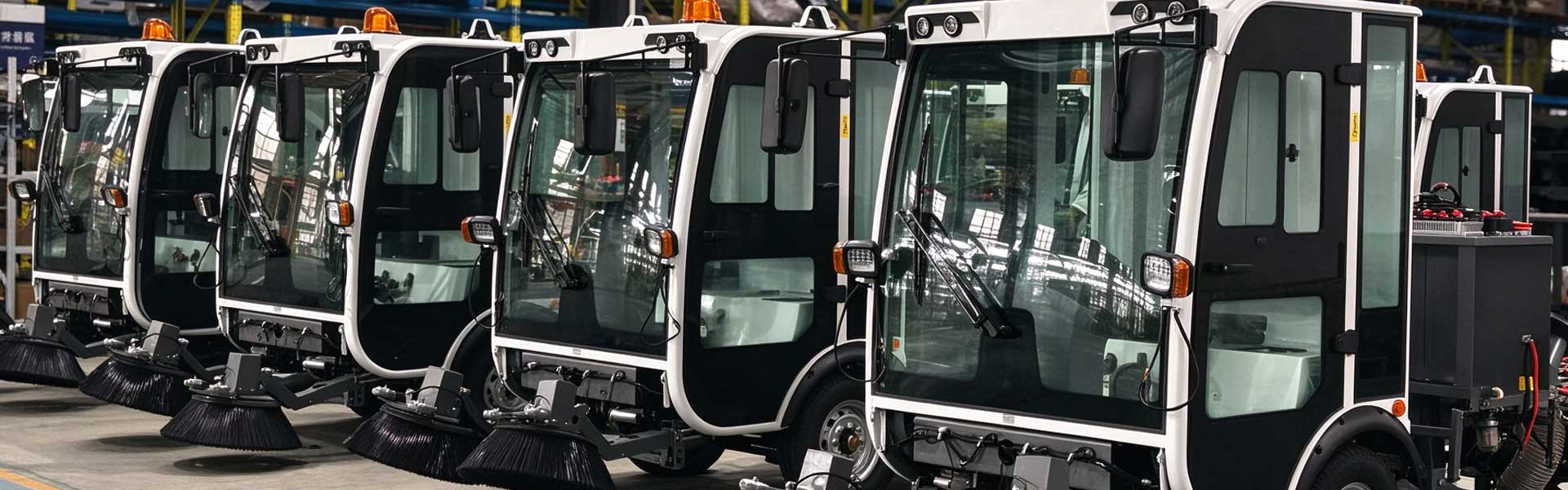
Factories, logistics centers, construction material warehouses and large industrial facilities often generate significant amounts of loose debris during daily operations. Dust, packaging waste, leaves and other suitable floor debris need to be collected regularly to maintain organized working areas.
For these environments, an industrial floor sweeper with a large debris hopper can be a practical equipment investment. A larger collection capacity may reduce the need for frequent emptying, particularly when the machine operates over extensive floor areas.
Businesses looking for an industrial floor sweeper with large hopper capacity should compare hopper volume, debris compatibility, cleaning width and operating conditions before making a purchase.
The best machine is not necessarily the one with the largest hopper. It is the one that can handle the facility's actual cleaning workload efficiently.
When Does a Large Debris Hopper Make a Difference?
The hopper is an important consideration for facilities that collect substantial amounts of loose material.
In a large warehouse, cleaning may involve long sweeping routes across multiple storage areas. In a factory, the amount and type of debris may change depending on production activities.
If the collection container is too small, operators may need to stop frequently to empty it.
A larger hopper can be useful in several situations:
Large distribution warehouses: Packaging scraps, dust and general loose waste may accumulate across extensive floor areas.
Manufacturing plants: Suitable production debris may require regular collection around storage and working zones.
Building material warehouses: Loose dust and appropriate dry debris may be generated during handling and storage.
Parking and logistics facilities: Leaves, sand and everyday outdoor debris may require regular collection.
Industrial service yards: Larger working areas may benefit from equipment with greater debris collection capacity.
However, the machine's actual ability to collect particular materials must be confirmed. Wet waste, heavy materials and hazardous industrial substances may require different equipment.
How to Select an Industrial Sweeper with the Right Hopper Capacity
1. Estimate the Amount of Daily Debris
Before selecting a machine, buyers should evaluate how much waste accumulates during a normal working shift.
A facility producing mostly light dust may not need the same hopper configuration as a warehouse handling large quantities of packaging scraps.
The frequency of cleaning also matters.
If a facility is cleaned several times per day, a smaller hopper may be sufficient. If cleaning takes place less frequently across a large area, greater collection capacity may be useful.
2. Check the Relationship Between Hopper Size and Machine Dimensions
A large hopper is only one part of the machine.
Buyers should also consider the overall dimensions, weight, turning radius and operating space.
A larger sweeper may be suitable for open industrial yards but inconvenient in narrow warehouse aisles.
The machine must be able to access the required cleaning areas and operate safely around warehouse equipment and personnel.
3. Compare Cleaning Width
Cleaning width influences how much floor area can be covered during each pass.
Industrial models may offer different working widths depending on their configuration.
A wider cleaning path may be beneficial in large open areas, while a smaller machine may be more practical in facilities with limited access.
Buyers should balance cleaning width with maneuverability and the actual floor layout.
4. Consider the Sweeping System
The main and side brushes play an important role in collecting debris.
The buyer should confirm the brush arrangement, replacement availability and suitability for the intended floor surface.
For example, a warehouse with ordinary concrete flooring may have different brush requirements from a facility with specialized floor coatings.
The supplier should provide product-specific information rather than making general claims about performance on every surface.
5. Review Battery and Maintenance Requirements
For battery-powered equipment, compare the battery configuration, charging requirements and expected operating duration.
Maintenance should also be considered.
Check the availability of replacement brushes, filters and other consumable parts, as well as the accessibility of routine maintenance points.
For businesses operating multiple machines, standardizing equipment models may simplify maintenance planning and operator training.
Why Industrial Buyers Should Evaluate Total Operating Needs
A low initial purchase price does not always mean the machine is the most suitable commercial choice.
If the hopper is too small, operators may spend more time emptying the machine. If the cleaning width is unsuitable, the machine may not work efficiently in the facility's layout.
Likewise, selecting a machine that is unnecessarily large can create additional costs without improving the cleaning process.
A practical procurement decision should consider the total working environment.
For factory owners, the objective is to maintain cleaner production and storage areas. For cleaning contractors, it is to deliver consistent service across customer facilities. For distributors, it is to offer products that match different industrial customer requirements.
A suitable heavy duty warehouse floor sweeper can support these goals when its configuration is selected correctly.
Working with an Industrial Floor Sweeper Supplier
When sourcing equipment internationally, buyers should request detailed product information before confirming an order.
An experienced industrial floor sweeper supplier should be able to assist with:
-
Comparing available hopper capacities.
-
Confirming cleaning width and machine dimensions.
-
Reviewing suitable floor and debris applications.
-
Checking battery and operating configurations.
-
Providing technical specifications.
-
Preparing quotations for single or bulk purchases.
-
Coordinating export documentation and shipping.
-
Providing after-sales communication and support.
As a trading and export company, we can coordinate equipment sourcing and purchasing arrangements according to the buyer's application and destination market.
For distributors and importers, it is also useful to compare several machine sizes so that different customer requirements can be covered.
Request a Quotation for an Industrial Floor Sweeper
If you are planning to purchase an industrial sweeper for a factory, warehouse, logistics center or cleaning business, share your actual cleaning conditions.
Please provide the facility area, debris type, preferred hopper capacity, required cleaning width, operating hours, order quantity and destination port.
Contact our team to compare suitable industrial floor sweeper models and receive a quotation based on your operational and purchasing requirements.