
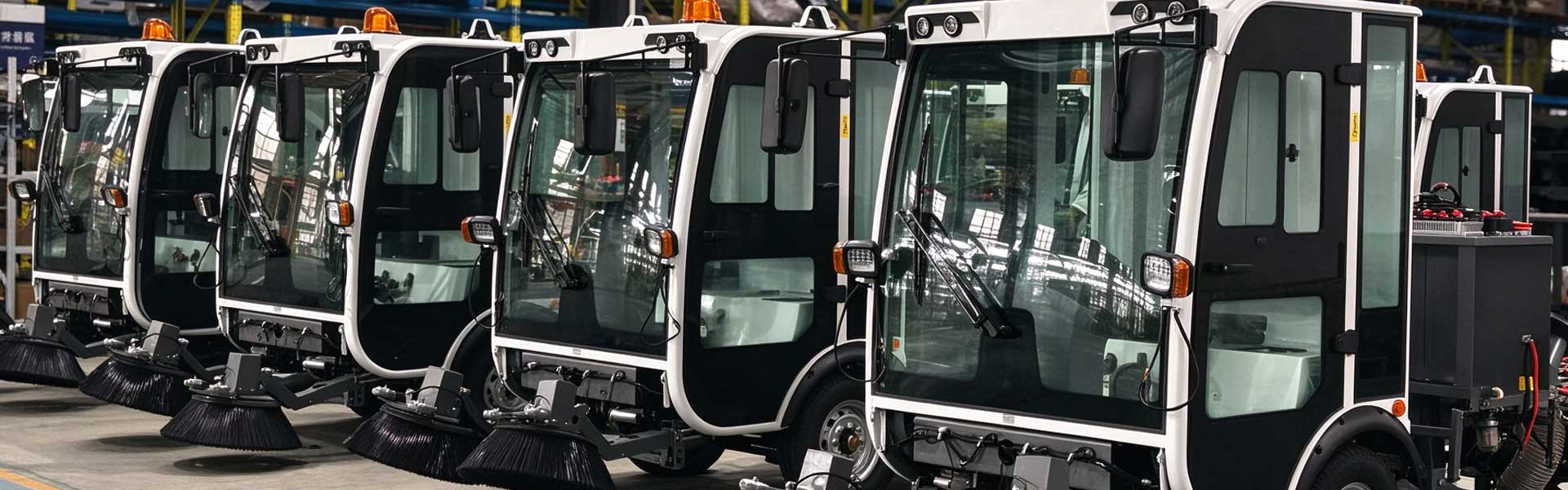
Choose Floor Sweepers According to Contract Requirements
Facility management contractors need floor cleaning equipment that can support different customer sites, cleaning schedules and operating conditions. A contractor responsible for warehouses, factories, shopping centers, parking facilities or commercial buildings may manage several cleaning projects simultaneously. Each site can have different floor areas, debris conditions and access limitations. Selecting the right floor sweeper is therefore an operational decision that affects equipment allocation, labor planning and service delivery. Contractors, cleaning companies, equipment distributors and project procurement teams should evaluate machines according to the actual requirements of their contracts rather than purchasing equipment based on working width alone.
Why Facility Management Contractors Need the Right Equipment Mix
A facility management company may be responsible for cleaning multiple properties under different service agreements.
One contract may involve a large warehouse with extensive concrete flooring. Another may cover a shopping center with a combination of public areas, corridors and service zones.
A third may involve an industrial plant where dust and production debris accumulate throughout the working day.
Using the same machine across every site may not be practical.
Contractors need to consider whether the equipment can operate within each facility's layout, complete the cleaning work within the available schedule and handle the type of debris generated.
Typical applications include:
-
Industrial factory floor maintenance.
-
Warehouse and logistics facility cleaning.
-
Shopping center service areas.
-
Commercial building maintenance.
-
Parking lot and outdoor paved area cleaning.
-
Distribution center cleaning.
-
Large institutional facilities.
A suitable equipment selection process begins with understanding the contract rather than the machine catalog.
Match the Sweeper to the Size of Each Cleaning Project
The size of the cleaning area is an important starting point.
Large open areas may benefit from ride-on sweepers with wider cleaning paths and larger waste collection capacities.
Smaller areas or locations with frequent obstacles may be better served by compact machines.
For contractors managing multiple sites, it is useful to classify projects by area and cleaning conditions.
Large Warehouses and Distribution Centers
These facilities often have extensive open floor areas and long operating aisles.
A ride-on floor sweeper may be appropriate when the main objective is covering large areas within scheduled cleaning periods.
Contractors should compare working width, cleaning efficiency, waste container capacity and battery operating duration.
Manufacturing Facilities
Factories may generate dust, packaging waste, production debris and other materials.
Equipment selection should consider the specific debris type and whether the machine's collection system is suitable for the environment.
For heavier industrial contamination, buyers should pay particular attention to the machine's intended application and operating limitations.
Shopping Centers and Commercial Buildings
Commercial facilities often have more obstacles, pedestrian activity and different cleaning zones.
Compact dimensions, maneuverability and the ability to access service corridors may be more important than maximum cleaning width.
Contractors should also consider operating schedules to minimize disruption to customers and facility users.
Parking Areas and Outdoor Facilities
Outdoor projects may involve sand, leaves, small rubbish and other loose debris.
Buyers should consider the surface material, site layout, debris volume and weather exposure when selecting a machine.
A model suitable for indoor warehouse floors may not necessarily be the best option for every outdoor cleaning project.
Select Equipment Based on Daily Service Schedules
Facility management contractors generally work according to service agreements and defined cleaning schedules.
The equipment must be able to complete the required cleaning tasks within the available working time.
For each contract, contractors should estimate:
-
Total area requiring daily cleaning.
-
Number of cleaning cycles.
-
Available cleaning hours.
-
Number of operators.
-
Travel distance between cleaning zones.
-
Charging and maintenance periods.
The machine's theoretical cleaning efficiency is a useful comparison figure, but it should not be treated as guaranteed real-world output.
Actual productivity depends on obstacles, turning, floor conditions, operator experience and the amount of debris collected.
Contractors should therefore leave sufficient operating time for practical site conditions.
Should Contractors Purchase Different Sweeper Models?
Companies serving different types of facilities may benefit from maintaining a mixed equipment fleet.
For example, a contractor could use larger ride-on machines for warehouses and factory floors while allocating compact models to smaller commercial properties.
The equipment portfolio should be developed according to the company's current contracts and expected project pipeline.
A practical fleet structure may include:
| Project category | Suitable equipment consideration |
|---|---|
| Large warehouses | Wider ride-on sweepers |
| Industrial facilities | Models suitable for specific debris |
| Shopping centers | Compact and maneuverable machines |
| Parking facilities | Sweepers suited to outdoor surfaces |
| Smaller service areas | Walk-behind machines |
Contractors should also evaluate whether different sites can share equipment.
If machines need to be transported frequently, their dimensions, weight and loading arrangements become important purchasing factors.
Control Equipment Costs Through Better Purchasing Decisions
Facility management companies need to manage equipment costs while maintaining service quality.
Purchasing decisions should consider the full operating requirements rather than focusing exclusively on the initial price.
Important commercial considerations include machine durability, maintenance arrangements, battery replacement planning, spare parts availability and operator training requirements.
Contractors should also evaluate whether the equipment can be used across more than one contract.
A machine with a suitable combination of working width and maneuverability may be more useful than a larger model that can only operate in a limited number of facilities.
For businesses expanding into new service markets, purchasing a small number of suitable machines first may help evaluate operational requirements before expanding the fleet.
Any investment plan should be based on actual contract demand and expected equipment utilization.
Standardize Equipment Information Across Multiple Sites
When contractors operate several properties, consistent equipment information makes fleet management easier.
The purchasing department should maintain records of machine models, serial numbers, battery specifications, maintenance requirements and spare parts.
Operators should receive instructions appropriate to the specific machine and site.
Daily inspection procedures should cover key items such as brushes, waste containers, filters, battery condition and other manufacturer-recommended checks.
If a contractor purchases several machines, it may also be useful to standardize certain specifications where site conditions allow.
This can simplify operator familiarization and equipment support without forcing every location to use an unsuitable machine.
Source Commercial Floor Sweepers for Contract Operations
Facility management contractors purchasing internationally need a supplier that can understand project requirements and coordinate different equipment models.
Voril operates as a trading and export company supplying commercial and industrial cleaning equipment to overseas business customers.
For floor sweeper purchasing projects, Voril can assist with:
-
Comparing ride-on and walk-behind models.
-
Selecting working widths and waste collection capacities.
-
Evaluating machine options for different facility types.
-
Discussing battery and configuration requirements.
-
Preparing quotations for multiple units.
-
Providing product specifications and technical documentation.
-
Coordinating export documentation and international shipping.
-
Providing after-sales communication and support.
Contractors can also discuss purchasing different machine models for separate project categories.
The final configuration should be confirmed according to the site conditions and available product specifications.
Request a Floor Sweeper Fleet Quotation for Your Contracts
If your company manages industrial, commercial or institutional cleaning projects, prepare a list of the facilities where the machines will operate.
Include the floor area, surface material, debris type, cleaning frequency, daily working hours, preferred machine type and number of units required.
If you manage several contracts, provide the requirements for each site separately.
Contact Voril to compare suitable floor sweeper models and obtain a quotation for your facility management equipment purchasing plan.