
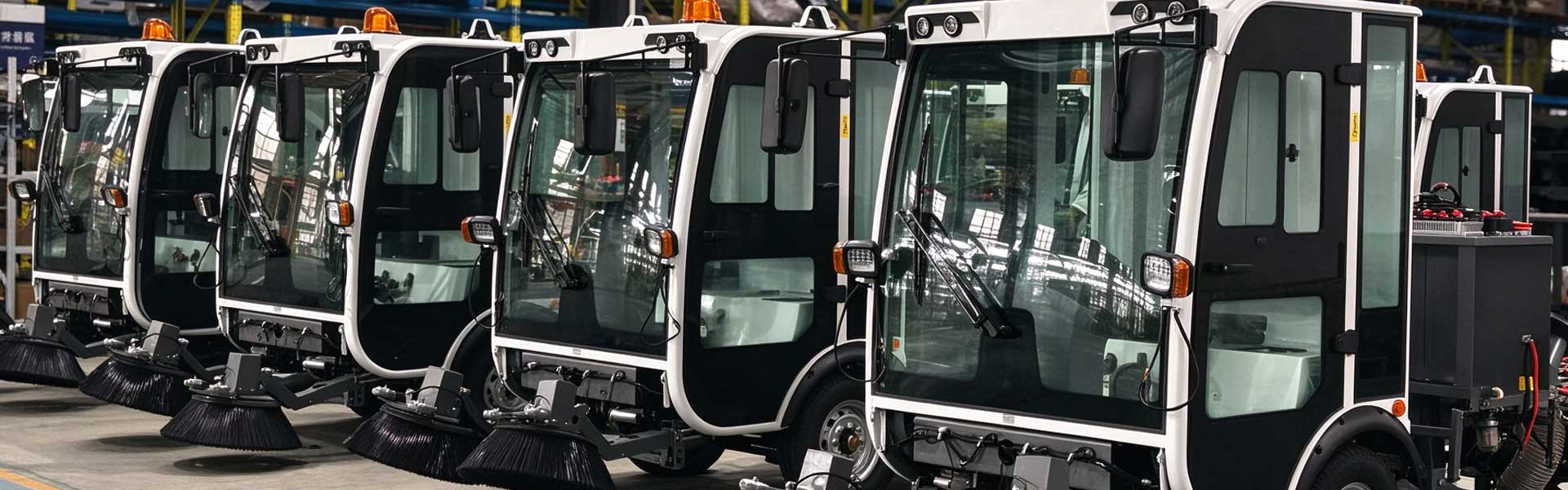
Buying an electric floor sweeper should start with one simple question:
How much floor do you need to clean every day?
A small warehouse, a 3,000 m² factory and a 15,000 m² logistics center may all need a sweeper, but they do not need the same machine.
Choosing a machine that is too small can increase cleaning time and labor requirements. Choosing one that is unnecessarily large can increase the purchase cost and make the machine harder to maneuver.
The better purchasing approach is to match the electric floor sweeper machine to the actual daily workload.
1. Calculate Your Daily Cleaning Area
Start with the total area that needs sweeping.
For example:
Facility A: 1,500 m²
Facility B: 5,000 m²
Facility C: 12,000 m²
Facility D: 20,000 m²
These facilities should not automatically purchase the same machine.
A practical commercial cleaning classification is:
| Daily Cleaning Area | Equipment Direction |
|---|---|
| Under 1,000 m² | Compact walk-behind |
| 1,000–5,000 m² | Walk-behind / compact ride-on |
| 5,000–10,000 m² | Ride-on electric sweeper |
| 10,000+ m² | Higher-productivity ride-on machine |
Industry product ranges similarly distinguish compact walk-behind machines from larger ride-on machines designed for medium and large areas.
These ranges are only a starting point. The actual selection should consider cleaning frequency, obstacles, debris volume and available cleaning time.
2. Don't Confuse Floor Area With Daily Workload
A 10,000 m² building does not necessarily require a 10,000 m²/hour machine.
For example:
Facility size: 10,000 m²
Area actually swept each day: 6,000 m²
Required cleaning time: 2 hours
The required average productivity is:
6,000 ÷ 2 = 3,000 m²/hour
But if the same facility needs all 10,000 m² cleaned within two hours:
10,000 ÷ 2 = 5,000 m²/hour
The machine requirement has now changed significantly.
This is why buyers should tell suppliers how much area must be cleaned and how quickly it needs to be completed.
3. Cleaning Width Is a Major Productivity Factor
Suppose an electric sweeper has a cleaning width of 800 mm.
Another machine has a cleaning width of 1,300 mm.
If both machines travel at a similar working speed, the wider machine can theoretically cover more floor with each pass.
For example, at an assumed effective travel speed of 4 km/h:
4,000 × 0.8 = 3,200 m²/hour
For a 1.3 m cleaning path:
4,000 × 1.3 = 5,200 m²/hour
These are simplified theoretical calculations. Real-world productivity will be lower because operators must turn, avoid obstacles, empty the hopper and sometimes repeat areas.
Nevertheless, cleaning width is an important purchasing specification.
4. Choose Walk-Behind or Ride-On Based on Workload
This is one of the most important purchasing decisions.
Walk-Behind Electric Floor Sweeper
A walk-behind machine is often suitable for:
- Small warehouses
- Retail spaces
- Workshops
- Narrow aisles
- Small parking areas
- Congested facilities
Its main advantage is maneuverability.
Ride-On Electric Floor Sweeper
A ride-on machine is more suitable when:
- The cleaning area is large
- The machine operates for long periods
- The operator needs to cover thousands of square meters
- Productivity is more important than compact size
For example, a 1,500 m² workshop with many obstacles may be better served by a compact walk-behind machine, while a 12,000 m² logistics facility may benefit from a ride-on configuration.
Commercial sweeper ranges commonly include both walk-behind and ride-on machines to match these different applications.
5. Hopper Capacity Should Match Your Debris Volume
Cleaning area is only one part of the workload.
You also need to consider:
How much debris is collected during each cleaning cycle?
A warehouse with light dust may fill a hopper slowly.
A factory handling packaging materials, wood pieces or production debris may fill it much faster.
For example:
Facility A: 3,000 m² + light dust
A compact hopper may be sufficient.
Facility B: 8,000 m² + leaves, paper and small debris
A larger hopper can reduce emptying interruptions.
Commercial machines are available with hopper capacities such as approximately 80–150 L and beyond, depending on the machine category.
For buyers, hopper capacity should therefore be considered together with cleaning area.
6. Battery Runtime Must Match the Cleaning Window
An electric floor sweeper machine is only useful if it can complete the required cleaning route.
Suppose:
- Daily cleaning requirement: 3 hours
- Available cleaning window: 4 hours
- Required area: 8,000 m²
A buyer should ask the supplier about:
- Rated battery capacity
- Typical operating time
- Charging time
- Battery type
- Battery replacement cost
- Charging requirements
Do not compare battery capacity only by voltage or amp-hours.
The more useful question is:
Can the machine complete our actual daily cleaning route on one charge?
For a commercial facility, this is much more important than simply selecting the largest battery available.
7. Match the Machine to the Debris
Different facilities produce different types of debris.
Warehouse
Typical debris:
- Cardboard
- Plastic packaging
- Dust
- Pallet debris
Factory
Typical debris:
- Dust
- Production residue
- Small material particles
- Packaging waste
Parking area
Typical debris:
- Sand
- Leaves
- Small stones
- Paper
- Road dust
Shopping center
Typical debris:
- Dust
- Paper
- Leaves
- Food-related dry debris
When selecting a commercial electric sweeper, tell the supplier what the machine will actually collect.
A machine designed mainly for fine dust may have different requirements from one intended for heavier debris.
8. Consider Machine Width Before Buying
A large cleaning path sounds attractive, but it can create problems if the machine cannot pass through the facility.
Check:
- Door width
- Warehouse aisles
- Elevator dimensions
- Factory corridors
- Parking entrances
- Storage areas
For example, a facility may have 1.8 m-wide access points.
Buying a machine with a larger overall width could make transportation between cleaning areas difficult.
This is why the buyer should compare:
Cleaning width ≠ Overall machine width
Both specifications are important.
9. Dust Control Should Be Part of the Purchase
Sweeping without proper dust management can simply move fine particles around the facility.
For indoor commercial and industrial applications, buyers should ask about:
- Filtration
- Dust collection
- Filter cleaning
- Suction system
- Dust containment
Professional sweeper manufacturers emphasize dust-control systems because they affect both cleaning results and the amount of airborne dust generated during operation.
For facilities such as warehouses and manufacturing plants, this can be an important purchasing criterion.
10. Calculate the Required Productivity
Here is a simple purchasing example.
A factory has:
Floor area: 12,000 m²
Area cleaned daily: 10,000 m²
Cleaning window: 3 hours
Required average productivity:
10,000 ÷ 3 = 3,333 m²/hour
The buyer should therefore look for a machine capable of achieving the required practical productivity under the site's actual conditions.
If the factory has many obstacles and only 70% of theoretical machine productivity is achievable, the buyer needs to consider that when selecting the machine.
For example, if the machine's theoretical productivity is 5,000 m²/hour:
5,000 × 70% = 3,500 m²/hour
That would provide a reasonable margin above the required 3,333 m²/hour in this hypothetical example.
11. Don't Buy the Largest Electric Sweeper Automatically
A common purchasing mistake is assuming:
Bigger machine = better machine
That is not always true.
A larger machine may provide:
- Wider cleaning path
- Larger hopper
- Higher productivity
But it may also have:
- Larger overall dimensions
- Higher purchase price
- More demanding transportation
- Less maneuverability
- More difficult operation in congested areas
For a 2,000 m² workshop, a compact machine may be more practical than a large ride-on sweeper.
For a 20,000 m² logistics center, the situation may be completely different.
The best machine is the one that matches the daily workload and site conditions.
12. Compare Purchase Price With Cleaning Cost
When evaluating a commercial electric sweeper, buyers should look beyond the machine price.
Consider:
Machine purchase cost
Battery and charging cost
Routine maintenance
Operator labor
Expected service life
For example, assume a company currently uses two workers for 3 hours each day to manually sweep a facility.
That represents:
2 × 3 = 6 labor-hours/day
Over 26 working days:
6 × 26 = 156 labor-hours/month
If a machine allows the same cleaning route to be completed by one operator in 2 hours:
1 × 2 × 26 = 52 labor-hours/month
The theoretical reduction is:
156 − 52 = 104 labor-hours/month
The actual savings depend on local labor rates, machine productivity and operating conditions, but this is the type of calculation a purchasing manager should make before buying.
13. Example: Choosing a Machine for a 6,000 m² Warehouse
Suppose a warehouse requires:
- Area: 6,000 m²
- Daily cleaning
- Cleaning window: 2 hours
- Dust + cardboard debris
- Narrowest aisle: 2.0 m
- One operator
- Indoor concrete floor
The purchasing requirements might become:
Required productivity:
6,000 ÷ 2 = 3,000 m²/hour
Machine direction:
Compact ride-on or high-productivity walk-behind
Important specifications:
- Practical cleaning productivity ≥ 3,000 m²/hour
- Suitable machine width
- Adequate hopper capacity
- Battery runtime ≥ required cleaning period
- Dust filtration
- Good maneuverability
This is a much more useful specification than simply asking a supplier:
"What is your best electric floor sweeper?"
14. Example: Choosing a Machine for a 15,000 m² Facility
Now consider:
- Area: 15,000 m²
- Daily cleaning: 12,000 m²
- Cleaning window: 3 hours
- Mostly open floor
- Light-to-medium debris
- One operator
Required average productivity:
12,000 ÷ 3 = 4,000 m²/hour
For this application, the buyer may place greater emphasis on:
- Ride-on configuration
- Wider cleaning path
- Large hopper
- Longer battery runtime
- Operator comfort
- High practical productivity
The machine should be selected according to this workload rather than simply by purchase price.
15. What Should You Include in an Electric Sweeper RFQ?
When contacting an electric sweeper supplier, provide:
Cleaning area: 12,000 m²
Daily cleaning: 10,000 m²
Cleaning frequency: Daily
Required cleaning time: 3 hours
Surface: Concrete
Debris: Dust, leaves, packaging waste
Narrowest access: 2.0 m
Indoor/outdoor: Indoor
Operators: 1
Preferred power: Battery electric
Destination: Your country/city
Then ask the supplier to recommend:
- Machine model
- Cleaning width
- Practical productivity
- Hopper capacity
- Battery specification
- Charging time
- Overall dimensions
- Warranty
- Spare parts
- Delivery time
- FOB/CIF price
This gives the supplier enough information to prepare a project-specific quotation.
16. Choose Your Electric Floor Sweeper by Numbers
The most useful purchasing formula is simple:
Daily area ÷ available cleaning time = required average productivity
Then check:
Required productivity + site conditions = suitable machine size
After that, confirm:
Cleaning width + hopper capacity + battery runtime + machine dimensions
This approach allows buyers to compare different machines using the same criteria.
17. Buy for the Workload You Have Today—and the Workload You Expect Tomorrow
A commercial cleaning machine can remain in service for years.
If your facility currently cleans 5,000 m² per day but expects to expand to 8,000 m², it may make sense to discuss the future workload with the supplier before purchasing.
The goal is to avoid two opposite problems:
Undersized machine:
Too slow, frequent interruptions, higher labor requirement.
Oversized machine:
Higher investment, larger footprint, unnecessary capacity.
The right electric floor sweeper should provide enough productivity to complete the daily cleaning route efficiently while remaining practical for the actual facility.
18. Request a Machine Recommendation Based on Your Daily Workload
If you are purchasing an electric floor sweeper machine, don't start with the machine model.
Start with your workload:
How many square meters?
How often?
How quickly must they be cleaned?
What type of debris?
How narrow are the access areas?
How many operators are available?
Once these numbers are clear, a supplier can recommend a suitable walk-behind or ride-on configuration.
For warehouses, factories, parking areas, logistics centers and commercial properties, the right commercial electric sweeper can turn repetitive manual sweeping into a more predictable and efficient cleaning operation.
Send your daily cleaning area, required cleaning time, surface type and debris conditions to the supplier. A machine matched to real workload data is far more useful than simply choosing the largest or cheapest sweeper in the catalogue.