
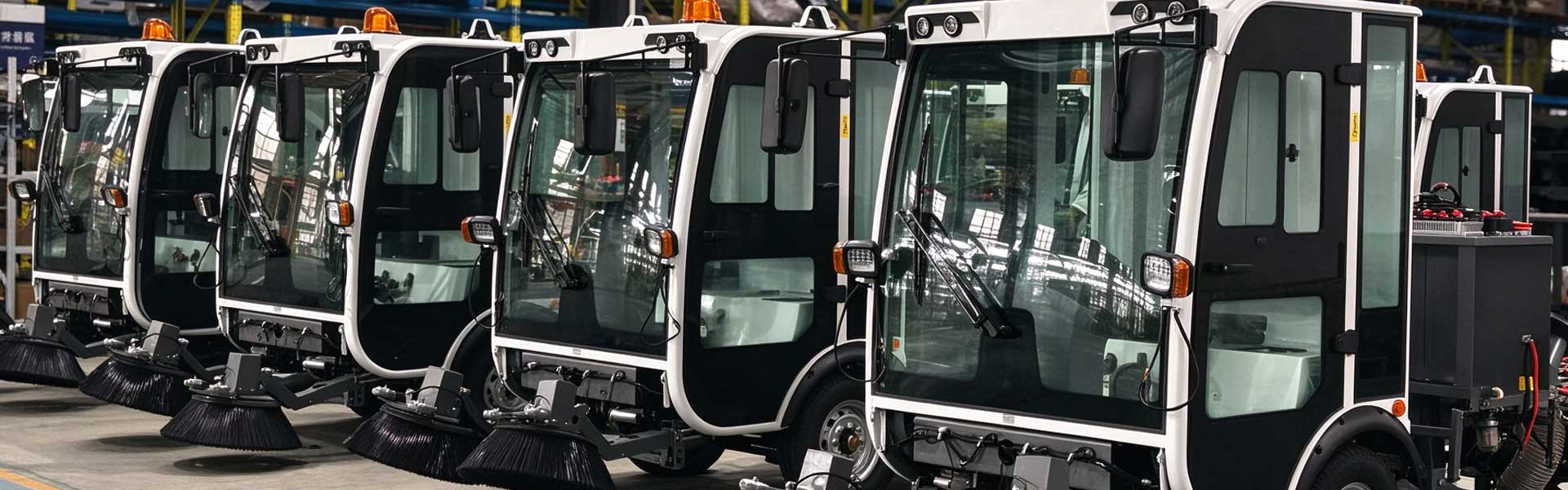
When buying a commercial floor scrubber, many facility managers face the same question:
Should we buy a ride-on or a walk-behind floor scrubber?
The answer should not be based only on floor area.
A better purchasing decision considers:
- Actual cleanable area
- Cleaning time available
- Aisle width
- Doorway size
- Cleaning frequency
- Operator workload
- Tank capacity
- Battery runtime
- Purchase budget
A current market comparison puts many walk-behind machines around 1,500–3,000 m²/h, while ride-on machines commonly range around 3,000–6,500 m²/h, depending on model and conditions.
But productivity is only one part of the decision.
Ride-On vs Walk-Behind: Quick Comparison
| Feature | Walk-Behind | Ride-On |
|---|---|---|
| Operator position | Walking | Seated |
| Typical cleaning width | 500–700 mm | 700–1,100+ mm |
| Typical productivity | 1,500–3,000 m²/h | 3,000–6,500+ m²/h |
| Maneuverability | Excellent | Good |
| Narrow aisles | Better | Depends on model |
| Large open floors | Suitable | Very suitable |
| Operator fatigue | Higher | Lower |
| Tank capacity | Smaller | Larger |
| Initial investment | Usually lower | Usually higher |
| Best application | Small/medium or restricted areas | Large/open facilities |
These are general market ranges, not specifications for every machine.
When Should You Buy a Walk Behind Floor Scrubber?
A walk behind floor scrubber can be a practical choice when the facility contains:
- Narrow aisles
- Small rooms
- Multiple doorways
- Crowded production areas
- Retail aisles
- Workshops
- Back-of-house areas
- Irregular floor layouts
The main advantage is maneuverability.
The operator can control the machine closely around:
- Shelving
- Machines
- Columns
- Display areas
- Pallets
- Corners
For example, a 1,500 m² workshop with narrow passages may be better served by a 500–600 mm walk-behind machine than by a larger ride-on machine.
The larger machine may have greater theoretical productivity, but if it cannot comfortably reach the entire floor, that productivity is not useful.
When Should You Buy a Ride On Floor Scrubber?
A ride on floor scrubber becomes more attractive when the facility has:
- Large open floor areas
- Long cleaning routes
- Wide aisles
- Frequent cleaning
- Short cleaning windows
- High daily traffic
Typical applications include:
- Logistics warehouses
- Distribution centers
- Manufacturing plants
- Large retail stores
- Exhibition halls
- Parking structures
- Large commercial facilities
A current industrial comparison lists ride-on scrubbers with cleaning paths from roughly 55–120 cm and productivity ranging from approximately 3,000 to 10,000+ m²/h across different machine classes.
Example: 2,000 m² Facility
Suppose a facility has:
2,000 m²
and only needs cleaning once per day.
Available cleaning time:
2 hours
Required productivity:
2,000 ÷ 2 = 1,000 m²/h
A walk-behind machine rated around 2,000 m²/h could provide enough capacity.
Buying a large ride-on machine could increase the equipment investment without solving an actual productivity problem.
For this type of facility, maneuverability and purchase cost may be more important than maximum cleaning speed.
Example: 8,000 m² Warehouse
Now consider:
8,000 m²
with a cleaning window of:
2 hours
Required productivity:
8,000 ÷ 2 = 4,000 m²/h
A typical walk-behind machine may struggle to provide enough practical capacity once turning and interruptions are included.
A ride-on machine rated around 5,000–6,000 m²/h may provide more suitable capacity, provided the warehouse has enough aisle and turning space.
This is where the purchasing logic changes.
Cleaning Width vs Productivity
Cleaning width is one of the most visible differences between machine types.
Suppose:
Walk-behind
Cleaning width:
500 mm
Ride-on
Cleaning width:
850 mm
The ride-on covers approximately:
850 ÷ 500 = 1.7 times
the cleaning width per pass.
That does not mean it cleans exactly 1.7 times faster.
Actual productivity also depends on:
- Travel speed
- Turning
- Water usage
- Brush pressure
- Floor contamination
- Operator behavior
- Route layout
Nevertheless, wider cleaning paths can make a significant difference in large open areas.
Operator Fatigue Is a Purchasing Factor
A walk-behind machine requires the operator to walk throughout the cleaning route.
For a small area, this is generally manageable.
But imagine cleaning:
10,000 m² every day
The operator may spend several hours walking behind the machine.
A ride-on machine allows the operator to remain seated while driving and controlling the cleaning system.
For high-frequency cleaning, this can make a meaningful difference to daily operation.
Current product comparisons also show that ride-on machines generally offer larger tanks and longer operating times than smaller walk-behind configurations.
Tank Capacity: Another Important Difference
Consider two hypothetical machines:
Walk-Behind
- Cleaning width: 500 mm
- Solution tank: 50 L
- Recovery tank: 60 L
Ride-On
- Cleaning width: 850 mm
- Solution tank: 100 L
- Recovery tank: 105 L
The ride-on has approximately twice the solution capacity.
For a large facility, this can reduce the number of interruptions for refilling.
One current 860 mm ride-on model, for example, lists a 100 L solution tank and 105 L recovery tank with approximately 4,000 m²/h rated productivity.
This is one reason ride-on machines are often used for large warehouses and industrial floors.
Narrow Aisles Can Change the Decision
Floor area alone is not enough.
Suppose a facility has:
6,000 m²
but most aisles are only:
1.1 m wide
A large ride-on scrubber may not be appropriate.
A smaller walk-behind machine could reach areas that a large machine cannot.
This is why buyers should measure:
Narrowest aisle + narrowest doorway + turning space
before selecting a machine.
Current buying guidance specifically recommends checking the complete cleaning route rather than relying on a fixed floor-area rule.
Purchase Price vs Operating Efficiency
Walk-behind machines generally have a lower initial purchase price than larger ride-on machines.
For example, one current market comparison lists walk-behind machines around US$2,000–6,000 and ride-on machines around US$6,000–18,000, although actual prices vary substantially by model, battery, cleaning width and configuration.
The question is therefore not:
“Which machine costs less?”
It is:
“Which machine can complete our cleaning work at an acceptable total cost?”
Example: Labor and Cleaning Time
Suppose a facility cleans:
6,000 m²/day
A walk-behind machine practically achieves:
2,000 m²/h
Estimated cleaning time:
6,000 ÷ 2,000 = 3 hours
A ride-on machine practically achieves:
4,500 m²/h
Estimated cleaning time:
6,000 ÷ 4,500 = 1.33 hours
The ride-on costs more to purchase.
But the cleaning time is reduced by approximately:
3 − 1.33 = 1.67 hours/day
Over 26 cleaning days:
1.67 × 26 ≈ 43 hours/month
If the facility has a tight cleaning window or wants to redeploy cleaning staff to other tasks, that difference can be commercially important.
The actual saving depends on the facility's labor cost and cleaning schedule.
Can You Use Both Types in One Facility?
Yes.
This can be a practical solution for large facilities with mixed floor layouts.
For example:
Main warehouse floor
Use a:
Ride-on floor scrubber
for large open areas.
Narrow aisles
Use a:
Walk-behind floor scrubber
for areas where the ride-on machine cannot maneuver comfortably.
This approach allows the larger machine to handle the high-volume work while the smaller machine handles restricted areas.
Which Commercial Floor Scrubber Fits Your Facility?
Use this purchasing checklist:
| Question | Walk-Behind | Ride-On |
|---|---|---|
| Cleanable area under 2,000 m² | ✓ | Possible |
| 2,000–5,000 m² | ✓ | ✓ |
| 5,000 m²+ open floor | Possible | ✓ |
| Narrow aisles | ✓ | Depends on model |
| Long cleaning route | Possible | ✓ |
| Short cleaning window | Depends | ✓ |
| Multiple small rooms | ✓ | Depends |
| Large warehouse | Possible | ✓ |
| Lower initial investment | ✓ | |
| Lower operator walking workload | ✓ |
The actual selection should be based on the complete route and cleaning schedule.
Example: Choosing for Three Different Facilities
Facility A — Workshop
Area: 1,200 m²
Aisles: Narrow
Cleaning: Once/day
Choice: Walk-behind
The machine's maneuverability is more important than maximum productivity.
Facility B — Retail Warehouse
Area: 4,000 m²
Aisles: Medium width
Cleaning: Daily
Choice: Walk-behind or compact ride-on
The buyer should compare cleaning time, machine dimensions and budget.
Facility C — Distribution Center
Area: 12,000 m²
Aisles: Wide
Cleaning: Daily
Cleaning window: 3 hours
Choice: Ride-on
Required practical productivity:
12,000 ÷ 3 = 4,000 m²/h
A ride-on machine with suitable practical productivity provides more capacity for this application.
What Should Buyers Ask a Floor Scrubber Supplier?
Before purchasing, provide:
- Total floor area
- Actual cleanable area
- Narrowest aisle
- Doorway width
- Floor material
- Cleaning frequency
- Available cleaning time
- Type of dirt
- Required cleaning width
- Battery runtime requirement
Then ask the supplier to recommend:
- Machine type
- Cleaning width
- Brush configuration
- Solution tank
- Recovery tank
- Battery
- Expected practical productivity
- Machine dimensions
This will produce a much more useful quotation than simply asking:
“How much is a floor scrubber?”
FAQ: Ride-On vs Walk-Behind Floor Scrubber
Is a ride-on floor scrubber better than a walk-behind?
Neither configuration is universally better. Ride-on machines are generally more suitable for large open areas and long cleaning routes, while walk-behind machines offer greater maneuverability in narrow or crowded spaces.
What size facility needs a ride-on floor scrubber?
There is no fixed threshold. As a purchasing reference, ride-on machines are commonly used for facilities above approximately 3,000–5,000 m², particularly when the floor is open and must be cleaned frequently.
What is the productivity of a walk-behind floor scrubber?
Many current walk-behind models fall around 1,500–3,000 m²/h in published specifications, depending on cleaning width and configuration.
What is the productivity of a ride-on floor scrubber?
Many ride-on models fall around 3,000–6,500 m²/h, while larger industrial machines can have higher rated productivity. Actual results depend on the facility and cleaning route.
Which machine is better for a warehouse?
For a large warehouse with wide aisles and open floors, a ride-on machine is often a suitable configuration. For narrow warehouse aisles or restricted areas, a walk-behind machine may be easier to operate.
Can I use a walk-behind scrubber for a large warehouse?
Yes, provided its practical productivity is sufficient for the available cleaning time and it can access all required areas. The question is whether it can finish the route efficiently enough for your operation.
Conclusion
Choosing between a ride on floor scrubber and a walk behind floor scrubber should start with the cleaning route, not simply the size of the building.
For small or crowded facilities, a walk-behind machine can provide the maneuverability and lower initial investment needed for the job.
For large warehouses, distribution centers and other open facilities, a ride-on machine can provide wider cleaning coverage, larger tanks and lower operator walking workload.
For example, an 8,000 m² warehouse with only two hours available for cleaning needs approximately 4,000 m²/h of practical productivity. That requirement provides a much clearer basis for selecting a commercial floor scrubber than simply comparing machine prices.
When requesting a quotation, give the supplier your actual floor area, aisle width, cleaning window and floor condition. The supplier can then recommend the appropriate walk-behind or ride-on configuration.