
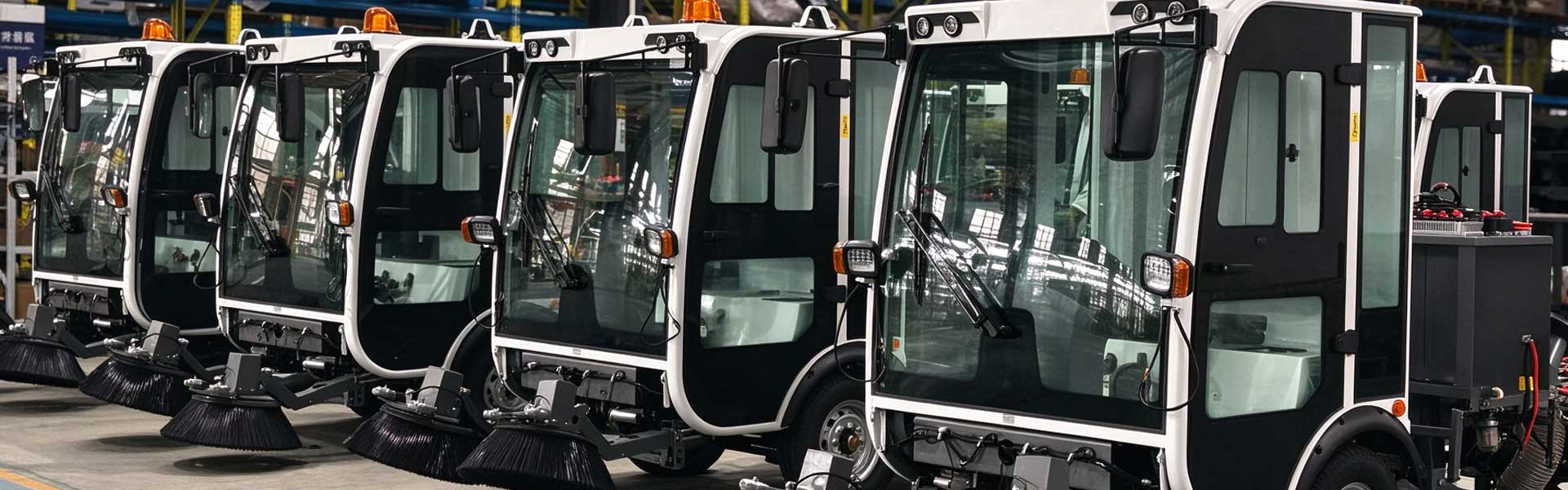
Choosing a floor sweeper machine is not simply a question of buying the biggest model.
A walk behind floor sweeper and a ride on floor sweeper solve the same basic problem—collecting loose dirt and debris—but they are designed for different working environments.
For a small warehouse with narrow aisles, a compact walk-behind machine may be easier to operate.
For a 10,000 m² distribution center with long aisles and large open areas, a ride-on machine can provide much higher productivity.
The key is to match the machine to the actual cleaning route.
Walk Behind Floor Sweeper: Compact and Easy to Maneuver
A walk-behind floor sweeper is operated by an employee walking behind the machine.
Its biggest advantage is maneuverability.
It can be useful in:
- Small warehouses
- Workshops
- Retail stores
- Narrow aisles
- Production areas
- Storage rooms
- Commercial buildings
When the cleaning route contains many corners, racks and obstacles, the smaller footprint can make the machine easier to control.
Walk-behind models also generally require less storage space than ride-on machines.
Example: 3,000 m² Warehouse
Suppose a warehouse has 3,000 m² of floor area.
The facility has relatively narrow aisles and several storage racks.
A compact walk-behind floor sweeper may be sufficient because the operator needs to make frequent turns.
Buying a much larger ride-on machine could increase the machine footprint without providing a meaningful advantage on such a restricted cleaning route.
Ride On Floor Sweeper: Built for Larger Cleaning Routes
A ride-on floor sweeper allows the operator to sit on the machine while sweeping.
This changes the economics of cleaning large facilities.
The machine can generally use a wider cleaning path and larger debris hopper, while the operator does not need to walk behind the machine for the entire cleaning route.
Commercial ride-on sweepers can reach productivity levels of approximately 40,000–100,000+ ft²/h, although real-world output depends on obstacles, turning, debris loading and operating conditions.
For large warehouses, factories and logistics centers, that productivity difference can reduce the daily cleaning window.
Example: 15,000 m² Logistics Center
Consider a 15,000 m² logistics center.
The warehouse operates two shifts and requires daily sweeping.
If a walk-behind machine averages approximately 4,000 m²/h under actual operating conditions:
15,000 ÷ 4,000 = 3.75 hours
A ride-on machine achieving approximately 7,000 m²/h could theoretically reduce the basic cleaning time to:
15,000 ÷ 7,000 ≈ 2.14 hours
The actual result will vary according to aisle layout, traffic, turning and debris.
But the example shows why machine productivity becomes increasingly important as the cleaning area grows.
Walk Behind vs Ride On Floor Sweeper
Here is a practical comparison:
| Feature | Walk Behind Floor Sweeper | Ride On Floor Sweeper |
|---|---|---|
| Operator | Walks behind machine | Sits on machine |
| Machine size | Compact | Larger |
| Maneuverability | Excellent in tight areas | Better in open areas |
| Cleaning route | Short to medium | Medium to large |
| Narrow aisles | Very suitable | Depends on machine size |
| Large warehouses | Possible | Highly suitable |
| Large open areas | Slower | Faster |
| Storage space | Lower requirement | Higher requirement |
| Hopper capacity | Usually smaller | Usually larger |
| Operator fatigue | Higher on long routes | Lower on long routes |
| Typical application | Workshops, small warehouses | Logistics centers, factories, large warehouses |
The right choice depends on the route rather than simply the total building size.
What About a 5,000 m² Facility?
A 5,000 m² building sits in the middle.
This is where buyers should look carefully at the facility layout.
Choose a Walk-Behind When:
- Aisles are narrow
- There are many obstacles
- Cleaning is divided into small areas
- The machine needs to enter restricted spaces
- Storage space is limited
Consider a Ride-On When:
- The floor is mostly open
- Cleaning happens every day
- There are long straight aisles
- The cleaning window is short
- One operator needs to cover a large area
This approach is more useful than simply saying that one machine type is suitable for a specific square-meter range.
Cleaning Width Directly Affects Productivity
One of the most important specifications when comparing a floor sweeper machine is cleaning width.
A wider cleaning path means the machine can cover more floor with each pass.
For example:
A 500 mm machine has a theoretical path of:
0.5 meters
A 1,000 mm machine doubles the cleaning width:
1.0 meter
A 1,300 mm machine provides an even wider sweeping path:
1.3 meters
However, wider is not automatically better.
If a 1,300 mm machine cannot comfortably move through your warehouse aisles, its additional cleaning width does not provide much practical value.
That is why cleaning width should always be considered together with aisle width and turning space.
Hopper Capacity Matters in Dirty Warehouses
The second specification many buyers overlook is the debris hopper.
A larger hopper allows the machine to collect more debris before the operator needs to stop and empty it.
This is particularly useful in:
- Logistics centers
- Manufacturing plants
- Warehouses
- Packaging facilities
- Distribution centers
Imagine two machines cleaning the same warehouse.
If Machine A requires frequent hopper emptying while Machine B can continue for a longer period, Machine B may provide better actual productivity even if the catalog sweeping speed is similar.
For high-debris environments, hopper capacity should therefore be part of the purchasing discussion.
Battery Runtime Is Another Buying Point
For electric floor sweeper machines, battery runtime matters because cleaning should ideally be completed within the planned operating window.
Before purchasing, calculate:
Required cleaning time = Cleaning area ÷ practical cleaning productivity
Then compare this figure with the machine's expected working time.
Do not rely only on the advertised maximum runtime.
Actual battery performance can change according to:
- Floor condition
- Driving speed
- Brush pressure
- Debris volume
- Operator behavior
- Number of stops and turns
A good supplier should help you match the battery configuration to the actual cleaning route.
Which Machine Should You Buy?
The decision can be simplified.
A Walk Behind Floor Sweeper Is Practical When:
Your priority is maneuverability.
It works well for smaller and more complicated cleaning routes where the operator needs to move around racks, equipment and obstacles.
A Ride On Floor Sweeper Is Practical When:
Your priority is productivity.
It is especially useful when the facility has large open floors, long cleaning routes and a limited cleaning window.
Example: Same Warehouse, Different Requirements
Imagine two companies, both operating 8,000 m² warehouses.
Company A
The warehouse has:
- Narrow aisles
- Many racks
- Small storage areas
- Frequent turns
A walk-behind machine may fit the environment better.
Company B
The warehouse has:
- Wide aisles
- Large open staging areas
- Long forklift routes
- Daily full-floor cleaning
A ride-on floor sweeper may provide greater productivity.
The building size is the same.
The required machine is different.
This is why buying a floor sweeper machine based only on square meters can lead to the wrong equipment choice.
Choose Your Floor Sweeper Machine Based on the Cleaning Route
Before requesting a quotation, prepare these details:
1. Cleaning area:
How many square meters need to be swept?
2. Aisle width:
What is the narrowest aisle?
3. Cleaning frequency:
Daily, several times per week or occasionally?
4. Cleaning window:
How much time is available for cleaning?
5. Debris:
Dust, cardboard, plastic, wood particles, sand or general dirt?
6. Indoor or outdoor:
Will the machine work only inside or also on external concrete areas?
With these six pieces of information, it becomes much easier to select the appropriate machine.
Find the Right Floor Sweeper Machine for Your Business
A walk behind floor sweeper is a practical option when maneuverability and compact dimensions are important.
A ride on floor sweeper becomes more attractive when the facility has large open areas, long cleaning routes and a need for higher productivity.
For buyers, the most important question is not simply:
“Which machine is bigger?”
It is:
“Which machine can complete my cleaning route within the required time?”
If you are looking for an electric floor sweeper machine for a warehouse, logistics center, factory or commercial facility, send us your floor area, narrowest aisle width and required cleaning time. We can help match the cleaning width, machine type and working capacity to your application.