
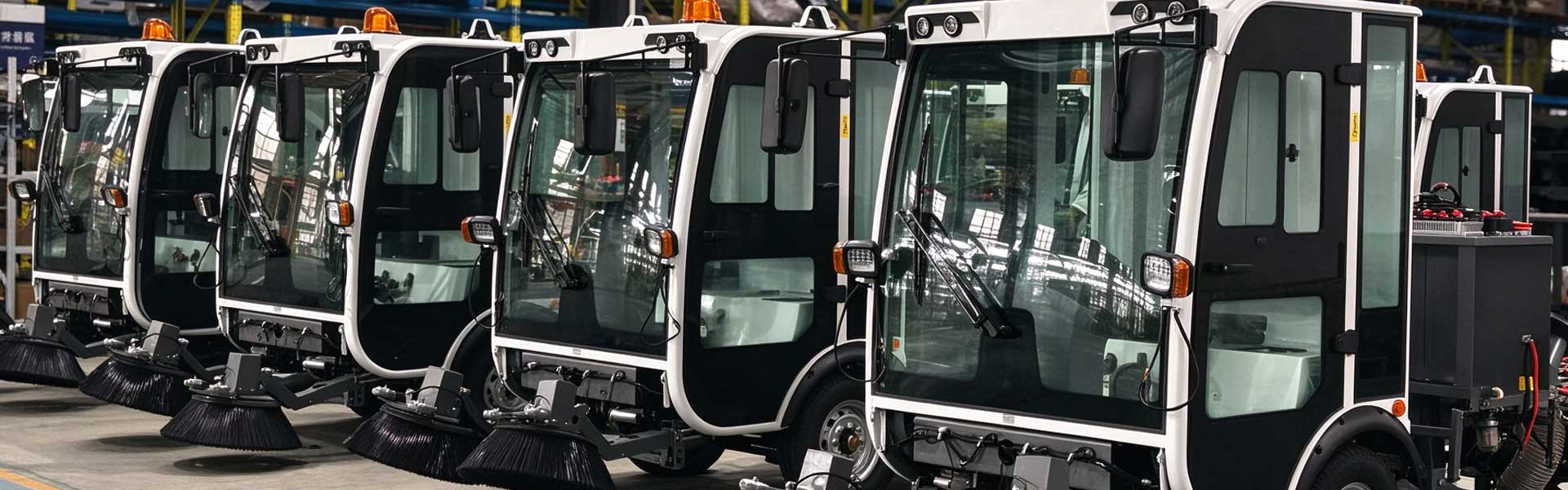
Start with the Building, Not the Machine
A large multi-use facility rarely has just one type of floor or one cleaning requirement.
A distribution center may contain warehouse aisles, loading areas, office corridors, and employee facilities. A manufacturing complex may combine production workshops, storage areas, and administrative buildings.
These different spaces create different cleaning challenges.
Choosing a floor scrubber based only on the total building area can lead to an unsuitable purchase. The better approach is to divide the facility into cleaning zones and identify what each area requires.
Step 1: Divide the Facility into Cleaning Zones
Before comparing machines, prepare a simple facility map.
| Facility zone | Typical cleaning requirements |
|---|---|
| Warehouse aisles | Regular dust and dirt removal |
| Production areas | Cleaning around equipment and workstations |
| Loading zones | Removal of heavier floor contamination |
| Office corridors | Frequent routine cleaning |
| Commercial areas | Consistent appearance and daily maintenance |
| Shared facilities | Flexible access and convenient operation |
This assessment helps determine whether the business needs a walk-behind scrubber, a ride-on scrubber, or multiple machines.
Step 2: Match the Machine to the Cleaning Area
For larger open areas, a ride-on floor scrubber is often worth considering.
Operators can clean larger sections while seated, making it suitable for facilities that require regular cleaning over extended periods.
For narrower passages, smaller rooms, or areas with frequent obstacles, a walk-behind machine may provide better maneuverability.
Some facilities benefit from using both types.
For example, a warehouse operator could use a ride-on machine for main aisles and a smaller scrubber for offices and restricted spaces.
Step 3: Compare Cleaning Width and Productivity
Cleaning width is an important factor because it affects the amount of floor covered during each pass.
For example, a 500 mm cleaning width may suit smaller commercial areas, while 700 mm and 860 mm configurations can be considered for larger cleaning operations.
The theoretical cleaning productivity is also worth comparing.
However, actual daily output depends on more than brush width. Turning, obstacles, water refilling, dirty-water disposal, operator experience, and battery charging all influence performance.
Buyers should therefore consider real operating conditions rather than relying entirely on the maximum advertised cleaning rate.
Step 4: Evaluate Tank Capacity and Battery Runtime
Large facilities often need longer cleaning sessions.
A larger clean-water tank can reduce the frequency of refilling, while an appropriately sized recovery tank supports continuous cleaning operations.
Battery capacity and charging time should also be considered.
When comparing equipment, buyers should confirm:
-
Battery voltage and capacity.
-
Expected operating time under normal conditions.
-
Charging duration.
-
Clean-water tank capacity.
-
Recovery tank capacity.
-
Availability of replacement batteries and consumables.
Step 5: Think About Total Purchasing Cost
The lowest machine price does not necessarily provide the best long-term value.
A commercial floor scrubber should be evaluated according to its purchase price, operating expenses, consumables, battery replacement, maintenance requirements, and expected service life.
For businesses managing multiple facilities, spare parts availability and supplier responsiveness can be particularly important.
A Practical Equipment Range for Different Facilities
Voril offers floor cleaning equipment options for commercial and industrial applications.
Depending on the cleaning requirements, buyers can consider:
-
500 mm walk-behind scrubbers for smaller and more restricted spaces.
-
500 mm ride-on scrubbers for routine commercial cleaning.
-
700 mm ride-on scrubbers for larger floor areas.
-
860 mm ride-on scrubbers for demanding industrial cleaning operations.
The final choice should be based on the floor layout, cleaning frequency, surface conditions, and available operating space.
Make Your Purchasing Decision with a Clear Plan
A large facility may need more than one machine to achieve an efficient cleaning schedule.
For equipment dealers and facility operators, comparing a commercial floor scrubber with an industrial floor scrubber for sale should involve both cleaning performance and long-term operating requirements.
Voril supports international buyers with product selection, technical information, quotations, and export coordination.
Contact our team with your facility area, floor type, cleaning schedule, and preferred machine configuration to identify suitable options from a reliable ride on floor scrubber supplier.