
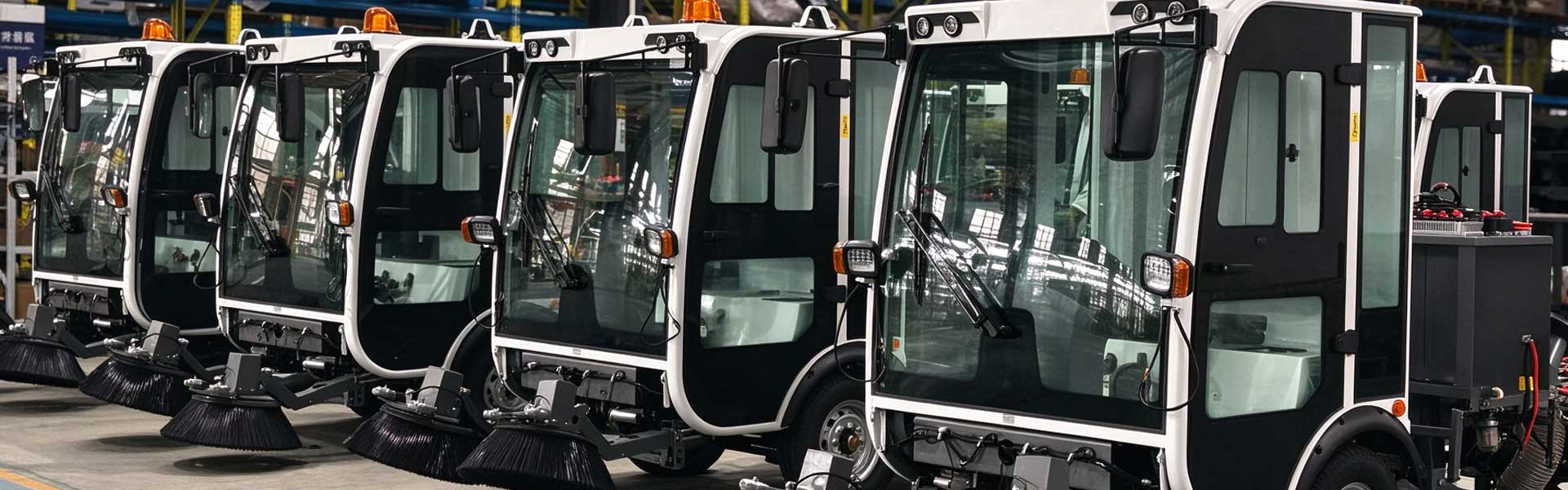
One Purchasing Decision, Multiple Warehouse Environments
Companies operating several warehouses often face a difficult equipment purchasing decision.
One location may handle packaged consumer goods, another may store building materials, and a third may serve as a logistics distribution center. Although all three facilities need floor cleaning equipment, their cleaning requirements may be very different.
Purchasing the same machine for every location is not always the most economical approach.
A better strategy is to evaluate the floor area, debris conditions, operating schedule and cleaning workload at each facility before selecting a suitable machine.
Step 1: Divide Your Warehouses into Cleaning Categories
Before requesting quotations, classify each location according to its cleaning requirements.
| Warehouse type | Typical floor conditions | Equipment consideration |
|---|---|---|
| General storage | Dust, packaging debris | Compact or medium sweeper |
| Logistics warehouse | Continuous vehicle movement and dust | Higher-capacity sweeper |
| Building materials storage | Sand, dirt and heavier debris | Suitable industrial configuration |
| Large distribution center | Extensive floor areas | High-efficiency riding sweeper |
This classification helps businesses avoid purchasing machines that are either oversized or insufficient for their facilities.
Step 2: Match Cleaning Capacity to Floor Area
Cleaning efficiency is an important purchasing consideration, particularly when several warehouses operate under tight schedules.
A smaller walk-behind machine may be appropriate for compact storage facilities or restricted areas. Large warehouses may benefit from riding sweepers with wider cleaning paths and greater working efficiency.
Voril offers different industrial sweeper configurations, including models with stated theoretical cleaning efficiencies ranging from approximately 8,000 to 25,000 m²/h, depending on the selected model.
For example, the WJ-1280 has a stated cleaning efficiency of approximately 8,000 m²/h, while larger models such as the VL-2400 are designed for higher-capacity applications.
Actual cleaning output depends on floor conditions, debris volume, obstacles, operator experience and working speed.
Step 3: Consider Whether All Locations Need the Same Machine
A multi-site purchasing strategy should balance equipment standardization with local requirements.
Using similar equipment across locations can simplify operator training, spare parts management and maintenance planning.
However, different warehouse sizes may justify different machine configurations.
A business with several medium-sized warehouses might choose a common machine platform for most sites while selecting larger equipment for its central distribution facility.
Step 4: Evaluate the Total Purchasing Cost
The purchase price is only one part of the long-term equipment cost.
When comparing an industrial floor sweeper, purchasing departments should also consider battery capacity, charging time, consumable parts, maintenance access and expected operating hours.
For businesses operating multiple locations, spare parts availability and after-sales communication are particularly important.
Equipment Options for Different Warehouse Sizes
Voril supplies industrial cleaning equipment for warehouses, factories and logistics facilities.
Depending on the cleaning requirements, buyers can evaluate different configurations:
-
Compact equipment for smaller working areas.
-
Medium-sized riding sweepers for general warehouse cleaning.
-
Higher-capacity machines for large industrial facilities.
-
Different battery and electrical configurations.
-
Equipment suitable for different floor surfaces and debris conditions.
The correct choice should be based on actual site conditions rather than machine size alone.
A Simple Purchasing Plan for Multi-Site Businesses
Before ordering, prepare a list of warehouse locations and record the following information for each site:
-
Total cleaning area.
-
Floor material and surface condition.
-
Type and quantity of debris.
-
Daily cleaning frequency.
-
Available charging facilities.
-
Required machine quantity.
This information makes it easier to compare a commercial floor sweeper across multiple facilities and develop a consistent equipment purchasing plan.
Source Your Warehouse Cleaning Equipment from Voril
For international distributors and multi-site businesses, Voril provides product selection assistance, specifications, quotations and export coordination.
If you are looking for a floor sweeper machine for sale for several warehouses, send us your facility information and expected purchasing quantity.
We can help you compare available models and identify a practical equipment combination for your warehouse operations.