
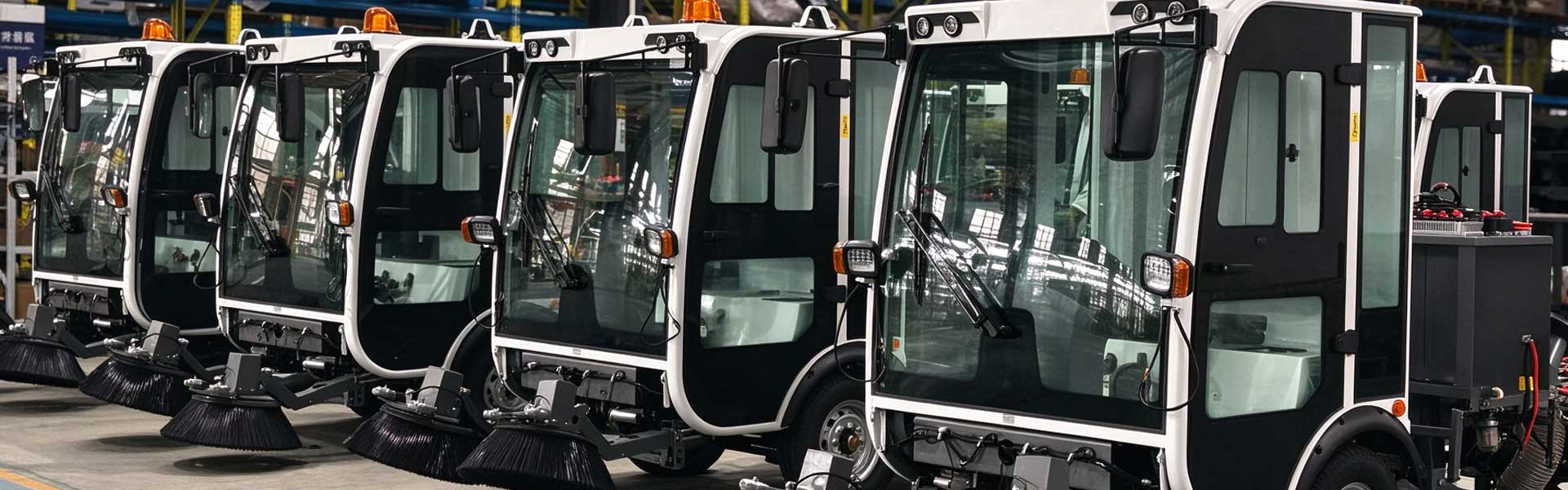
For warehouses, factories, parking facilities, and logistics centers, keeping floors clean is an ongoing operating expense. Manual sweeping may be sufficient for small areas, but as a facility grows, cleaning labor and time requirements can increase significantly.
An electric floor sweeper can help businesses collect dust, loose debris, packaging fragments, and other dry material more efficiently across suitable floor surfaces. For companies with large cleaning areas, the right machine may help reduce manual work and improve daily cleaning consistency.
However, the actual savings depend on labor costs, floor conditions, cleaning frequency, machine utilization, and maintenance expenses. Buyers should evaluate the complete operating picture before investing in equipment.
1. Reduce the Time Required for Routine Sweeping
One of the main reasons businesses purchase an electric floor sweeper is to cover large floor areas more efficiently.
Consider a warehouse with 6,000 m² of floor space. If two employees each spend three hours sweeping every day, the facility uses six labor-hours per cleaning cycle.
If a suitable sweeper reduces the task to two operator-hours, the potential saving is four labor-hours per cycle.
Assuming 250 operating days per year, this would represent 1,000 labor-hours annually, provided the estimated reduction can be achieved consistently.
This is an illustrative example, not a guaranteed result. Actual savings depend on the machine's performance, obstacles, debris volume, and the time required to empty the collection hopper and complete maintenance.
Businesses should measure their current cleaning time before selecting an industrial floor sweeper for sale.
2. Choose the Right Sweeper for Your Facility
Different machines are designed for different working areas.
Walk-behind electric sweepers may be suitable for smaller warehouses, workshops, retail backrooms, and areas with limited turning space. They are useful when operators need to clean around equipment or navigate relatively narrow routes.
Ride-on electric sweepers are often worth considering for larger facilities, including logistics centers, manufacturing plants, parking areas, and extensive warehouse floors. The operator can cover larger open areas without walking behind the machine throughout the shift.
For example, a warehouse with long aisles and frequent packaging debris may benefit from a ride-on sweeper with a suitable working width and collection hopper.
When comparing models, consider cleaning width, theoretical productivity, hopper capacity, battery runtime, maneuverability, and filter performance. Advertised productivity is a useful starting point, but actual output will be lower when the route contains obstacles or frequent stops.
3. Understand Where the Cost Savings Come From
A commercial electric floor sweeper can affect several operating costs.
Cleaning labor: Faster routine sweeping may allow employees to spend less time on floor maintenance and more time on other duties.
Cleaning consistency: Mechanized sweeping can help businesses establish more predictable cleaning schedules across large areas.
Debris collection: A suitable hopper can collect loose debris in fewer manual collection trips, depending on the volume and type of material.
Operational planning: Businesses can schedule regular cleaning routes and monitor the time required to maintain each area.
For example, a manufacturing facility may use a sweeper to collect cardboard fragments, dust, and loose production debris before these materials spread into adjacent work zones.
A sweeper is primarily intended for dry debris and dust management. If the floor contains liquid spills, sticky residues, or heavy oil contamination, a floor scrubber or another suitable cleaning method may also be required.
4. Calculate the Total Cost of Ownership
The purchase price is only one part of the cost.
When evaluating a commercial electric floor sweeper, include the following expenses:
-
Initial machine purchase and delivery.
-
Battery charging and electricity.
-
Brushes, filters, and other replacement parts.
-
Routine servicing and maintenance.
-
Operator time and equipment downtime.
A simple annual cost comparison can help.
Suppose manual sweeping currently requires 1,500 labor-hours annually. If a machine reduces that workload by 60%, the potential reduction is 900 labor-hours.
At an illustrative labor cost of US$12 per hour, the estimated annual labor saving would be US$10,800.
From this amount, subtract annual electricity, maintenance, consumables, and other incremental costs to estimate the net operating benefit. The 60% reduction and labor rate are example assumptions, not industry-wide benchmarks.
This approach gives buyers a more realistic basis for evaluating the investment.
5. What Should Buyers Compare Before Ordering?
When sourcing an electric sweeper, check the machine's suitability for your floor area and debris type.
Important purchasing considerations include:
-
Working width and expected cleaning productivity.
-
Hopper capacity and dust-control system.
-
Battery capacity and operating time.
-
Floor surface and typical debris conditions.
-
Operator visibility and maneuverability.
-
Availability of replacement filters, brushes, and batteries.
-
Warranty terms and after-sales support.
For overseas buyers, also confirm the power and charging requirements, packaging, shipping terms, and export documentation.
A reliable quotation should clearly identify the model, standard configuration, optional accessories, and delivery conditions.
Source Commercial Electric Floor Sweepers from Voril
Voril supports overseas distributors, dealers, and commercial customers sourcing electric sweepers for industrial and commercial applications.
As an export trading company, we help buyers clarify equipment requirements, compare available configurations, and coordinate quotations and shipping arrangements.
To identify a suitable model, share your facility area, floor type, debris conditions, required working hours, preferred machine configuration, and destination country.
Our team can help evaluate available options based on your cleaning needs and purchasing plans.
Contact Voril to request a quotation from an electric floor sweeper supplier and explore practical options for reducing routine cleaning costs.