
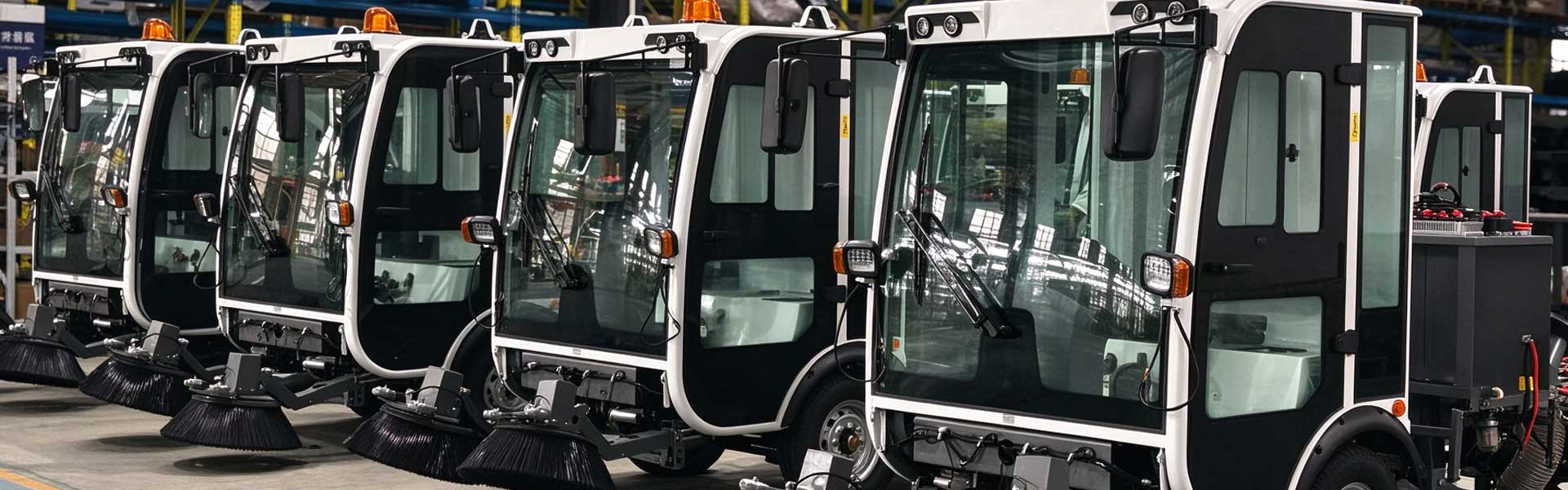
A warehouse floor can look clean after sweeping while still carrying dust, tire marks, oil residue and other dirt that a broom cannot remove.
For warehouses with concrete, epoxy or other hard floors, a warehouse floor scrubber can provide a deeper cleaning solution by applying cleaning solution, scrubbing the surface and recovering dirty water in the same cleaning process.
For facility managers, warehouse operators and cleaning contractors, the goal is simple:
Clean more floor in less time while keeping the machine practical for daily use.
Sweeping Removes Debris. Scrubbing Goes Further.
A sweeper is useful for removing loose debris.
A scrubber is designed for a different job.
A commercial floor scrubber for warehouse applications can combine:
- Water or cleaning solution
- Rotating brush or pad
- Scrubbing pressure
- Vacuum recovery
- Rear squeegee
The result is a cleaning process that can remove dirt from the floor surface and recover the dirty water instead of simply moving dust around.
This makes a floor scrubber particularly useful when warehouse floors experience:
- Forklift tire marks
- Dust buildup
- Oil or grease residue
- Foot traffic
- Spilled liquids
- General industrial dirt
Why an Electric Floor Scrubber Makes Sense for Warehouses
An electric floor scrubber provides battery-powered cleaning without requiring a fuel engine or power cable when configured as a cordless machine.
This is particularly useful in warehouses because operators can move between:
- Storage aisles
- Loading areas
- Production zones
- Packing areas
- Dispatch areas
without needing to manage a long electrical cable.
Current commercial machines cover a wide range of sizes. For example, a 21-inch walk-behind scrubber can offer published productivity around 27,000 sq. ft./hour, while larger ride-on models can advertise more than 60,000 sq. ft./hour depending on configuration.
These are published productivity figures, not guaranteed real-world cleaning times. A warehouse with racks, columns and forklift traffic will normally achieve less than the theoretical maximum.
Match the Warehouse Floor Scrubber to Your Facility
The first question is not:
“Which scrubber has the most power?”
It is:
“How much floor do we need to clean every day?”
For example:
Small Warehouse — 10,000–30,000 sq. ft.
A compact walk-behind warehouse floor scrubber can provide good maneuverability.
It can work well around:
- Shelving
- Narrow aisles
- Small loading areas
- Workshops
- Stockrooms
Medium Warehouse — 30,000–100,000 sq. ft.
A larger self-propelled or battery walk-behind machine can provide a useful balance between cleaning width and maneuverability.
Large Warehouse — 100,000+ sq. ft.
A ride-on floor scrubber for warehouse applications can become more attractive because the operator can remain seated while covering large open floor areas.
For example, a current 34-inch commercial ride-on scrubber is marketed with a cleaning productivity of up to 65,000 sq. ft./hour and approximately 4–6 hours of working time, with 41-gallon solution and 45-gallon recovery tanks.
These specifications illustrate why larger scrubbers are designed for facilities where long cleaning routes and fewer refill stops matter.
Cleaning Width Determines How Many Passes You Need
Cleaning width is one of the easiest specifications to understand.
Imagine a warehouse with 60,000 sq. ft. of floor.
A 20-inch scrubber and a 34-inch scrubber do not cover the same area in each pass.
The larger cleaning path can reduce the number of passes required, provided the warehouse has enough open space to accommodate it.
However, if the warehouse contains narrow aisles, a smaller machine may be easier to operate.
Before buying, measure:
- Aisle width
- Door width
- Loading bay access
- Elevator width
- Turning radius
This information helps the supplier recommend a machine that can actually move through your warehouse.
Don't Ignore Solution and Recovery Tank Capacity
A scrubber needs both clean water and dirty-water recovery capacity.
A small tank means more frequent refilling.
A larger tank allows the operator to clean for longer before stopping.
For example, one current commercial walk-behind scrubber configuration uses approximately 14.5 gallons of solution capacity and 16 gallons of recovery capacity, while larger ride-on machines can carry substantially more.
For a large warehouse, tank capacity can be just as important as brush width.
Imagine an operator having to stop every 30–40 minutes to refill or empty tanks. Even a high-speed machine can lose productivity because of those interruptions.
One-Pass Scrubbing Helps Reduce Downtime
A professional floor scrubber is designed to scrub and recover dirty water during the cleaning process.
This matters in an operating warehouse.
After cleaning, the floor should be left as dry as practical so that normal warehouse activity can resume.
A current commercial ride-on example combines a dual-disc brush system with a rear squeegee and vacuum recovery system to clean and recover dirty water in the same pass.
For warehouses with forklifts and continuous employee traffic, faster floor recovery can make the cleaning process easier to schedule.
Example: Cleaning a 100,000-Square-Foot Warehouse
Consider this example:
Warehouse size: 100,000 sq. ft.
Floor: Concrete
Cleaning frequency: Daily
Main dirt: Dust, tire marks and general warehouse residue
Required equipment: Battery-powered scrubber
Suppose the selected machine achieves a practical cleaning rate of 40,000 sq. ft./hour.
The basic cleaning calculation is:
100,000 ÷ 40,000 = 2.5 hours
The actual job may take longer because of racks, columns, turns, loading zones and other obstacles.
Nevertheless, this calculation gives the facility manager a useful benchmark when comparing machines.
If the warehouse requires daily cleaning, even a 30-minute reduction per cleaning cycle can accumulate into significant labor savings over a year.
Battery Runtime Should Match Your Cleaning Shift
When selecting an electric floor scrubber, ask how long the machine can operate during normal cleaning.
For example, some commercial walk-behind models advertise approximately 2–5 hours depending on configuration, while larger ride-on models may offer approximately 4–8 hours.
The right runtime depends on your schedule.
If your cleaning route requires only two hours per day, there may be little reason to pay for a much larger battery system.
If the machine is expected to operate for an entire shift, longer runtime becomes much more important.
Choose the Right Brush and Cleaning System
Warehouse floors are not all equally dirty.
A lightly used storage warehouse may only require routine maintenance.
A manufacturing warehouse may have heavier contamination.
When contacting a supplier, explain:
- Concrete or epoxy floor
- Light or heavy dirt
- Oil or grease exposure
- Forklift traffic
- Daily cleaning frequency
- Required cleaning area
The supplier can then recommend the appropriate brush, pad and cleaning configuration.
A Floor Scrubber Can Also Become a Business Tool
For a professional cleaning company, a warehouse floor scrubber is not simply a cleaning machine.
It can expand the type of contracts your company can handle.
For example, a cleaning contractor that previously focused on offices and retail stores may use a larger scrubber to bid for:
- Warehouse contracts
- Distribution centers
- Manufacturing facilities
- Logistics facilities
- Large commercial buildings
The machine becomes part of your service capacity.
If you can clean a 100,000-square-foot warehouse within a planned maintenance window, you may be able to take on contracts that would be difficult to handle efficiently with traditional mops or manual cleaning equipment.
Choose an Electric Floor Scrubber for the Job You Actually Have
Before purchasing, prepare these details:
Warehouse size: 80,000 sq. ft.
Floor type: Concrete
Cleaning frequency: Daily
Cleaning time: 3–4 hours
Main contamination: Dust and forklift tire marks
Narrowest aisle: 2.2 m
Machine quantity: 2 units
Send these details to your supplier and ask for a recommended configuration.
This gives the supplier enough information to recommend the cleaning width, battery capacity, tank size and machine type around your actual application.
Keep Your Warehouse Cleaner With the Right Floor Scrubber
A clean warehouse is easier to maintain when cleaning equipment is designed around the facility's real workload.
The right warehouse floor scrubber can help you:
- Remove stubborn floor dirt
- Reduce manual cleaning
- Cover large areas more efficiently
- Recover dirty water during cleaning
- Reduce cleaning interruptions
- Maintain consistent floor appearance
For smaller facilities, a compact walk-behind electric floor scrubber may provide the maneuverability you need. For large distribution centers, a ride-on floor scrubber for warehouse applications can provide greater cleaning coverage and operator efficiency.
If you are planning to purchase a warehouse scrubber, provide your floor area, floor type, aisle width and daily cleaning time. A suitable machine can then be selected according to your actual warehouse—not simply according to a catalog specification.