
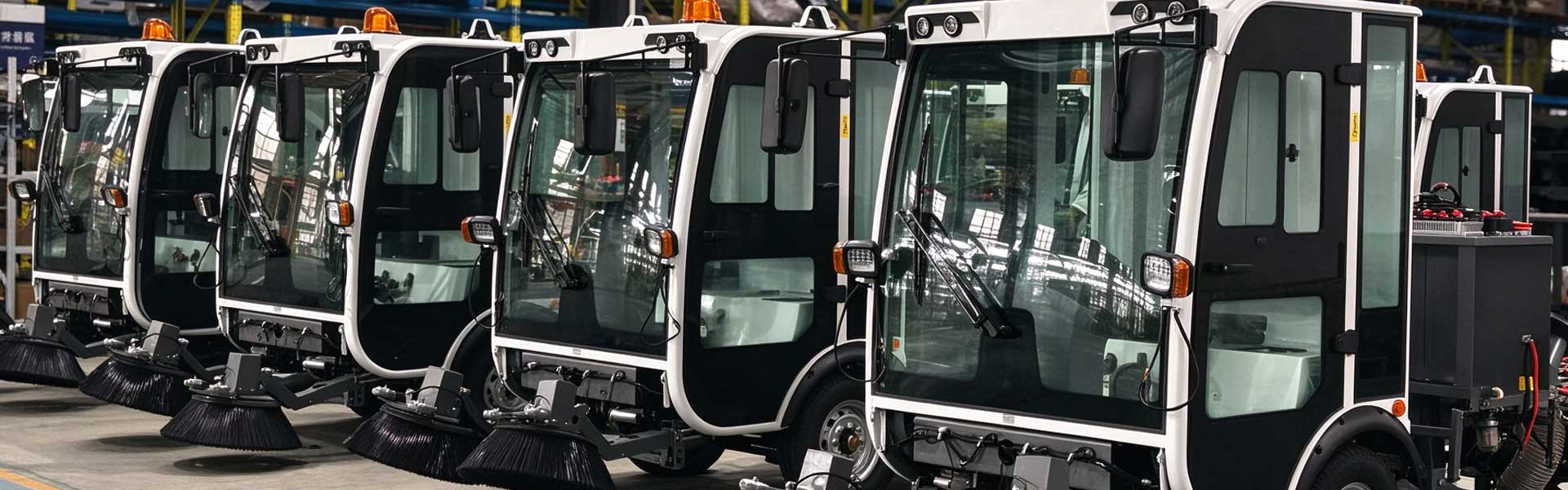
Why Airports Need High-Capacity Floor Sweepers
Airport facilities can contain thousands or even hundreds of thousands of square meters of floor and pavement that require regular cleaning.
Terminal entrances collect dust and outdoor debris. Passenger areas experience constant foot traffic. Parking structures accumulate tire dust and dirt, while cargo and logistics areas may collect packaging debris and other materials.
For these environments, manual sweeping is difficult to scale.
A high-capacity floor sweeper allows cleaning teams to cover large areas with a powered machine rather than relying on multiple workers with manual brooms.
For an airport operator, the purchasing question is therefore not simply "Which sweeper is cheapest?" The more important question is whether the machine can cover the required area within the available cleaning window.
Where Does a High-Capacity Floor Sweeper Fit?
Airports have several different cleaning zones, and each area may require a different machine configuration.
Terminal Buildings
Large terminal halls often have expansive hard floors and high passenger traffic.
A ride-on sweeper can be useful for open areas where the operator needs to cover a large floor quickly.
For example, a 1,300 mm working-width sweeper with a rated productivity of around 13,000 m²/h can be considered for large open areas, depending on the actual floor conditions and operating efficiency.
Airport Parking Structures
Parking garages are another strong application.
Vehicles continuously bring dust, sand and small debris into parking areas. A ride-on sweeper can cover parking lanes and open concrete areas more efficiently than manual sweeping.
For large parking facilities, machine hopper capacity is also important because frequent emptying can interrupt the cleaning operation.
Cargo and Logistics Areas
Airport cargo facilities can contain pallets, packaging materials, dust and other debris.
These areas often have relatively large open floors, making them suitable for higher-capacity sweepers.
A machine with a wide cleaning path can reduce the number of passes required to cover the same floor area.
Service Roads and Outdoor Areas
Some airport cleaning requirements extend beyond indoor terminal floors.
Outdoor pedestrian areas, service zones and parking areas may require sweeping equipment capable of handling dust and larger debris.
For these areas, buyers should evaluate the machine's wheel configuration, ground clearance, hopper design and ability to operate on the specific surface.
Cleaning Width Matters When Airport Areas Are Large
One of the first specifications airport buyers should compare is cleaning width.
A smaller machine may be easier to maneuver around gates, columns, furniture and passenger facilities. A wider machine can provide higher productivity in open spaces.
For example:
- 800 mm class: suitable for smaller or more restricted areas
- 1,300–1,400 mm class: suitable for larger commercial and industrial areas
- 1,800–2,000 mm class: better suited to very large open spaces
- 2,200–2,400 mm class: designed for applications where maximum coverage is a major priority
The best solution may therefore be a combination of machines rather than one model throughout the airport.
A Practical Airport Cleaning Example
Imagine an airport facility with 30,000 m² of hard-floor areas requiring routine sweeping.
A smaller 800 mm sweeper rated at approximately 8,000 m²/h may be useful for restricted areas, but it would require substantially more passes to cover the entire facility.
A larger 1,300 mm machine rated at approximately 13,000 m²/h could be more suitable for open terminal, parking or logistics areas.
For even larger open areas, a 2,000 mm-class machine with rated productivity around 12,000–18,000 m²/h could be considered.
These are rated figures rather than guaranteed real-world output. Actual productivity depends on obstacles, debris levels, driving speed, cleaning frequency and operator efficiency.
This is why an airport floor sweeper supplier should evaluate the airport's layout instead of selecting a machine only from its maximum theoretical productivity.
Hopper Capacity Can Affect Daily Productivity
Cleaning speed is only one part of the purchasing decision.
If the hopper is too small for the amount of debris collected, operators may need to stop frequently for dumping.
For example, a parking structure exposed to heavy vehicle traffic may collect significantly more dust and debris than a clean indoor terminal floor.
In this case, a larger hopper can improve the practical productivity of the cleaning team because the machine can continue sweeping for longer periods before disposal.
For airport operators, hopper capacity should therefore be considered together with cleaning width and working time.
Ride-On Sweepers Reduce Manual Cleaning Work
Large airports can have long cleaning routes.
Using a ride-on sweeper allows the operator to remain seated while controlling the machine, which is more practical for extended cleaning periods than manually pushing a broom or smaller cleaning tool.
For example, if a cleaning team needs to maintain a large parking structure every morning, a ride-on sweeper can cover the required route systematically and repeatably.
This is particularly valuable when cleaning must be completed before passenger traffic increases.
Sweeper or Scrubber? Many Airports Need Both
A floor sweeper and a floor scrubber perform different jobs.
A sweeper is primarily used to collect:
- Dust
- Sand
- Leaves
- Paper
- Packaging debris
- Small solid particles
A floor scrubber is designed for washing hard floors and recovering dirty water.
In a large airport, both machines can be part of the cleaning fleet.
For example, the cleaning sequence may involve sweeping loose debris from a large terminal or parking area first and then using a floor scrubber in areas where washing is required.
This approach can help prevent loose debris from interfering with the scrubbing process.
How to Select a Commercial Floor Sweeper
When purchasing a commercial floor sweeper for sale, airport buyers should compare more than the headline cleaning capacity.
Important purchasing specifications include:
- Cleaning width
- Rated cleaning productivity
- Hopper capacity
- Battery capacity or fuel system
- Operating time
- Machine dimensions
- Turning radius
- Brush configuration
- Dust-control system
- Floor compatibility
- Spare-parts availability
- After-sales support
For airport applications, machine dimensions are particularly important because the sweeper must fit through entrances, service areas and other restricted spaces.
Building an Airport Sweeper Fleet
Large airports may benefit from using several machine sizes.
For example:
Small machine: restricted terminal areas and narrow routes
Medium machine: passenger halls, corridors and commercial areas
Large ride-on machine: parking structures, cargo zones and large open floors
This fleet approach allows each machine to operate where its configuration provides the best value.
For distributors, this also creates an opportunity to supply airport cleaning contractors with multiple models instead of selling a single standard sweeper.
Choose an Industrial Floor Sweeper Manufacturer for Large Projects
Airport cleaning is a demanding commercial application where productivity, machine capacity and reliability all affect the purchasing decision.
The right sweeper depends on the size of the cleaning area, the amount of debris, available cleaning time and the physical layout of the facility.
If you are sourcing from an industrial floor sweeper manufacturer, compare models by working width, hopper capacity, rated productivity, battery runtime and machine dimensions rather than focusing only on the lowest purchase price.
For airport operators, cleaning contractors and equipment distributors looking for a commercial floor sweeper for sale, a properly matched high-capacity machine can become an important part of an efficient large-area cleaning fleet.