
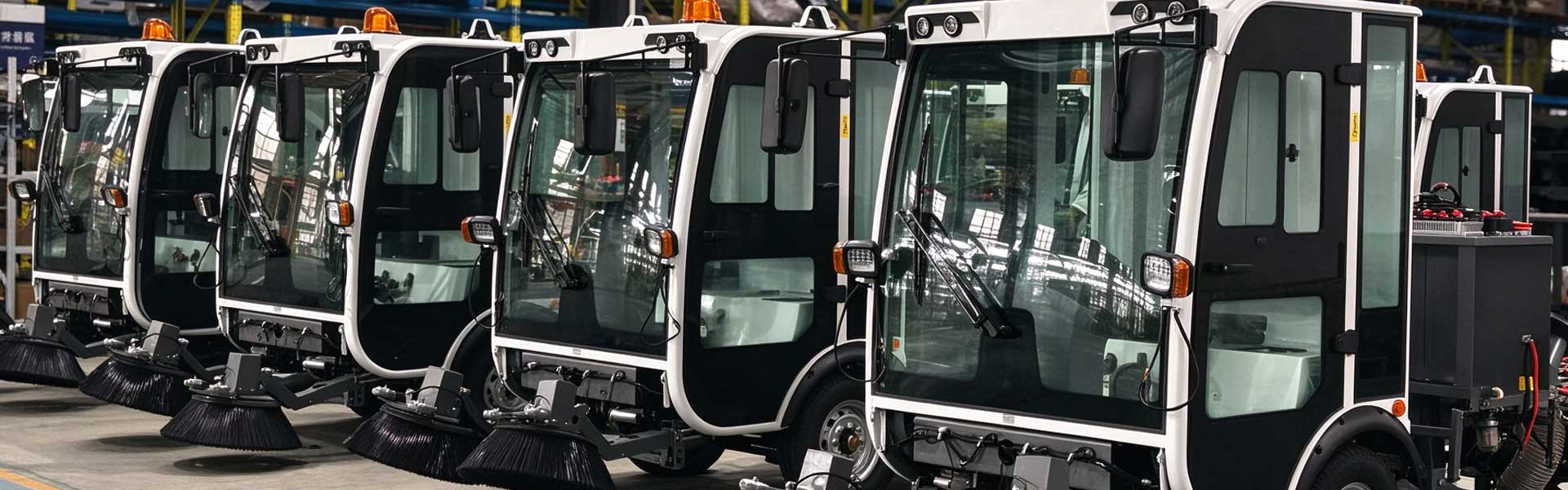
Factory floors collect dust, oil residue, packaging debris and dirt brought in by forklifts and workers. Manual mopping may work for small areas, but it becomes time-consuming when production workshops, assembly lines and warehouse aisles need regular cleaning.
Choosing the right floor scrubber can help businesses maintain cleaner floors while reducing manual labor. For factory owners, facility managers and equipment distributors, the key is to select a machine that matches the actual cleaning area, floor conditions and daily workload—not simply the model with the largest specifications.
1. Match the Floor Scrubber to Your Factory Size
The first step is to estimate how much floor area needs to be cleaned and how often the task must be completed.
For example, a factory with a 2,000 m² workshop that needs daily cleaning has different requirements from a logistics facility with 12,000 m² of warehouse space. A compact walk-behind machine may be suitable for smaller production areas, narrow aisles and spaces around equipment. A ride-on model may be a better option for larger, relatively open floors where operators need to cover more ground.
When comparing an industrial floor scrubber for sale, buyers should consider:
- Total floor area and the portion cleaned each day
- Available aisle width and turning space
- Floor material, such as sealed concrete, epoxy or tile
- Cleaning frequency and the level of dirt
- Whether the machine must work around production equipment or stored pallets
As a planning example, suppose a factory has 4,000 m² of floor space and allocates two hours for routine cleaning. The required average coverage is 2,000 m² per hour. This is a planning target, not a guaranteed machine output. Actual productivity depends on turns, obstacles, water refilling, charging and the amount of scrubbing required.
2. Choose the Right Cleaning Width and Productivity
Cleaning width affects how much floor a machine can cover per pass. A wider brush or cleaning path may improve productivity in open areas, while a narrower machine can be easier to maneuver around machinery and storage racks.
For an initial comparison, buyers can review the following illustrative categories:
| Factory application | Possible machine type | Main purchasing consideration |
|---|---|---|
| Small workshop or crowded production area | Compact walk-behind scrubber | Maneuverability and access |
| Medium-sized assembly or processing floor | Larger walk-behind scrubber | Cleaning width and tank capacity |
| Large factory or distribution warehouse | Ride-on floor scrubber | Productivity and operator comfort |
| Large floor with narrow aisles | Compact ride-on or walk-behind model | Turning space and aisle clearance |
Do not calculate the daily cleaning schedule from theoretical coverage alone. A machine advertised with a theoretical productivity of 2,500 m²/h will not necessarily clean 5,000 m² in two hours in a real factory. Obstacles, corners, heavily soiled areas and refill stops reduce effective coverage.
Ask the supplier for both the rated productivity and guidance on expected performance in your operating environment.
3. Check Tank Capacity and Battery Runtime
Tank capacity and battery runtime affect how long a machine can work before it needs to stop. If the recovery tank fills quickly or the clean-water tank needs frequent refilling, operators may spend more time on service stops and less time cleaning.
Consider an illustrative comparison:
- Factory A cleans a 1,500 m² assembly area once per shift.
- Factory B cleans an 8,000 m² warehouse floor every morning.
- Factory C cleans a workshop with frequent oil and dust contamination.
Factory A may prioritize compact dimensions and easy maneuvering. Factory B may need a larger-capacity ride-on machine and longer operating time. Factory C may need a model and cleaning process suitable for its specific floor contamination, with careful attention to compatible cleaning chemicals and recovery performance.
When requesting a factory floor cleaning machine, ask the supplier to confirm the clean-water tank, recovery tank, battery configuration, charging time and recommended operating duration for the specific model. If your cleaning schedule is fixed, explain how many hours the machine must work per shift.
4. Consider Floor Conditions and Daily Obstacles
Not all factory floors have the same cleaning requirements. Smooth epoxy floors, sealed concrete, tiled areas and floors with textured surfaces can respond differently to brush pressure, pad selection and cleaning solutions.
A suitable machine should be able to move safely through the facility and clean the intended surfaces without disrupting production. Before ordering, confirm:
- Whether the floor has slopes, ramps or uneven transitions
- The narrowest aisle and door opening
- The height of any restricted entrance
- The type of dirt or residue commonly found on the floor
- Whether operators need to clean around machines, workbenches or pallet racks
If the factory operates forklifts throughout the day, the cleaning schedule and machine route should also be planned to minimize interference with material handling.
5. Compare the Complete Purchase Package, Not Just the Price
Two floor scrubbers with similar headline specifications may have different purchase packages. One quotation may include batteries, charger, brushes, squeegee blades and basic spare parts, while another may list some of these items separately.
A professional industrial floor scrubber supplier should help you clarify the equipment configuration before you place an order.
Ask for a quotation that specifies:
- Exact model and rated specifications
- Brush or pad configuration
- Battery and charger included in the package
- Clean-water and recovery tank capacities
- Standard accessories and optional items
- Warranty coverage and spare-parts availability
- Packaging, lead time and shipping terms
- Operating instructions and after-sales support
For example, if one offer is $4,800 and another is $4,500, the lower-priced option may not be the better value if the battery, charger or essential accessories are excluded. These prices are illustrative only. Compare equivalent configurations and delivery terms before making a decision.
6. Estimate the Cost of Daily Cleaning
Purchase price is only one part of the total cost. Buyers should also consider labor, electricity, brushes, squeegee blades, batteries and routine maintenance.
For example, if manual cleaning requires three workers for two hours each day, the task consumes six labor-hours per day. If a suitable machine reduces the task to one operator working for two hours, the task would consume two labor-hours per day—a potential reduction of four labor-hours daily.
This is a simplified planning example, not a guaranteed saving. The actual result depends on local wages, floor conditions, cleaning standards and the machine selected. A supplier can help estimate a realistic cleaning workflow based on your floor plan and operating schedule.
7. Get a Floor Scrubber Recommendation for Your Factory
Before choosing a model, prepare a few details for the supplier:
- Total floor area and daily cleaning area
- Floor material and type of dirt
- Narrowest aisle and doorway dimensions
- Required working time per shift
- Preferred walk-behind or ride-on configuration
- Destination country and requested quantity
Voril supports international buyers with product selection, specification comparisons, quotations and export coordination for floor cleaning equipment. Share your factory cleaning requirements to request a suitable model recommendation and quotation.
Frequently Asked Questions
What type of floor scrubber is suitable for a factory?
A walk-behind scrubber can suit smaller or crowded work areas, while a ride-on scrubber is often worth considering for larger, open factory floors. The best choice depends on floor area, access, contamination and working hours.
How do I estimate the required cleaning capacity?
Divide the area that must be cleaned by the available cleaning time to calculate the average required coverage. Then allow for obstacles, turns, refilling and heavily soiled areas. Confirm realistic performance with the supplier.
What should a factory floor scrubber quotation include?
It should clearly state the model, specifications, battery and charger, brushes, squeegee components, accessories, warranty, spare parts, delivery terms and any optional costs.
Can I request a floor scrubber quotation for multiple factories or distribution?
Yes. Provide the intended application, quantity, destination country and preferred specifications so the supplier can prepare a more relevant quotation.
Contact Voril to discuss your factory floor cleaning requirements and compare suitable floor scrubber options.