
When buyers search for a floor sweeper, the first question is often:
“Should I buy an industrial or commercial model?”
But this is not always the best starting point.
A better question is:
“What kind of environment will the machine clean every day?”
A supermarket, warehouse, factory, logistics center and parking area can all require a floor sweeper, but their cleaning conditions are very different.
For example, a warehouse may need to remove dust and packaging debris, while a manufacturing workshop may have metal chips, heavier dust and production waste.
Therefore, the correct machine should be selected according to the cleaning environment, debris load and working area.
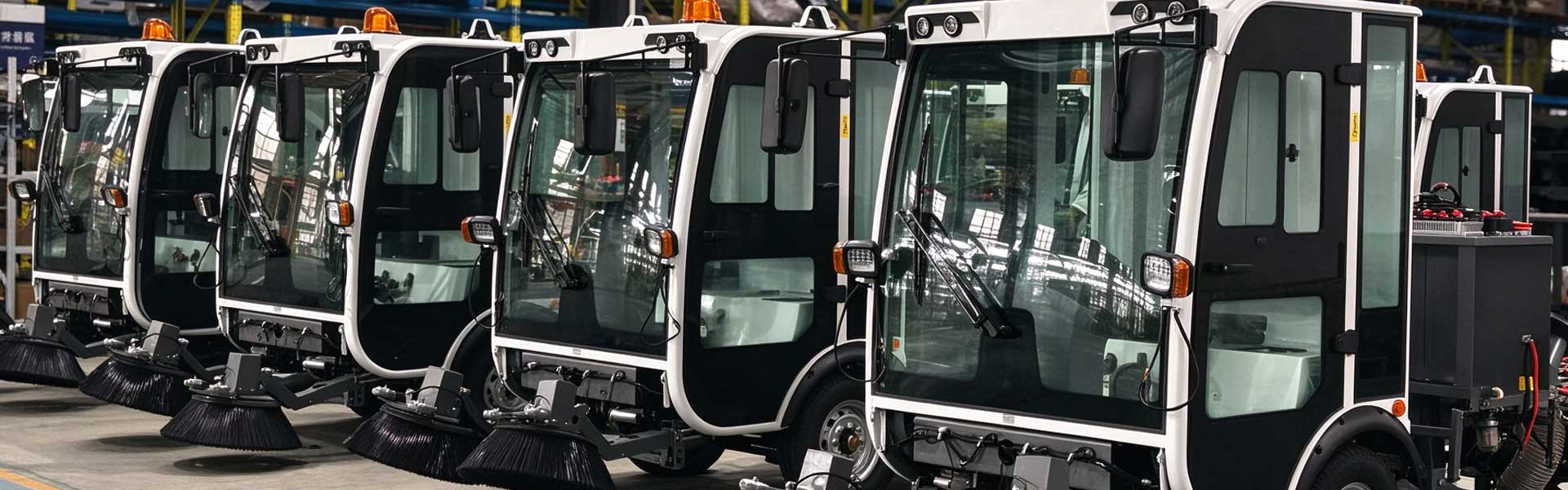
Current industrial sweeper models can range from compact machines to ride-on machines with sweeping widths around 1,400–2,000 mm and productivity ratings reaching 18,000 m²/h or more.
Start With the Type of Dirt
Before requesting a quotation from an industrial floor sweeper supplier, identify what the machine actually needs to collect.
Light Dust
Common in:
- Warehouses
- Supermarkets
- Shopping centers
- Parking areas
- Commercial buildings
Heavy Dust
Common in:
- Cement-related facilities
- Manufacturing workshops
- Construction areas
- Industrial warehouses
Larger Debris
Common in:
- Logistics centers
- Packaging facilities
- Workshops
- Outdoor industrial areas
Metal Chips and Production Waste
Common in:
- Metalworking factories
- Machinery workshops
- Automotive facilities
The heavier the debris, the more important the brush system, hopper capacity and machine construction become.
Warehouse Cleaning: Productivity Matters
Warehouses often have large open areas but also contain aisles, pallets and storage racks.
Imagine a warehouse with 30,000 m² of floor.
If the cleaning team wants to complete the main sweeping route within 3 hours, the required practical productivity is:
30,000 ÷ 3 = 10,000 m²/h
This does not mean the buyer should automatically purchase a machine rated at exactly 10,000 m²/h.
The published productivity of sweepers is generally based on defined operating conditions, while real cleaning is affected by turns, obstacles, debris collection and operator movement.
Therefore, the buyer should leave an operating margin.
For example, a machine rated around 12,000–15,000 m²/h may provide a more practical starting point for a 30,000 m² warehouse, depending on the actual route.
Factory Workshops Need More Than High Productivity
Factories can be more demanding than warehouses.
A workshop may have:
- Metal chips
- Dust
- Packaging waste
- Oil-contaminated debris
- Production residues
- Pallet fragments
In this environment, the buyer should look beyond the advertised sweeping capacity.
Important specifications include:
- Main brush width
- Side brush configuration
- Hopper capacity
- Dust-control system
- Brush pressure
- Ground clearance
- Machine construction
- Operating time
- Waste-dumping method
A machine with a large hopper can reduce the number of dumping interruptions.
For example, some current ride-on sweepers offer hopper capacities of around 150–260 L depending on model size.
For a factory producing significant quantities of dry debris every day, this can make a meaningful difference.
Logistics Centers Need a Different Balance
A logistics center typically has a combination of:
- Large open floors
- Long aisles
- Loading areas
- Pallet storage
- Frequent vehicle movement
- Cardboard and packaging debris
The machine needs sufficient productivity while remaining maneuverable.
Consider a logistics facility with 50,000 m² of floor.
If the cleaning target is five hours:
50,000 ÷ 5 = 10,000 m²/h practical productivity
A buyer might therefore compare machines rated around 12,000–18,000 m²/h rather than choosing a small walk-behind sweeper.
Current industrial ride-on sweeper examples include machines rated at approximately 18,000 m²/h with 2,000 mm sweeping width and 260 L hopper capacity.
This type of configuration is much more appropriate for large open areas than a compact commercial sweeper.
Parking Areas Require Outdoor Capability
Parking areas create a different cleaning environment.
The floor may contain:
- Sand
- Leaves
- Dust
- Small stones
- Vehicle debris
- Paper
- Packaging waste
The machine may also need to operate across ramps and uneven surfaces.
For this application, buyers should consider:
Machine size + sweeping width + hopper capacity + ground clearance + dust control
A compact indoor sweeper may be easy to maneuver but may not be the best choice for a large parking facility.
For a shopping center with a 20,000–30,000 m² parking area, a ride-on sweeper may provide significantly better productivity.
Supermarkets Need Maneuverability
A supermarket may have a large floor, but that does not automatically mean it needs an industrial ride-on sweeper.
There may be:
- Shelving
- Checkout counters
- Display stands
- Narrow aisles
- Customers
- Refrigeration equipment
Here, maneuverability becomes extremely important.
A compact commercial sweeper may be more appropriate than a large industrial machine.
The same principle applies to:
- Shopping malls
- Retail stores
- Exhibition halls
- Schools
- Commercial buildings
A smaller machine can reach more areas and reduce manual sweeping around obstacles.
Industrial or Commercial? Use This Simple Comparison
| Cleaning Environment | Recommended Direction |
|---|---|
| Small retail store | Compact commercial sweeper |
| Supermarket | Commercial / compact ride-on |
| Shopping mall | Commercial or medium ride-on |
| Warehouse | Industrial sweeper |
| Logistics center | Industrial ride-on sweeper |
| Factory workshop | Industrial sweeper |
| Large parking area | Industrial ride-on sweeper |
| Manufacturing plant | Heavy-duty industrial sweeper |
These are starting points rather than fixed rules.
A warehouse with narrow aisles may need a smaller machine, while a supermarket distribution center may require a large industrial ride-on model.
Machine Width Should Match the Site
One of the most common purchasing mistakes is focusing on sweeping width without checking the total machine dimensions.
For example, an industrial sweeper may have a sweeping width of 1,400 mm, but its total body width will be different.
Buyers should measure:
- Narrowest aisle
- Doorway
- Loading area
- Turning space
- Storage area
- Elevator if applicable
A current industrial sweeper comparison shows examples from approximately 920 mm walk-behind sweeping width to 1,400–2,000 mm ride-on configurations.
This gives buyers a useful starting range when comparing machines.
Hopper Capacity Can Reduce Downtime
Consider two machines:
Machine A
- 80 L hopper
- 5,000 m²/h productivity
Machine B
- 150 L hopper
- 10,000 m²/h productivity
For a large industrial facility, Machine B may be more appropriate because it can collect more debris while covering more floor per hour.
But for a small retail environment, Machine A may be easier to maneuver and less expensive to purchase.
The correct answer depends on the cleaning route.
Example: Choosing a Sweeper for a 40,000 m² Factory
Suppose a factory has:
Floor area: 40,000 m²
Cleaning frequency: Daily
Available cleaning window: 4 hours
Floor: Concrete
Debris: Dust + production waste
Required practical productivity:
40,000 ÷ 4 = 10,000 m²/h
The buyer should then compare industrial machines around this productivity range while checking:
- Hopper capacity
- Sweeping width
- Brush configuration
- Dust-control system
- Operating time
- Overall dimensions
- Maintenance requirements
A machine with an advertised productivity of 12,000–15,000 m²/h could provide useful operating margin, although the actual result should be confirmed through a route test.
Why Buyers Should Work With an Industrial Floor Sweeper Supplier
For distributors and importers, the supplier should provide more than a product catalogue.
A reliable industrial floor sweeper supplier should be able to help with:
- Machine selection
- Product specifications
- OEM requirements
- Battery configuration
- Spare parts
- Export packaging
- Documentation
- Shipping
- After-sales support
This becomes particularly important when purchasing multiple machines.
For example, a distributor ordering 10 sweepers may need consistent specifications across the complete batch so that spare parts and operator training can be standardized.
What to Include in Your Sweeper Inquiry
A good inquiry should include:
Application: Warehouse / Factory / Logistics / Parking
Floor area: 40,000 m²
Floor type: Concrete
Debris: Dust and packaging waste
Cleaning frequency: Daily
Cleaning time: 4 hours
Machine type: Ride-on preferred
Quantity: 5 units
Destination: Target country
This information allows the supplier to recommend an appropriate model rather than simply sending a generic catalogue.
Conclusion
Choosing between an industrial and commercial sweeper should start with the cleaning environment.
A supermarket may prioritize maneuverability.
A warehouse may prioritize productivity.
A factory may prioritize debris collection and durability.
A logistics center may need a combination of large sweeping width, hopper capacity and long operating time.
A parking facility may require a machine designed for larger outdoor areas.
For buyers looking for a commercial floor sweeper for sale, the best approach is therefore to define the application first and compare machine specifications second.
If you are sourcing sweepers for distribution, factory cleaning, warehouse operations or rental applications, provide your floor area, debris type, cleaning frequency and required cleaning time. A professional floor sweeper machine supplier can then recommend a configuration that fits your actual operating environment rather than simply selling you the largest machine available.