
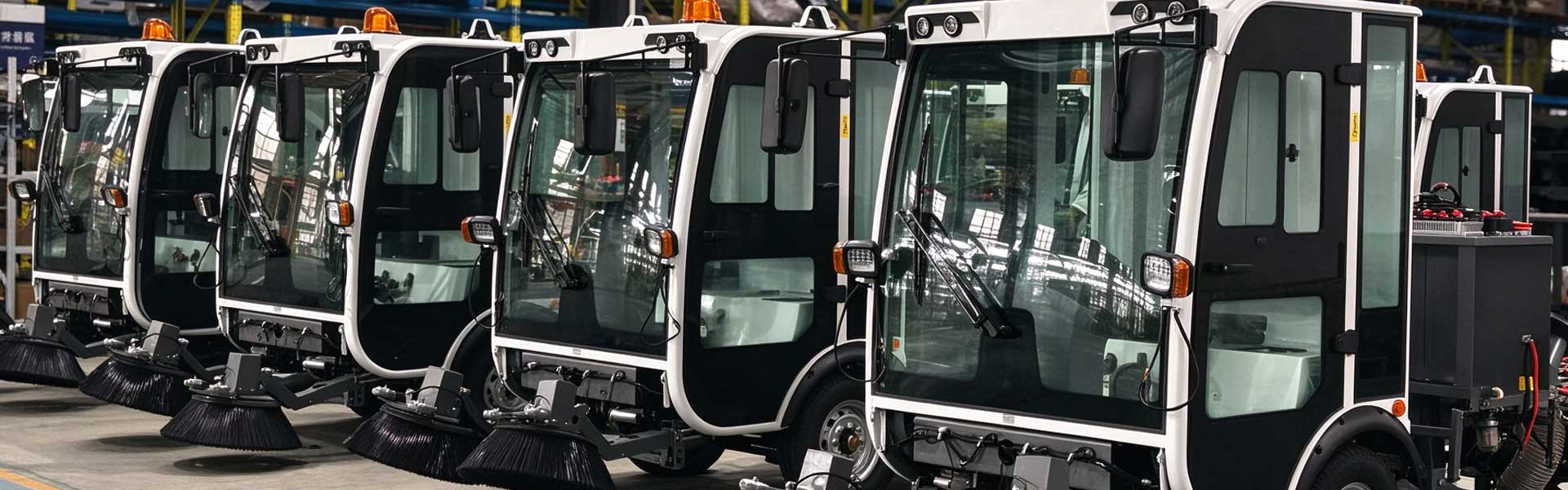
Battery runtime is an important consideration when purchasing an electric floor sweeper for a warehouse, factory, logistics center, parking facility, or commercial property. If the machine cannot complete the planned cleaning task on one charge, operators may need to interrupt work, recharge the battery, or reorganize the cleaning schedule.
However, there is no single runtime that suits every application. A compact walk-behind sweeper used for light cleaning may have very different operating requirements from a large ride-on sweeper working across a busy industrial facility.
For businesses comparing an electric floor sweeper for sale, the goal is to choose a machine that can handle the daily cleaning workload while fitting the available charging time, operating schedule, and maintenance budget.
1. How Many Hours Should an Electric Floor Sweeper Run?
The required runtime depends on how long the machine must operate between charging periods.
For preliminary purchasing purposes, buyers can divide their requirements into three broad operating patterns:
| Daily cleaning requirement | Runtime to investigate | Typical purchasing consideration |
|---|---|---|
| Short cleaning tasks | Around 1–2 hours | Compact areas and occasional cleaning |
| Regular warehouse cleaning | Around 3–4 hours | Daily cleaning across moderate floor areas |
| Extended industrial cleaning | Around 4–6 hours or more | Larger facilities and longer operating periods |
These are illustrative planning ranges, not guaranteed runtime specifications. Actual battery performance depends on the machine model, battery capacity and condition, cleaning intensity, surface conditions, temperature, and operator behavior.
Some models may operate for longer periods, while others may be designed for shorter cleaning tasks.
For example, a small workshop that needs 90 minutes of sweeping each morning may not require the same battery configuration as a distribution center that cleans multiple warehouse zones over a six-hour period.
The most useful starting point is to establish the actual daily operating time before comparing machines.
2. Match Battery Runtime to Your Cleaning Area
The size of the facility influences how long the sweeper must operate, but total floor area alone does not determine the required runtime.
A large, open warehouse may be easier to clean than a smaller factory filled with machinery, storage racks, and narrow passages.
When evaluating an industrial floor sweeper machine, consider:
- Total cleanable floor area
- Floor surface and amount of debris
- Width of operating aisles
- Number of obstacles and turning points
- Cleaning frequency
- Required completion time
- Operator experience and travel speed
For example, consider two facilities with 8,000 m² of cleanable floor space.
The first is a logistics warehouse with wide aisles and relatively light dust. The second is a manufacturing facility with machinery, workstations, and frequent debris accumulation.
Although their floor areas are identical, the second facility may require more time because operators must maneuver around equipment and clean more difficult areas.
This is why suppliers should evaluate the actual cleaning environment rather than recommending a machine based only on square meters.
3. Understand Cleaning Productivity and Battery Runtime Together
Battery runtime tells you how long the machine can operate, while cleaning productivity estimates how much area it can cover during that time.
Both figures are needed to assess whether a sweeper can complete the planned workload.
For example, suppose an electric floor sweeper has a rated cleaning productivity of 8,000 m²/h and an estimated operating time of four hours under specified conditions.
Multiplying these figures gives a theoretical four-hour coverage of 32,000 m².
However, this is a nominal calculation, not a guarantee that the machine can clean 32,000 m² of real-world floor space. Rated productivity may assume relatively continuous operation and does not necessarily account for obstacles, turning, overlapping passes, debris conditions, and other interruptions.
A more useful purchasing estimate applies an operating-efficiency factor to the theoretical productivity.
For example, if a facility achieves 50% of the rated productivity in practice, a machine rated at 8,000 m²/h would cover approximately 4,000 m² per operating hour under that assumed condition.
At four hours of runtime, the illustrative coverage would be approximately 16,000 m².
The 50% figure is only an example, not a standard efficiency rate. Actual results should be estimated from the machine design, floor plan, debris conditions, and a realistic cleaning trial.
When comparing a commercial electric floor sweeper, ask the supplier to distinguish between rated cleaning productivity and expected practical coverage.
4. What Affects Electric Floor Sweeper Battery Runtime?
Several factors influence how long an electric sweeper can operate before charging.
Battery Capacity
Battery capacity is an important starting point, but it should not be considered in isolation.
Two machines with similar battery ratings may deliver different operating times because of differences in motor power, machine size, cleaning systems, and operating conditions.
Ask the supplier for the battery voltage, rated capacity, battery type, and expected runtime under clearly stated conditions.
Cleaning Intensity
A machine collecting light dust on a smooth warehouse floor may operate differently from one handling heavier debris across a demanding industrial environment.
Depending on the design, the use of suction systems, side brushes, and other powered components can influence energy consumption.
Floor Conditions
Smooth concrete, rough concrete, ramps, expansion joints, and uneven surfaces can affect the machine's workload.
Facilities with frequent ramps or demanding floor conditions should explain these details during equipment selection.
Operator Behavior
Frequent stopping, reversing, turning, and restarting can influence practical productivity and energy consumption.
A well-planned cleaning route may help the operator complete the job more efficiently.
Battery Age and Maintenance
Battery performance can change over time. Incorrect charging, unsuitable storage conditions, poor maintenance, or battery deterioration may reduce available operating time.
Buyers should follow the manufacturer's charging and maintenance instructions rather than assuming that the original runtime will remain unchanged throughout the battery's service life.
5. Choose the Right Sweeper for One-Shift or Multi-Shift Operations
The required battery configuration depends heavily on the facility's work schedule.
One-Shift Operations
A factory or warehouse that cleans for two to four hours per day may be able to use a machine that recharges outside the cleaning period.
For example, a facility operating from 8:00 a.m. to 5:00 p.m. may schedule sweeping in the morning and recharge the machine during the afternoon or overnight, depending on the cleaning workload and charging requirements.
The key is to ensure that the available operating time covers the planned task with a reasonable allowance for changing conditions.
Extended Daily Cleaning
A facility that needs four to six hours of sweeping may require a higher-capacity battery configuration or a machine designed for longer operating periods.
The purchasing manager should also consider whether the cleaning schedule includes breaks, debris disposal, and movement between different buildings or zones.
Multi-Shift Operations
Warehouses and factories operating two or three shifts may require a more detailed charging plan.
Depending on the selected battery system and the manufacturer's recommendations, the facility may need scheduled charging periods, a suitable charging location, or additional equipment to maintain cleaning availability.
Before purchasing, confirm the expected operating time, charging time, permitted charging frequency, and battery replacement arrangements.
Do not assume that a machine can operate continuously across multiple shifts simply because its battery capacity appears sufficient.
6. Walk-Behind or Ride-On Electric Floor Sweeper?
Battery runtime should be considered together with machine size and cleaning productivity.
A walk-behind sweeper may be suitable for smaller facilities, confined areas, and locations where operators need to maneuver around equipment.
A ride-on sweeper may be more appropriate for larger open spaces where operators must cover long routes and collect dust or debris across broad floor areas.
Consider these examples:
| Facility type | Configuration worth evaluating | Main consideration |
|---|---|---|
| Small workshop | Walk-behind sweeper | Compact size and maneuverability |
| Medium-sized warehouse | Walk-behind or compact ride-on | Cleaning time and aisle layout |
| Large logistics center | Ride-on sweeper | Productivity and travel distance |
| Large industrial floor | Ride-on sweeper | Debris capacity and operating time |
| Parking facility | Suitable ride-on configuration | Floor conditions, ramps, and debris load |
These are general purchasing guidelines. Actual selection should account for the sweeper's cleaning width, debris hopper capacity, turning radius, battery specifications, and operating conditions.
For example, a facility with 5,000 m² of open floor space and a strict cleaning deadline may benefit from evaluating a ride-on model, while a smaller facility with narrow work areas may prefer a compact walk-behind machine.
7. How to Plan Charging Without Interrupting Cleaning Operations
A practical charging plan can help prevent avoidable downtime.
Before selecting a sweeper, estimate how long the machine needs to work, when it can be recharged, and whether the battery can support the planned schedule.
Consider the following steps:
Step 1: Establish the daily cleaning workload. Identify the total floor area and the time available for sweeping.
Step 2: Confirm the expected runtime. Request a realistic estimate based on the machine configuration and intended application.
Step 3: Check charging time. Confirm the required charging period and the recommended charging method.
Step 4: Identify the charging location. Ensure that the facility can provide the required electrical supply and a suitable charging area.
Step 5: Plan for changing conditions. Allow for heavier debris, additional cleaning tasks, and possible reductions in battery performance over time.
For example, if a warehouse requires three hours of sweeping every day, selecting a machine with an estimated runtime of exactly three hours under ideal conditions may leave little allowance for unexpected work.
A more practical selection process considers operating conditions and an appropriate runtime margin rather than relying on the best-case specification.
8. What Battery Specifications Should You Check Before Buying?
When evaluating an electric floor sweeper for sale, ask the supplier to provide clear information about the battery and charging system.
Important specifications include:
- Battery type
- Rated voltage and capacity
- Estimated operating time under stated conditions
- Charging time
- Charger specifications
- Expected battery service life under recommended use
- Battery replacement availability
- Warranty coverage
- Charging and maintenance instructions
Also confirm whether the quoted machine includes the battery and charger, especially when comparing offers from different suppliers.
For international purchases, verify the electrical supply requirements, charger compatibility, and any relevant battery transportation arrangements.
The complete battery configuration should be included in the quotation to make cost comparisons more meaningful.
9. Example: Selecting a Sweeper for a 12,000 m² Warehouse
Imagine a logistics warehouse with 12,000 m² of cleanable floor space. The facility needs daily sweeping before the morning shift, and the cleaning team has approximately three hours to complete the task.
The purchasing manager should compare machines based on:
- Rated cleaning productivity
- Expected practical coverage
- Working width
- Debris hopper capacity
- Estimated operating time
- Battery charging requirements
- Aisle width and turning space
- Floor conditions and debris levels
Suppose a candidate machine has a rated productivity of 12,000 m²/h. If practical productivity reaches 40% of that rating under the facility's conditions, the estimated coverage would be 4,800 m²/h.
At that illustrative rate, three hours would cover approximately 14,400 m², providing a nominal margin over the 12,000 m² target.
However, the 40% assumption must be validated for the actual application. If the warehouse has many obstacles, heavy debris, or a complex cleaning route, actual productivity may be lower.
A realistic supplier assessment or on-site cleaning trial can help determine whether the proposed machine can meet the schedule.
10. How Much Should You Spend on an Electric Floor Sweeper?
The purchase price depends on machine size, cleaning width, battery configuration, hopper capacity, control system, and other features.
A compact walk-behind sweeper may have a lower initial price, while a larger ride-on machine may require a greater investment but provide higher productivity for suitable applications.
The best value depends on the total cost of completing the required cleaning work.
When comparing models, consider:
- Initial purchase price
- Battery and charger configuration
- Cleaning productivity
- Operating time per charge
- Routine maintenance requirements
- Consumables and replacement parts
- Warranty and technical support
- Expected daily workload
For example, a lower-priced machine may be sufficient for a workshop with a short cleaning route. A large distribution center may find that a higher-capacity model better matches its cleaning schedule, provided that the productivity and operating-cost advantages justify the investment.
Avoid choosing equipment solely by advertised runtime or rated square meters per hour. The combination of battery performance, practical cleaning productivity, and facility layout determines the real value.
11. Request a Quotation for an Electric Floor Sweeper
The correct electric floor sweeper should provide sufficient operating time, practical cleaning productivity, and suitable maneuverability for your facility.
Before requesting a quotation, prepare the following information:
- Total cleanable floor area
- Floor surface and type of debris
- Required daily cleaning time
- Preferred walk-behind or ride-on configuration
- Required operating time per charge
- Available charging arrangements
- Destination country and quantity required
With these details, a supplier can compare suitable machine configurations and provide a more meaningful quotation.
Contact our team for electric floor sweeper specifications, battery runtime information, and pricing. Share your facility size, cleaning schedule, and operating conditions to help identify a suitable sweeper for your business.