
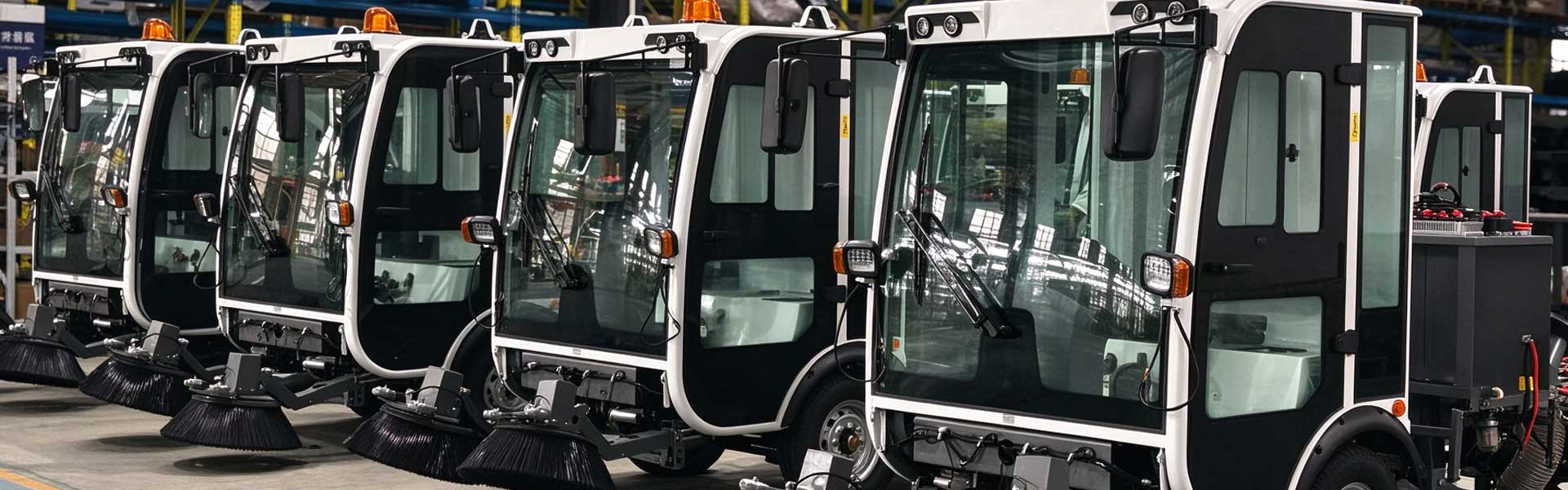
For commercial and industrial buyers, choosing a floor scrubber is not simply a matter of selecting the machine with the highest cleaning rate.
A warehouse may have 10,000 m² of floor, but only 6,000 m² may need daily cleaning. A factory may have a large production area but narrow aisles, heavy traffic and equipment that reduces the machine's actual working speed.
The better purchasing question is:
How much floor needs to be cleaned, how often does it need to be cleaned, and how much time is available for each cleaning cycle?
That is the basis for selecting the right floor scrubber cleaning capacity.
1. Start With the Actual Cleaning Area
The total size of a building does not necessarily equal the area that a machine must clean.
Before requesting a quotation, buyers should identify:
- Actual hard-floor area
- Cleaning area per shift
- Cleaning frequency
- Available cleaning time
- Narrowest aisle or doorway
- Floor condition
- Expected traffic during cleaning
For example, a 10,000 m² warehouse may contain 2,000 m² of storage areas that do not require daily scrubbing. If the actual cleaning route is 8,000 m², the machine should be selected around the 8,000 m² daily route, not the entire building.
This simple distinction can prevent buyers from paying for a machine that is unnecessarily large.
Current commercial floor-scrubber buying guidance similarly recommends calculating the cleanable route and available cleaning window before comparing working width, tank capacity and machine productivity.
2. Use Cleaning Time to Calculate the Required Capacity
A simple purchasing calculation is:
Required practical cleaning capacity = Cleaning area ÷ Available cleaning time
For example:
- Cleaning area: 6,000 m²
- Available time: 3 hours
- Required practical capacity: 2,000 m²/h
This means the buyer should look for a machine capable of achieving approximately 2,000 m²/h under actual operating conditions.
However, manufacturers' maximum productivity figures are generally based on relatively ideal conditions. Turning, obstacles, refilling, recovery-tank emptying and traffic can reduce actual productivity.
For purchasing, it is therefore safer to leave some capacity margin rather than choosing a machine that only meets the mathematical minimum.
3. Traffic Can Change the Right Machine Size
Traffic is one of the easiest factors to overlook.
Consider two facilities with exactly the same 8,000 m² floor area.
Facility A: Open Warehouse
The warehouse has:
- Wide aisles
- Few obstacles
- Long straight cleaning routes
- Low pedestrian traffic
- Regular daily cleaning
A larger ride-on scrubber can work efficiently because the operator spends more time moving forward and less time turning.
Facility B: Busy Manufacturing Plant
The plant has:
- Production equipment
- Pallets
- Workers moving through the area
- Narrow passages
- Frequent turns
- Multiple cleaning zones
A smaller or more maneuverable scrubber may actually complete the route faster, even if its published capacity is lower.
This is why an industrial floor scrubber should be selected according to the actual route rather than the largest number printed on the specification sheet.
4. Daily Cleaning Usually Justifies More Capacity
Cleaning frequency also affects the purchasing decision.
If a facility is cleaned once a week, a smaller machine may be sufficient because the cleaning window can be longer.
If the same facility must be cleaned every day, particularly before production starts, the machine needs to complete the route quickly and consistently.
For example:
Warehouse: 12,000 m²
Cleaning frequency: Daily
Available time: 4 hours
Required practical capacity:
12,000 ÷ 4 = 3,000 m²/h
A machine with significantly more capacity than 3,000 m²/h gives the operator additional time for corners, obstacles and heavily soiled areas.
That capacity margin can be more valuable than simply buying the lowest-cost machine.
5. Match Capacity With Machine Type
Different cleaning routes usually call for different machine classes.
| Cleaning Requirement | Practical Starting Point |
|---|---|
| Small rooms and restricted areas | Compact walk-behind scrubber |
| Medium commercial areas | Self-propelled walk-behind scrubber |
| Large open warehouses | Ride-on floor scrubber |
| Large factories | High-capacity ride-on scrubber |
| Long daily cleaning routes | Larger tank + higher-capacity machine |
For example, a compact walk-behind machine may be ideal for a 3,000–5,000 m² route with many obstacles. A large warehouse with a 20,000 m² daily route may benefit much more from a ride-on machine.
The goal is not to buy the biggest floor scrubber machine. The goal is to buy the machine that can finish the required route within the available cleaning window.
6. Tank Capacity Matters as Much as Cleaning Rate
A machine may have a high theoretical cleaning capacity but still lose productivity if the operator has to stop frequently.
For larger facilities, buyers should compare:
- Clean-water tank
- Recovery tank
- Battery runtime
- Charging time
- Water filling location
- Drainage location
- Expected cleaning cycle
For example, if a large machine can clean quickly but needs repeated water refilling during a shift, its real productivity may be lower than expected.
A larger solution and recovery tank can reduce interruptions on long warehouse and factory routes.
7. Example: Choosing a Scrubber for a 15,000 m² Warehouse
Suppose a logistics warehouse has:
- 15,000 m² cleanable floor
- Concrete floor
- Forklift traffic
- Moderate dust and tire marks
- Daily cleaning
- Maximum cleaning window of 4 hours
The basic requirement is:
15,000 ÷ 4 = 3,750 m²/h practical cleaning rate
A buyer should therefore avoid selecting a machine simply because its brochure says 3,750 m²/h.
The published rating may represent ideal conditions. The actual route includes turning, pallets, traffic and other interruptions.
A machine with a higher rated capacity gives the operator a useful buffer.
For a warehouse with long open aisles, a ride-on machine around the 4,500 m²/h or higher class may therefore be a more practical starting point than a smaller machine operating continuously at its limit.
8. When a Smaller Scrubber Is Actually the Better Purchase
More capacity is not always better.
A large machine can become inefficient when the site has:
- Narrow doors
- Small rooms
- Tight corners
- Narrow aisles
- Elevators
- Multiple separate cleaning areas
- Heavy pedestrian traffic
In these situations, a smaller walk-behind machine can spend less time maneuvering.
For example, a 5,000 m² facility with many rooms may be better served by a compact machine than a large ride-on model.
The best industrial floor scrubber is therefore determined by both productivity and accessibility.
9. Use a 20–30% Capacity Buffer for Purchasing
For commercial procurement, it is generally safer to avoid selecting a machine whose rated capacity exactly matches the calculated minimum.
Industrial cleaning guidance recommends allowing a capacity buffer because real routes include turning, obstacles and other productivity losses. A 20–30% planning margin is a useful starting point before an on-site test.
For example:
Required practical rate: 3,000 m²/h
Instead of purchasing around exactly 3,000 m²/h, a buyer could evaluate machines capable of approximately:
3,600–3,900 m²/h or higher
The final selection should still consider working width, maneuverability, tank capacity and battery runtime.
10. Buy for the Cleaning Route, Not Just the Building Size
When requesting a quotation for a floor scrubber machine, send the supplier the following information:
- Total floor area
- Actual cleaning area per session
- Cleaning frequency
- Available cleaning time
- Floor material
- Soil level
- Narrowest doorway or aisle
- Whether the route has ramps
- Walk-behind or ride-on preference
- Destination country
This allows the supplier to recommend a machine based on your actual operating conditions instead of simply sending the largest model available.
Final Purchasing Recommendation
Choosing floor scrubber capacity is essentially a productivity calculation.
Cleaning area + cleaning frequency + available time + traffic + site layout = the right machine size.
For a small, congested facility, maneuverability may be more important than maximum capacity. For a large warehouse or factory, higher capacity, larger tanks and longer operating time can significantly improve daily cleaning efficiency.
If you are comparing models for a commercial or industrial project, provide the supplier with your cleaning area, available cleaning time and site layout. A professional supplier can then recommend the appropriate industrial floor scrubber instead of simply quoting the biggest machine.