
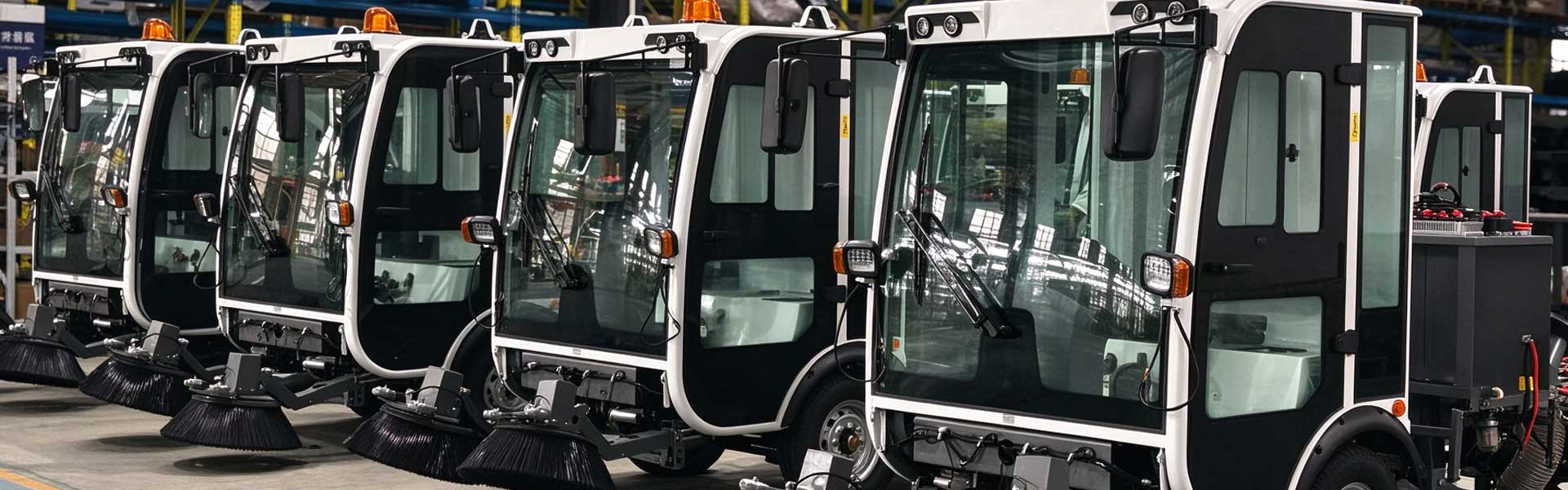
When buyers search for floor sweeper price, they often expect to find one simple number.
In reality, the price of a commercial floor sweeper can vary significantly depending on the machine type, cleaning width, battery system, hopper capacity, filtration, driving system and level of automation.
For example, current commercial sweeper listings show battery walk-behind machines around $2,200–$2,850, while a 49-inch ride-on sweeper can be around $5,500–$5,700. More specialized industrial ride-on machines can exceed $15,000 or even $20,000.
This means the better question is not:
"What is the cheapest floor sweeper?"
It is:
"What machine configuration gives me the required cleaning capacity at a reasonable total operating cost?"
For factories, warehouses, workshops and distribution centers, understanding the factors behind floor cleaning machine cost makes it much easier to compare quotations.
Typical Floor Sweeper Price Ranges
The market covers several very different types of equipment.
| Machine Type | Typical Market Example | Typical Application |
|---|---|---|
| Manual push sweeper | Around $100–$500+ | Small areas |
| Battery walk-behind sweeper | Around $1,700–$7,500+ | Workshops, warehouses, commercial areas |
| Compact ride-on sweeper | Around $5,500–$10,000+ | Medium warehouses and factories |
| Industrial ride-on sweeper | $10,000–$20,000+ | Large factories and logistics facilities |
| Large industrial machines | $20,000+ | Large-area industrial cleaning |
These figures are market reference ranges rather than fixed quotations. Actual prices vary by brand, configuration, country, shipping, batteries and optional equipment. Current U.S. commercial listings, for example, show ride-on models around $5,515–$8,999, while some premium industrial ride-on sweepers are listed above $16,000–$20,000.
For an importing buyer, the factory quotation can also be substantially different from a retail-market price because the final cost may include or exclude freight, local distribution, taxes, warranty services and other charges.
1. Cleaning Width Is One of the Biggest Price Factors
One of the first specifications to compare is sweeping width.
A compact machine may have a cleaning path around 600–1,000 mm, while larger commercial ride-on sweepers can have working widths of 1,200–2,000 mm or more.
For example, one commercial ride-on electric sweeper lists a 1,500 mm working width without side brushes and up to 2,200 mm with two side brushes, with a theoretical sweeping capacity of up to 22,000 m²/h. A larger 2,000 mm configuration reaches up to 27,000 m²/h with two side brushes.
A wider machine generally costs more because it requires:
- Larger brush systems
- More powerful drive components
- Larger body dimensions
- Higher-capacity dust collection
- Larger battery requirements
- Stronger chassis construction
But wider does not automatically mean better.
Example: 5,000 m² Workshop
Suppose a workshop has:
5,000 m² of cleanable floor
with relatively narrow production aisles.
A very large 2,000 mm sweeper may have excellent theoretical productivity, but its size may make it difficult to move between machines and storage racks.
A smaller 1,000–1,400 mm commercial floor sweeper could be easier to operate in this environment.
The buyer should therefore compare:
Cleaning width + machine width + turning radius + actual floor layout
rather than buying the largest machine available.
2. Walk-Behind or Ride-On Makes a Major Difference
The machine's driving method has a direct impact on both price and productivity.
Walk-Behind Floor Sweeper
A walk-behind sweeper is generally more compact.
It can be suitable for:
- Small warehouses
- Workshops
- Retail stores
- Garages
- Narrow aisles
- Back-of-house areas
Current commercial listings show battery walk-behind sweepers from roughly $1,770 to $7,600, depending on width, battery, dust control and other specifications.
Ride-On Floor Sweeper
A ride-on model allows the operator to sit on the machine while cleaning.
This becomes more useful as floor area increases.
For example, one current 49-inch ride-on sweeper is listed at approximately $5,515, with a rated productivity of around 77,500 ft²/h, equivalent to roughly 7,200 m²/h, while another retail listing gives a similar 49-inch model at about $5,700.
The price difference therefore needs to be considered together with labor productivity.
3. Battery Type and Capacity Affect the Price
For an electric commercial floor sweeper, the battery is an important part of the equipment cost.
Different machines may use:
- Lead-acid batteries
- AGM batteries
- Lithium batteries
- Different voltage and Ah configurations
A larger battery system can provide longer operating time but can also increase the purchase price and machine weight.
For example, a current 49-inch commercial ride-on sweeper lists a 48V 52Ah battery with up to approximately 3 hours of runtime per charge.
Another electric ride-on sweeper specification lists different configurations while maintaining a theoretical sweeping capacity of up to 22,000 m²/h.
Example
A factory cleans its production area:
2 hours every morning
and
1 hour every afternoon
Total:
3 hours/day
A machine with approximately 3 hours of practical operating time may be considered, but the buyer should verify actual runtime under the expected cleaning conditions.
If the factory needs 6 hours of cleaning every day, a small battery configuration may create unnecessary charging interruptions.
Therefore, when comparing floor sweeper price, don't look at the battery price separately from the machine.
Look at:
Battery capacity + runtime + charging time + expected daily cleaning schedule.
4. Hopper Capacity Changes Practical Productivity
The dust hopper is another factor affecting the equipment configuration and price.
A small commercial sweeper may use a hopper around 30–60 L, while larger ride-on machines can use hoppers of 100–300 L or more.
For example, one industrial electric sweeper configuration lists a 260 L dirt tank, while a larger 2,000 mm model lists 305 L.
A larger hopper is particularly useful when the facility produces significant amounts of:
- Dust
- Packaging waste
- Paper
- Wood particles
- Metal debris
- Sand
- General workshop waste
Example
Consider two machines:
Machine A: 60 L hopper
Machine B: 160 L hopper
If the factory generates a large amount of debris, Machine A may require more frequent emptying.
Even if Machine A has a lower purchase price, the additional stopping and dumping time can reduce practical productivity.
This is why a buyer should consider cost per completed cleaning route, not only purchase price.
5. Filtration and Dust Control Add Value
For indoor factories and workshops, filtration can have a significant effect on the equipment configuration.
A commercial sweeper may include:
- Dust filter
- Large filter area
- Automatic filter shaker
- Vacuum system
- Water dust suppression
- Sealed dust collection system
These features can increase the machine's price but may be important when the facility generates fine dust.
For example, a current electric sweeper specification lists a filtration system together with a water-spray dust-control function, while another industrial configuration lists a 6 m² filter area.
If the machine is mainly collecting large cardboard pieces and packaging waste, the filtration requirement may be different from a workshop generating fine concrete or wood dust.
So the buyer should tell the supplier what type of debris the machine will collect.
6. Cleaning Productivity Matters More Than Machine Price Alone
Suppose two companies are comparing machines.
Machine A
- Price: $4,000
- Cleaning capacity: 4,000 m²/h
- Walk-behind
- Smaller hopper
Machine B
- Price: $6,000
- Cleaning capacity: 8,000 m²/h
- Ride-on
- Larger hopper
At first glance, Machine A appears cheaper.
But suppose the facility needs to clean:
16,000 m² every day.
Theoretical cleaning time:
Machine A:
16,000 ÷ 4,000 = 4 hours
Machine B:
16,000 ÷ 8,000 = 2 hours
Even before considering actual route efficiency, the second machine could significantly reduce the time spent on daily cleaning.
If the cleaning operator's loaded labor cost were $15/hour, the theoretical difference would be:
2 hours × $15 = $30/day
Over 300 working days:
$30 × 300 = $9,000
This is only an example calculation, not a guaranteed saving. Actual results depend on route layout, operator efficiency, debris levels and machine utilization.
But it demonstrates why floor cleaning machine cost should be evaluated together with productivity.
7. Factory-Direct and Retail Floor Sweeper Prices Are Different
Another reason buyers see very different floor sweeper price results online is the sales channel.
A machine can pass through:
Manufacturer → Exporter → Distributor → Dealer → End Customer
Each stage may add:
- Margin
- Freight
- Local warehouse cost
- Warranty service
- Sales support
- Taxes
- Spare-parts inventory
For example, current U.S. retail listings show a 49-inch ride-on sweeper around $5,500–$5,700, while premium industrial ride-on machines can be listed at more than $16,000.
Therefore, an importer comparing a China factory quotation with a local dealer quotation should not compare the numbers without checking what is included.
Ask:
Is the quotation EXW, FOB, CIF or another Incoterm?
Also check:
- Battery included?
- Charger included?
- Side brushes included?
- Spare brushes included?
- Dust filter included?
- Warranty included?
- Installation included?
- Spare parts included?
- Shipping included?
A $4,500 machine with a basic configuration is not directly comparable with a $6,000 machine that includes additional accessories and service.
8. Machine Size Should Match the Cleaning Area
A practical way to control floor cleaning machine cost is to match machine size with the actual facility.
Small Commercial Area
For small shops, workshops and narrow areas:
Walk-behind sweeper
may provide sufficient productivity.
There is less reason to pay for a large ride-on machine if the operator can efficiently cover the entire facility with a compact machine.
Medium Warehouse
For medium-sized warehouses:
Battery walk-behind or compact ride-on
may be considered.
Current commercial products include 40-inch battery walk-behind sweepers around $2,200, while 49-inch ride-on machines are around $5,500–$5,700 in some U.S. listings.
Large Factory
For large manufacturing facilities:
Ride-on commercial floor sweeper
can provide substantially greater cleaning productivity.
For very large industrial sites, specialized machines can cost considerably more than standard commercial models. Current listings show industrial ride-on machines above $20,000 in some configurations.
9. What Makes a Commercial Floor Sweeper More Expensive?
When comparing two quotations, check these specifications:
| Specification | Potential Effect on Price |
|---|---|
| Sweeping width | Wider usually costs more |
| Walk-behind / ride-on | Ride-on generally costs more |
| Battery capacity | Larger battery increases equipment cost |
| Lithium battery | Can increase initial purchase price |
| Hopper capacity | Larger hopper usually adds cost |
| Filtration | Larger/more advanced filtration can add cost |
| Side brushes | Additional cleaning width and components |
| Automatic filter shaker | Adds equipment and automation |
| Hydraulic high dump | Adds significant cost |
| Steel chassis | More robust construction can increase cost |
| Control system | More functions can increase cost |
| Spare parts package | Increases initial purchase cost |
| Quantity | Bulk orders may receive different pricing |
The right configuration depends on the customer's application.
A buyer cleaning a 2,000 m² workshop does not necessarily need the same machine as a buyer cleaning a 30,000 m² logistics warehouse.
10. A Practical Commercial Floor Sweeper Price Example
Suppose a distributor receives an inquiry from a manufacturing company.
The customer provides:
- Floor area: 12,000 m²
- Floor: Concrete
- Cleaning frequency: Daily
- Cleaning time: Maximum 2.5 hours
- Debris: Dust + packaging waste
- Application: Indoor factory
- Operator: 1 person
Required average productivity:
12,000 ÷ 2.5 = 4,800 m²/h
The distributor can now search for a machine with a theoretical capacity above this level.
Instead of asking:
"What is your cheapest floor sweeper?"
the buyer can ask:
"We need to clean approximately 12,000 m² of concrete factory floor within 2.5 hours. Please recommend a battery-powered ride-on or walk-behind model and provide the working width, theoretical cleaning capacity, hopper volume, battery runtime and quotation."
This produces a much more useful equipment comparison.
11. Don't Forget the Cost of Ownership
The purchase price is only the beginning.
For commercial equipment, consider:
Initial Price + Shipping + Battery + Consumables + Maintenance + Spare Parts + Labor + Downtime
Important consumable and maintenance items may include:
- Main brush
- Side brush
- Dust filter
- Battery
- Charger
- Drive components
- Wheels
- Electrical components
A machine with a slightly higher purchase price may still be commercially attractive if spare parts are easy to obtain and the machine is designed for regular industrial use.
For distributors, this is especially important because after-sales support can influence repeat orders.
12. What Should You Ask Before Buying?
When requesting a commercial floor sweeper quotation, provide the supplier with:
Facility Information
- Floor area
- Floor type
- Indoor or outdoor
- Narrowest aisle
- Doorway width
- Cleaning frequency
Debris Information
- Fine dust
- Sand
- Metal chips
- Wood particles
- Paper
- Packaging waste
Machine Requirements
- Sweeping width
- Theoretical cleaning capacity
- Hopper volume
- Battery type
- Working time
- Charging time
- Filter system
- Side brush configuration
Commercial Requirements
- Quantity
- Destination country
- Required Incoterm
- Spare parts
- Warranty
- Packaging
- Delivery time
With these details, the supplier can provide a quotation based on your actual application rather than sending a generic price.
What Is a Reasonable Floor Sweeper Price?
There is no single price that applies to every commercial sweeper.
As a current market reference, commercial floor sweepers can range from under $2,000 for some battery walk-behind models to around $5,500–$9,000 for certain ride-on models, while larger industrial machines can exceed $15,000–$20,000.
For an importer or distributor, the factory quotation can be different from these retail figures depending on configuration, quantity, Incoterms and destination.
The most useful way to compare a floor sweeper price is therefore:
Price ÷ Practical Cleaning Productivity
rather than simply comparing the purchase price.
For example, a $4,000 sweeper that requires four hours to complete a cleaning route and a $6,000 sweeper that can complete the same route in two hours represent very different operating costs.
Looking for a Commercial Floor Sweeper?
If you are sourcing an electric commercial floor sweeper for a warehouse, factory, workshop or distribution center, send us:
Floor Area + Floor Type + Debris Type + Required Cleaning Time + Indoor/Outdoor + Desired Cleaning Width
We can recommend a suitable configuration and provide the machine specifications, factory quotation and available options.
For distributors, we can also discuss different sweeping widths, hopper capacities, battery configurations and production quantities according to your target market.