
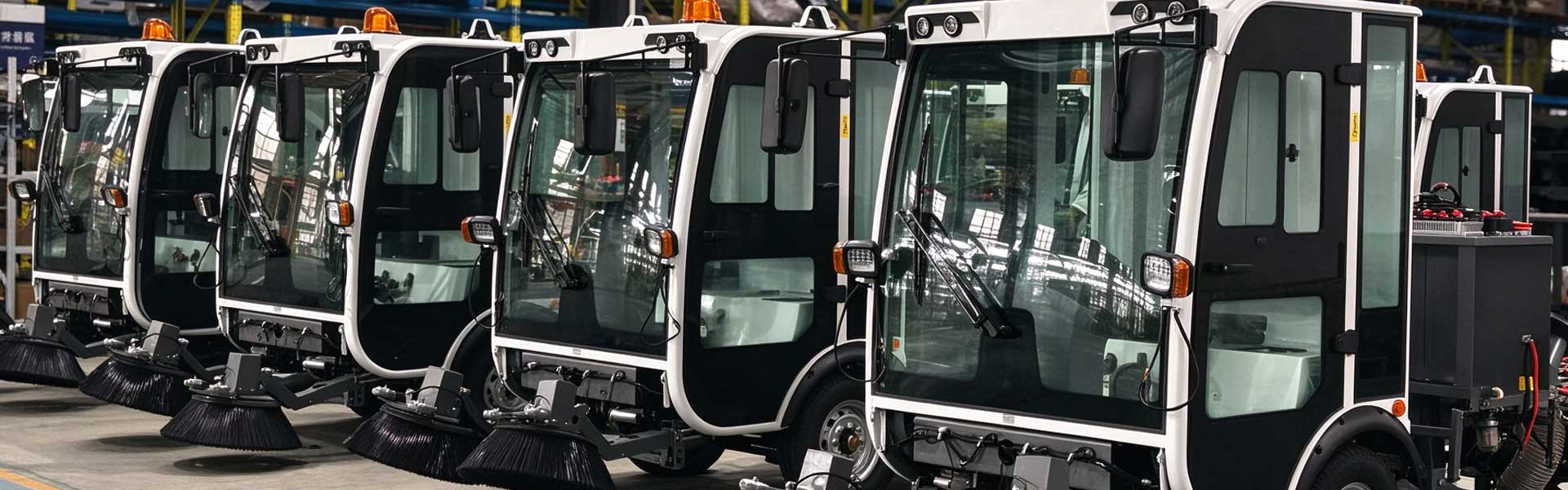
When searching for a floor sweeper for sale, it is easy to focus on the machine price first. However, the lowest purchase price does not always mean the lowest cleaning cost.
For commercial buildings, factories, warehouses, logistics centers and parking areas, the right floor sweeper machine should be selected according to the actual cleaning area, debris type, working time, aisle width and required productivity.
The most important floor sweeper specifications to check first are usually:
- Sweeping width
- Cleaning productivity
- Hopper capacity
- Battery type and runtime
- Machine width and turning radius
- Dust filtration system
- Main brush and side brush configuration
- Dumping method
- Machine weight and dimensions
- After-sales support and spare parts
A machine advertised with 15,000 m²/h productivity may not be the right choice if the facility has narrow aisles, frequent obstacles or heavy debris. The goal is not to buy the machine with the biggest number on the specification sheet. The goal is to buy a machine that can complete the actual cleaning route efficiently.
1. Start With Cleaning Productivity
The first specification to check is the cleaning productivity, normally expressed in m²/h or ft²/h.
For example, suppose a factory has a 20,000 m² floor area and the cleaning team has only two hours available after production.
The basic requirement is:
20,000 m² ÷ 2 hours = 10,000 m²/h
This means a sweeper with a published productivity around 10,000 m²/h or higher may be worth considering.
However, published productivity should not automatically be treated as actual daily productivity. Turning, stopping, emptying the hopper, avoiding pallets and moving around workers all reduce real operating efficiency.
For example:
| Facility | Cleaning Area | Available Time | Basic Requirement |
|---|---|---|---|
| Small warehouse | 5,000 m² | 2 h | 2,500 m²/h |
| Factory | 20,000 m² | 2 h | 10,000 m²/h |
| Distribution center | 30,000 m² | 3 h | 10,000 m²/h |
| Large warehouse | 50,000 m² | 4 h | 12,500 m²/h |
This is a better starting point than simply asking, “How many square meters can this floor sweeper clean per hour?”
Commercial sweeper specifications vary significantly by machine size. For example, Tennant's 6100 battery ride-on sweeper lists estimated productivity up to 7,720 m²/h, while larger ride-on models can be rated considerably higher.
For buyers, the key question is whether the machine can finish your actual route within the available cleaning window.
2. Check the Sweeping Width
The second important floor sweeper specification is cleaning width.
A wider sweeping path can reduce the number of passes required on an open warehouse floor.
For example, imagine two machines:
- Machine A: 800 mm sweeping width
- Machine B: 1,300 mm sweeping width
On a large open floor, the 1,300 mm machine can potentially cover more area per pass.
But wider is not always better.
If your factory has:
- 1.2 m aisles
- narrow production lines
- many columns
- small storage rooms
- narrow doors
a large machine may be difficult to operate.
A compact machine with a narrower cleaning path may actually complete the entire route faster because it can enter more areas.
Current commercial ride-on sweepers illustrate this difference. Tennant's compact 6100, for example, offers 760 mm or 970 mm cleaning paths, while larger models such as the S20 offer 1,270 mm or 1,575 mm paths.
A practical buying rule
Before requesting a quotation, measure:
- Narrowest door
- Narrowest aisle
- Turning area
- Loading area
- Storage area
- Distance between production equipment
Then compare these measurements with the machine's overall width and turning requirements.
Do not select sweeping width before checking the facility layout.
3. Hopper Capacity Directly Affects Productivity
The hopper is where collected dust, leaves, packaging debris, dirt and other solid waste are stored.
For a small commercial facility, a small hopper may be sufficient.
For a factory or distribution center, hopper capacity becomes much more important.
For example, a machine with a 50–70 L hopper may require more frequent emptying than a machine with a 100–150 L hopper when cleaning a large facility with heavy debris.
Current commercial models demonstrate the range available in the market. Tennant's S880 compact battery ride-on sweeper has a 67 L hopper, while the S20 compact ride-on sweeper has a 310 L hopper.
Consider a warehouse producing large amounts of:
- Cardboard pieces
- Plastic packaging
- Dust
- Pallet debris
- Wood particles
In this situation, hopper capacity can directly affect working interruptions.
Example
Suppose a cleaning route generates approximately 120 L of debris.
With a 60 L hopper:
120 L ÷ 60 L = 2 full hopper loads
With a 120 L hopper:
120 L ÷ 120 L = 1 full hopper load
The second machine may reduce interruptions even if its sweeping width is similar.
For heavy-duty applications, buyers should therefore consider hopper capacity together with debris volume, not as an isolated number.
4. Battery Runtime Matters for Electric Floor Sweepers
For an electric floor sweeper machine, battery performance should be part of the quotation discussion.
Check:
- Battery voltage
- Battery capacity
- Expected working time
- Charging time
- Charger type
- Battery replacement cost
- Battery availability
- Whether the battery is included in the quoted price
For example, a compact battery ride-on sweeper may have a working time of around 2–3 hours depending on configuration and operating conditions. Tennant's S880 lists up to 150 minutes of estimated runtime, while its 6100 model lists up to 3.4 hours with the base battery.
Suppose your cleaning requirement is:
2.5 hours per shift
A machine with a practical operating time close to 3 hours may fit the application better than a machine that requires charging halfway through the route.
For a factory running multiple shifts, buyers should also ask whether an additional battery or charging strategy is available.
5. Dust Control Is Critical for Factory Cleaning
Sweeping dust into the air defeats part of the purpose of mechanized cleaning.
For factories and industrial warehouses, check the machine's:
- Dust filter
- Vacuum system
- Filter cleaning method
- Dust sealing
- Optional high-efficiency filtration
- Dust suppression configuration
For example, Tennant's 6100 uses a multi-stage dust control system and offers an optional HEPA configuration rated at 99.97% efficiency at 0.3 micron.
The required configuration depends on the material being collected.
A warehouse mainly collecting cardboard and large debris may have different requirements from a metal-processing factory producing fine dust.
Therefore, when requesting a floor sweeper for sale, describe the actual debris to the supplier.
For example:
Fine dust + metal chips + packaging waste + pallet debris
is much more useful than simply saying:
We need a sweeper for a factory.
6. Check the Main Brush and Side Brushes
Brush configuration affects how the machine collects debris.
The main brush normally handles the central cleaning path, while side brushes help collect debris along:
- Walls
- Edges
- Shelves
- Production equipment
- Curbs
If your facility has many walls and shelving systems, side-brush performance becomes more important.
For example, a warehouse with long pallet racks may require frequent edge cleaning. A machine with effective side brushes can reduce the amount of manual sweeping left behind along these areas.
When comparing floor sweeper specifications, ask for:
- Main brush diameter
- Main brush material
- Main brush width
- Side brush diameter
- Number of side brushes
- Brush replacement cost
- Brush adjustment method
These details are more useful for purchasing decisions than horsepower alone.
7. Check Machine Width, Not Just Sweeping Width
This is one of the easiest specifications to overlook.
A machine may have a 1,200 mm cleaning path but be significantly wider once the body, wheels and side brushes are included.
For example:
Door width: 1,000 mm
Machine overall width: 1,050 mm
The machine simply cannot enter the area.
This is why buyers should request the complete machine dimensions before ordering.
Important dimensions include:
- Overall length
- Overall width
- Overall height
- Sweeping width
- Turning radius
- Minimum aisle width
- Ground clearance
Compact ride-on sweepers are specifically designed for tighter environments. For example, Tennant's 6100 is 810 mm wide, while its 1,200 mm cleaning path S880 is 905 mm wide.
8. Decide Between Walk-Behind and Ride-On
Your cleaning area and labor budget can help determine whether you need a walk-behind or ride-on machine.
Walk-Behind Floor Sweeper
Suitable for:
- Small warehouses
- Retail stores
- Workshops
- Narrow spaces
- Small factories
Advantages include:
- Compact dimensions
- Easier transportation
- Lower purchase cost
- Good maneuverability
Ride-On Floor Sweeper
More suitable for:
- Large factories
- Distribution centers
- Logistics warehouses
- Parking areas
- Large commercial facilities
Advantages include:
- Higher productivity
- Less operator fatigue
- Larger hopper options
- Wider cleaning paths
- Longer continuous cleaning routes
For example, a 30,000 m² distribution center requiring cleaning within three hours needs approximately:
30,000 ÷ 3 = 10,000 m²/h
If the route contains wide open aisles, a ride-on machine may be a more practical configuration than a small walk-behind model.
The final decision should still be based on the actual site layout.
9. Don't Ignore the Dumping Method
Once the hopper is full, someone has to empty it.
There are several approaches, including:
- Manual dumping
- Low-level hopper
- High-dump hopper
For small machines and light debris, manual dumping may be acceptable.
For larger industrial sweepers, high-dump systems can reduce manual handling and make it easier to transfer debris into a waste container.
For example, Tennant's S880 uses a high-dump hopper, while the 6100 uses manual dumping.
If your facility collects several hundred liters of debris per shift, the dumping system should be included in the purchasing discussion.
10. Calculate Labor Savings Before Comparing Prices
A floor sweeper is not only a cleaning machine. It can also replace a significant amount of manual sweeping labor.
Consider a factory where:
- 3 workers manually sweep
- 2.5 hours per day
- 26 working days per month
Monthly labor time is:
3 × 2.5 × 26 = 195 labor-hours/month
Suppose a ride-on floor sweeper allows one operator to complete the same route in two hours:
1 × 2 × 26 = 52 labor-hours/month
The theoretical difference is:
195 − 52 = 143 labor-hours/month
This does not mean the machine automatically saves 143 paid labor-hours—the workers may be reassigned to other tasks—but it shows the potential labor capacity released by mechanized cleaning.
This is a much better way to evaluate a floor sweeper for sale than comparing two machine prices alone.
11. Example: Selecting a Floor Sweeper for a 25,000 m² Factory
Consider a metal-processing factory with:
- Floor area: 25,000 m²
- Cleaning window: 3 hours
- Fine dust: Yes
- Metal chips: Yes
- Packaging debris: Yes
- Narrow aisles: Some
- Electricity available: Yes
The basic productivity requirement is:
25,000 ÷ 3 = 8,333 m²/h
The purchasing team should then compare several specifications.
| Specification | Target for This Application |
|---|---|
| Productivity | Around 8,333 m²/h or higher |
| Power | Electric/battery |
| Sweeping width | Based on aisle layout |
| Hopper | Preferably medium-to-large |
| Dust control | Strong filtration |
| Side brushes | Important |
| Machine width | Must fit narrowest aisle |
| Runtime | Enough for the cleaning window |
| Brush | Suitable for dust and metal debris |
Notice that productivity is only the first filter.
A machine with extremely high theoretical productivity but excessive width may not be suitable for this factory.
12. Example: Selecting a Floor Sweeper for a Warehouse
Now consider a 15,000 m² logistics warehouse.
The warehouse has:
- Wide aisles
- Pallet debris
- Cardboard
- Plastic packaging
- Dust
- Frequent forklift traffic
The required productivity for a two-hour cleaning window is:
15,000 ÷ 2 = 7,500 m²/h
Here, the buyer may prioritize:
- Sweeping productivity
- Hopper capacity
- Battery runtime
- Side-brush performance
- Machine width
- Dust filtration
Because the warehouse has wide aisles, a wider ride-on sweeper can potentially reduce the number of passes.
13. What Should You Ask a Supplier Before Buying?
When contacting a supplier about a floor sweeper for sale, provide enough information for the supplier to recommend the correct configuration.
A useful RFQ can include:
Application: Factory / warehouse / logistics center
Floor area: 20,000 m²
Cleaning time: 2–3 hours
Floor type: Concrete
Debris: Dust, cardboard, pallet debris
Narrowest aisle: 1.8 m
Door width: 2.2 m
Power: Electric
Quantity: 2 units
Destination: Country and port
Then ask the supplier to quote:
- Machine model
- Sweeping width
- Productivity
- Hopper capacity
- Battery specification
- Working time
- Charging time
- Machine dimensions
- Dust filtration
- Brush configuration
- Warranty
- Spare parts
- Lead time
- FOB/CIF price
This information allows suppliers to provide a much more useful quotation.
14. Floor Sweeper Specifications Checklist
Before placing an order, check these specifications:
| Specification | Why It Matters |
|---|---|
| Cleaning productivity | Determines whether the machine can meet your schedule |
| Sweeping width | Affects coverage per pass |
| Machine width | Determines whether it fits doors and aisles |
| Hopper capacity | Determines how often debris must be emptied |
| Battery runtime | Determines continuous working time |
| Charging time | Affects multi-shift operation |
| Dust filtration | Important for dust-heavy applications |
| Main brush | Determines collection performance |
| Side brushes | Important for edges and corners |
| Dumping method | Affects waste-handling labor |
| Machine weight | Important for transport and floor conditions |
| Turning radius | Important in warehouses and factories |
| Spare parts | Affects long-term operating cost |
| Warranty | Reduces purchasing risk |
15. The Right Floor Sweeper Is the One That Fits the Cleaning Route
When comparing a floor sweeper machine, do not choose solely according to the highest advertised productivity or the lowest purchase price.
Instead, calculate the actual requirement.
For example:
Cleaning area ÷ available cleaning time = minimum required productivity
Then check whether the machine can physically operate in the facility.
For a large open warehouse, productivity and hopper capacity may be the main priorities.
For a factory with narrow production lines, machine width and maneuverability may be more important.
For a dusty industrial environment, filtration and dust control should receive greater attention.
For multi-shift operations, battery capacity, charging time and spare battery availability can directly affect productivity.
A properly selected floor sweeper for sale should therefore be evaluated as a complete cleaning solution rather than simply as a machine with a certain price.
Request a Floor Sweeper Quotation
If you are sourcing a floor sweeper machine for a factory, warehouse, logistics center or commercial facility, provide your cleaning area, working time, floor type, debris type and narrowest aisle width.
With these details, the supplier can match the appropriate sweeping width, hopper capacity, power configuration and dust-control system to your actual application.
The most useful comparison is not simply:
“Which floor sweeper is cheaper?”
It is:
“Which floor sweeper can complete our required cleaning route with the right productivity, operating cost and configuration?”